
 Available in US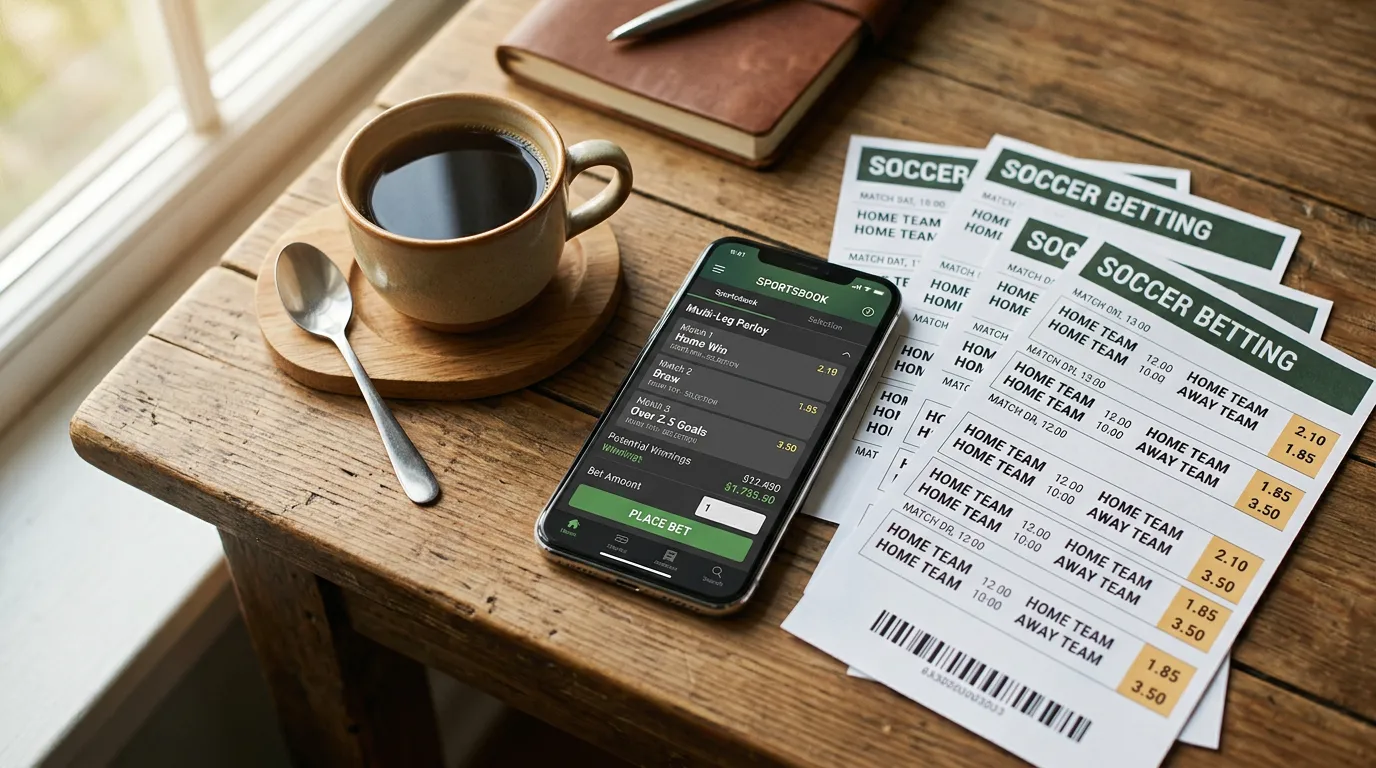
Parlays built Canada’s sports betting culture. For decades, the only legal way to bet on sports in this country was through provincial parlay products — Proline in Ontario, Sport Select in the Western provinces, Mise-o-jeu in Quebec. You could not place a single-game wager until Bill C-218 passed in August 2021. That history matters because Canadian bettors understand parlays intuitively in a way that American bettors, who grew up with single-game Vegas lines, sometimes do not. Now single bets are legal across the country — but multi-bets still hit different. The World Cup 2026 parlays on this page are designed for bettors who understand both the thrill and the mathematics of combining multiple legs into a single ticket.
How Parlays Work — A Quick Refresher
My first-ever sports bet was a three-leg Proline parlay in 2009 — Maple Leafs moneyline, Raptors spread and a CFL total. I got two of three right and won exactly nothing. That experience taught me the defining characteristic of parlays faster than any textbook could: every leg must win for the ticket to pay out.
A parlay combines two or more individual bets into a single wager. The payout is calculated by multiplying the decimal odds of each leg together. A two-leg parlay with both legs at 2.00 decimal pays 4.00 (2.00 x 2.00), meaning a $10 bet returns $40. Add a third leg at 2.00, and the payout jumps to 8.00 — $80 on that same $10 stake. The mathematics are seductive, which is why sportsbooks love parlay bettors: the house edge compounds with every leg you add.
In practical terms, each additional leg reduces your probability of winning exponentially. Two independent bets at 50% probability each give you a 25% chance of hitting a two-leg parlay. Three legs drops to 12.5%. Four legs: 6.25%. By the time you reach a six-leg parlay, you are looking at roughly a 1.5% chance of winning, even if every individual leg is a coin flip. The payouts grow proportionally, but so does the risk — and the sportsbook’s margin compounds across legs, meaning the true expected value of a parlay is always lower than the advertised payout suggests.
This does not mean parlays are inherently bad bets. They are a tool, and like any tool, their value depends on how you use them. A two- or three-leg parlay built from correlated events — where the outcome of one leg increases the probability of another — can offer genuine value. A six-leg parlay built from unrelated markets is entertainment, not investment. Knowing the difference is the single most important skill in parlay betting.
For World Cup 2026 parlays specifically, the tournament structure creates natural correlation opportunities that do not exist in regular season betting. A team’s group stage performance affects their knockout path, which affects the total goals scored across the tournament, which affects individual player scoring. These connections allow you to build parlays where the legs reinforce each other rather than simply multiplying independent probabilities.
Best World Cup Parlay Ideas for 2026
I build every parlay around a thesis — a single idea about how the tournament will unfold — and then select legs that are logically connected to that thesis. Here are three parlay constructions I am considering for the 2026 World Cup, each built on a different structural idea.
Parlay one — the Spain dominance thesis. Leg one: Spain to win Group H (approximately 1.35 decimal). Leg two: Spain to reach the final (approximately 3.00 decimal). Combined payout: roughly 4.05 decimal, or $40.50 on a $10 bet. The logic is straightforward: if Spain win their group, their knockout path avoids the toughest bracket until the semifinals, making the final a realistic destination. These legs are positively correlated — winning the group makes reaching the final more likely — which means the combined probability is higher than multiplying the individual probabilities would suggest. The sportsbook prices each leg independently, creating a small edge for the parlay bettor who understands the correlation.
Parlay two — the England scoring machine thesis. Leg one: England to win Group L (approximately 1.60 decimal). Leg two: Harry Kane anytime scorer in the Panama match (approximately 1.55 decimal). Leg three: over 2.5 goals in England vs Panama (approximately 1.50 decimal). Combined payout: roughly 3.72 decimal. All three legs are linked: if England are dominant enough to win the group, they are likely dominating Panama specifically, which means more goals and more Kane chances. The correlation here is strong — a Kane goal in a high-scoring England win against Panama is a single event expressed through three separately priced legs.
Parlay three — the upset special. Leg one: Japan to win Group F (approximately 3.00 decimal). Leg two: Morocco to qualify from Group C (approximately 1.35 decimal). Combined payout: roughly 4.05 decimal. This parlay bets on two teams with proven World Cup upset pedigree — Japan beat Germany and Spain in 2022 group play, Morocco reached the 2022 semifinals — continuing their trajectory in 2026. The legs are uncorrelated, but each individually represents value at the listed price, which makes the parlay defensible on its own terms.
A word on parlay sizing: I never risk more than 2% of my tournament bankroll on any single parlay, and most of my parlays are in the 0.5-1% range. The inherent volatility of multi-leg bets means you should expect to lose most of them. The goal is not to win every parlay — it is to win enough at high enough payouts to be profitable over the full tournament. If you place 20 parlays across the World Cup and hit three or four at average payouts of 4.00 to 6.00 decimal, you will be in excellent shape.
Group Stage Parlay Strategies
The group stage is parlay season. With up to eight matches played on some days during the opening round, the opportunity to combine results from simultaneous or same-day matches is enormous. But the group stage also introduces a specific challenge: by matchday three, some teams have already qualified or been eliminated, which distorts motivation and lineup selection. Building parlays around matchday three requires a different approach than matchdays one and two.
On matchday one, I focus on favourites in comfortable matchups. The opening round of group play is historically the most predictable — higher-ranked teams win their first match approximately 65% of the time, and the combination of tournament nerves from underdogs and tactical conservatism from favourites produces results that align with pre-tournament expectations. A three-leg parlay combining Germany to beat Curaçao, Spain to beat Cabo Verde and France to beat Iraq would price around 2.00 to 2.50 decimal — not an exciting payout, but a reliable foundation.
Matchday two is where I look for value in totals markets. By the second round of matches, teams have adjusted tactically based on their opening result. Teams that lost their first match tend to play more aggressively in their second, which pushes goal totals up. Teams that won comfortably may rotate their squads, which can suppress scoring. Building a parlay around over/under totals on matchday two — targeting overs in matches where a desperate team faces a relaxed one — has been a profitable approach across recent tournaments.
Matchday three is the trap. Dead rubbers — matches where one or both teams have nothing to play for — are notoriously difficult to predict. Star players are rested, reserves get tournament minutes, and the competitive intensity drops. I avoid building parlays that include matchday three results unless both teams have something significant at stake, such as the difference between finishing first and second in a tight group, which determines knockout-round seeding.
The same-game parlay, now offered by most Ontario-licensed sportsbooks, is a powerful tool for group stage betting. Combining a match result with total goals, both teams to score and a player prop within a single match creates payouts of 5.00 to 10.00 decimal while allowing you to concentrate your analysis on a single event. For the 2026 World Cup, I will build same-game parlays around the mismatches — Germany vs Curaçao, Spain vs Cabo Verde, England vs Panama — where the favourite’s dominance is expected to produce a specific type of match: high possession, multiple goals, specific scorers finding the net.
Parlay Risks — When to Go Big, When to Hold Back
Every experienced parlay bettor has a story about the one leg that ruined the ticket. I had a five-leg parlay during the 2022 World Cup that needed only Japan to beat Croatia in the Round of 16 — a match Japan led 1-0 before Croatia equalized and won on penalties. Four legs hit, one did not, and the ticket paid zero. That is the mathematical reality of parlays, and pretending otherwise is how bankrolls get destroyed.
The risk profile of a parlay increases non-linearly with each leg. A two-leg parlay has a built-in buffer — you only need to be right twice. By four or five legs, you are stacking probabilities so aggressively that a single injury, a single referee decision, a single goalkeeping error can invalidate the entire ticket. My hard rule: no World Cup parlays exceed four legs. The payout at five or six legs is tempting, but the hit rate is so low that you are effectively buying a lottery ticket at a negative expected value.
When to go big — meaning three or four legs at higher individual odds — is during the knockout rounds, where match outcomes are more polarized. In a Round of 16 match between a group winner and a third-placed qualifier, the favourite typically has a 55-65% win probability. Two of those legs combined at 1.60 decimal each gives you a 2.56 payout at roughly a 35% hit rate. That is a reasonable risk-reward ratio for a bettor who has identified the right favourites.
When to hold back is during matchday three of the group stage and the early knockout rounds where upsets are most common historically. The Round of 32, a new stage in the expanded 48-team format, is an unknown quantity — we have no historical data on how teams perform in this round, which means the sportsbooks are guessing at the pricing just as much as we are. I will be cautious with parlays involving Round of 32 matches until I have seen how the first few play out and can calibrate my expectations accordingly.
One final consideration: some Ontario-licensed sportsbooks offer parlay insurance or boosted parlay payouts as promotional offers during major tournaments. These promotions — where you receive a free bet refund if one leg of a four-leg parlay misses, for example — change the expected value calculation meaningfully. A parlay that would normally be negative EV becomes closer to neutral or even slightly positive when insurance is applied. I actively seek out these promotions during the World Cup and adjust my parlay sizing accordingly.
Canadian Parlay History — From Proline to Single Bets
If you grew up betting sports in Canada before 2021, you know Proline. The green cards, the grid of matchups, the mandatory minimum of three selections — Proline was Canada’s introduction to sports betting, and it was fundamentally a parlay product. The Ontario Lottery and Gaming Corporation launched it in 1990 as a government-operated alternative to illegal bookmaking, and for three decades it was the only game in town.
What most casual fans do not realize is how dramatically Proline’s odds disadvantaged Canadian bettors compared to international markets. Proline’s implied margins — the overround built into the odds — regularly exceeded 30%, compared to 5-8% at a typical international sportsbook. A bettor placing the same three-leg parlay on Proline and on a private book would receive roughly 40-60% less payout on Proline for the same winning ticket. The product was profitable for provincial coffers but offered poor value to the bettor.
Bill C-218, which received Royal Assent in June 2021 and took effect in August of that year, changed everything. By removing the federal ban on single-game wagering, the law opened the door for provincial regulators to license private operators and offer single-bet products. Ontario moved fastest, launching its regulated iGaming market in April 2022, and the province now hosts over 40 licensed sportsbook operators. The result has been a dramatic improvement in betting value for Ontario residents — odds margins have compressed from Proline’s 30%+ to the 5-8% range typical of competitive markets.
For World Cup 2026 parlays, this history creates an interesting dynamic. Canadian bettors who learned their craft on Proline understand parlay mechanics instinctively — they have been building multi-leg tickets for decades. The difference now is that they can do so at competitive odds, with deeper markets, and with the option to also place single bets when a parlay is not the right tool. The 2026 World Cup will be the first major tournament where Canadian bettors have access to both regulated single bets and competitively priced parlays nationwide. That combination, for bettors who understand the fundamentals of World Cup betting strategy, represents a genuine step change in opportunity.
