
 Available in US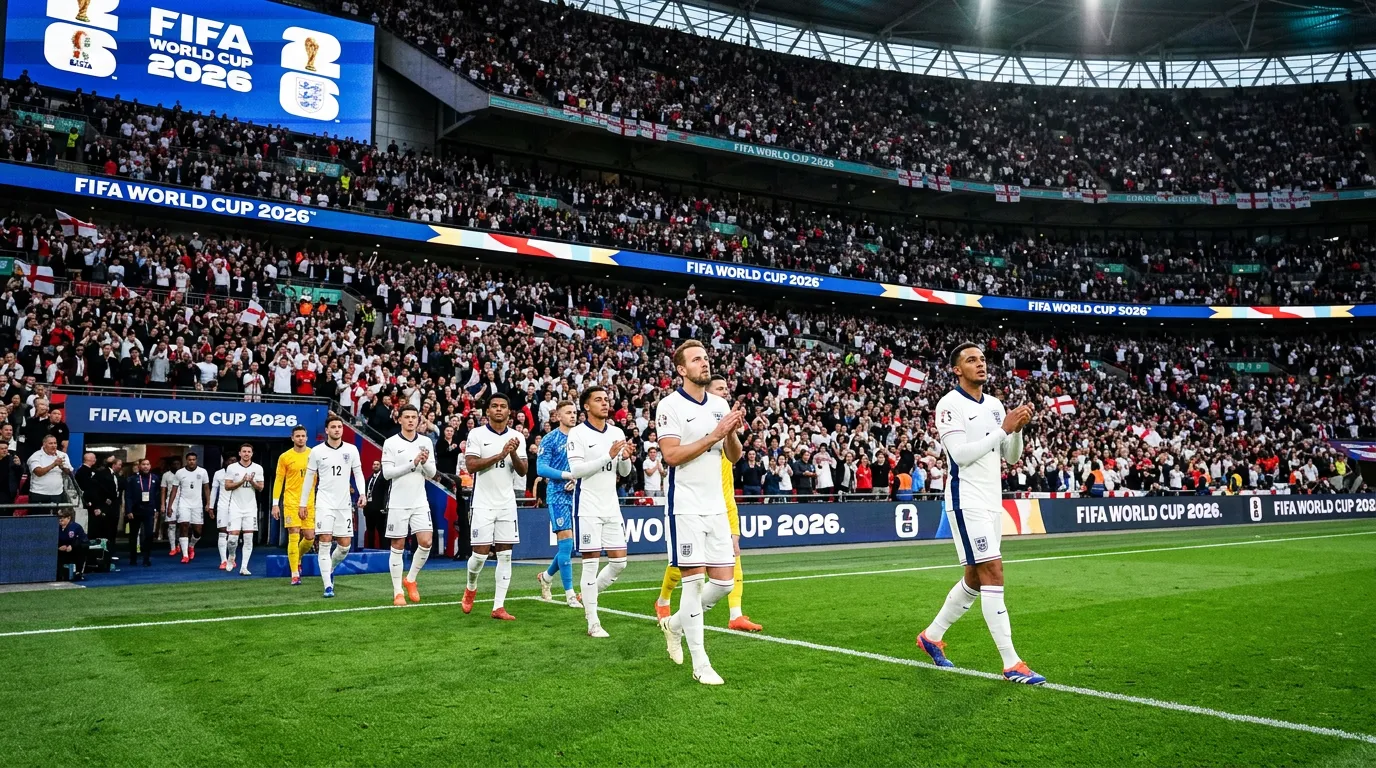
Sixty years. That is how long England have waited since their only World Cup triumph, a July afternoon at Wembley in 1966 that has become as much burden as badge of honour. The Three Lions have been to two European Championship finals in the last five years — losing both — and reached a World Cup semifinal in 2018, a World Cup quarterfinal in 2022, and yet the trophy cabinet remains stubbornly empty. There is a particular cruelty in being consistently good enough to reach the final stages but never quite good enough to win the decisive match. The england world cup 2026 campaign arrives with perhaps the most talented squad the nation has produced since the golden generation of the early 2000s, and the pressure to convert that talent into a title is immense.
I have a theory about England at major tournaments: they perform in inverse proportion to the expectations placed on them. In 2018, when nobody expected anything after the dismal 2014 and 2016 performances, England reached the semifinals with a squad that played with freedom. In 2022, when expectations were sky-high after the Euro 2020 final, they exited in the quarterfinals to France in a match they should have won. If that theory holds, the 2026 World Cup — where England are priced among the top three or four favourites — could be another exercise in magnificent frustration. But there are reasons to believe this squad is different. The talent at every position is deeper than any previous England generation, and the tactical evolution under the coaching staff suggests a team that is finally ready to play proactive football rather than sitting back and hoping individual moments bail them out.
How England Qualified
England qualified with characteristic efficiency and occasional genuine flair. They topped their UEFA qualifying group with nine wins and one draw, scoring 30 goals while conceding just four — the best defensive record in European qualifying. The numbers were emphatic, but the most significant development was tactical. England played a consistently high defensive line throughout qualifying, pressing opponents in their own third and recovering possession higher up the pitch than any previous England team in the modern era. The old stereotype of England defending deep and hoping to score on the counter has been replaced by a proactive system that demands the ball and creates chances through sustained pressure.
The qualifying campaign also provided opportunities to integrate younger players alongside the established core. Kobbie Mainoo, still just 19 during qualifying, earned regular starts in midfield and demonstrated the composure on the ball that England’s midfield has historically lacked. Cole Palmer’s emergence as one of the Premier League’s most creative players translated to the international stage with five assists across the qualifying campaign. The blend of Premier League experience throughout the squad — every player in the likely starting eleven plays in the top division of English football or at a top-five European league — gives England a competitive intensity that few national teams can match.
One concern from qualifying was England’s tendency to control matches without killing them off. In four of their ten qualifiers, England led 1-0 at half-time and failed to score again in the second half. The inability to put opponents away — despite dominating possession and territory — is a pattern that resurfaces at major tournaments, where the quality of opposition increases and defensive discipline tightens. If England want to win the World Cup, they need to convert dominance into goals more ruthlessly than they did in qualifying.
The set-piece improvements during qualifying were dramatic and worth noting for bettors. England scored nine goals from corners and free kicks across their ten qualifiers — the highest set-piece conversion rate in European qualifying. The coaching staff hired a dedicated set-piece analyst in early 2025, following the trend pioneered by clubs like Brentford and Brighton, and the results were immediate. With Kane, Stones, and Bellingham all standing over 180 cm and attacking aerial deliveries with aggression, England’s set-piece threat adds a dimension that supplements their open-play creativity. In tournament football, where matches are tight and defences organized, set pieces decide an outsized proportion of knockout-round games — and England are now among the best in the world at converting them.
Key Players — Bellingham, Saka & England’s Depth
Jude Bellingham at 22 is already one of the best midfielders in world football. His first two seasons at Real Madrid produced a combined 30 goals and 18 assists from midfield — numbers that would be exceptional for a forward, let alone a player whose primary responsibilities include ball progression, pressing, and defensive coverage. Bellingham’s ability to arrive late in the penalty area, timing his runs to exploit the gap between the opposing midfield and defence, gives England a goal threat from midfield that they have not possessed since Frank Lampard’s peak years. At the World Cup, Bellingham will be the player opponents plan against, and the player whose individual moments could decide knockout matches.
Bukayo Saka has evolved from a bright young talent into England’s most consistent creator. His dribbling statistics from the right wing — successful take-ons, chances created, progressive carries — rank him in the top five in the Premier League over the last two seasons. Saka’s two-footedness makes him unpredictable for defenders: he can drive to the byline and cross with his right foot or cut inside and shoot or pass with his left. His penalty record is exemplary after the redemption arc that followed his miss in the Euro 2020 final, and that mental resilience has become one of his defining qualities.
Harry Kane remains England’s most prolific scorer, now operating from Bayern Munich where the Bundesliga’s tactical demands have added a new dimension to his game. Kane’s dropping deep to link play — always a feature of his Tottenham years — has become even more pronounced in Munich, and for England, he operates as a hybrid between a traditional number nine and a number ten. His World Cup record of seven goals in ten matches includes crucial goals in knockout rounds, and at 32, this is likely his best remaining opportunity to win the trophy that has eluded him throughout his career.
The defensive unit is where England’s improvement has been most dramatic. Trent Alexander-Arnold’s move into a hybrid right-back/midfielder role — pioneered at Liverpool under Arne Slot — has given England a ball-playing option from the back line that transforms their build-up play. William Saliba, had he chosen France (he chose England — born in France but eligible through his mother), would have strengthened a rival. Instead, Declan Rice and John Stones provide defensive solidity. In goal, Jordan Pickford brings World Cup experience and a penalty-saving record that makes England dangerous in any shootout scenario.
The bench underlines England’s depth. Phil Foden can play across the front three or in midfield. Eberechi Eze offers flair and unpredictability as a substitute. Cole Palmer’s dead-ball delivery adds a set-piece weapon. Marcus Rashford provides pace off the bench when legs tire in the second half. This is the deepest England squad in living memory, and the ability to change games through substitutions could prove decisive in the expanded tournament format where eight matches are required to win the trophy.
Group L — Croatia, Ghana & Panama
Group L is widely considered the toughest group at the 2026 World Cup, and the England-Croatia match on the opening matchday is the headline fixture. These two teams have recent World Cup history — Croatia eliminated England in the 2018 semifinal, England beat Croatia at Euro 2020 — and the tactical matchup between England’s aggressive pressing and Croatia’s midfield possession game produces compelling viewing. Luka Modrić, at 40, may be playing his final World Cup, and the narrative weight of that farewell adds another dimension to an already charged encounter.
Croatia are not the force they were in 2018 or even 2022, when they finished third. The golden generation of Modrić, Ivan Perišić, and Dejan Lovren is aging out, and the replacements — while talented — lack the collective tournament experience that carried Croatia through multiple knockout rounds. Josko Gvardiol, the Manchester City defender, is world-class, and Mateo Kovacic provides midfield quality, but the overall squad has declined from its 2018 peak. That said, Croatia’s tournament pedigree means they should never be underestimated in a single match, and the Group L clash in Dallas could easily produce an upset.
Ghana bring athleticism, pace, and an unpredictability that makes them difficult to prepare for. Their African qualifying campaign was built on attacking football and set-piece quality, and they have Premier League representation through Thomas Partey, Mohammed Kudus, and several younger players. Ghana’s World Cup pedigree — quarterfinals in 2010, competitive group stages in 2006 and 2014 — means they will not be overawed by the occasion. Panama, returning to the World Cup after their debut in 2018, are the likely bottom seed but have improved significantly since their 6-1 loss to England in Russia. Their CONCACAF qualifying campaign demonstrated a defensive resilience that made them difficult to beat at home, and the tournament setting in North America — with substantial Panamanian diaspora communities in US cities hosting matches — gives them something approaching a home advantage that most Group L observers are underrating.
The scheduling of England’s group matches deserves attention. The England-Croatia opener in Dallas is followed by matches in Toronto and potentially other venues, depending on the final schedule assignments. For Canadian-based England fans — and there is a substantial English expatriate community in Toronto, Vancouver, and across the country — the proximity of the matches adds a local dimension that previous World Cups lacked. The atmosphere at BMO Field for England’s match there will rival anything in the Premier League.
England’s Betting Odds & Outright Markets
England are priced at approximately 8.00 to win the 2026 World Cup, placing them in the third tier of favourites behind Spain and France, and roughly level with Argentina and Brazil. That implies about a 12.5% probability, which I consider slightly low given the depth of the squad and the tactical improvements under the current coaching structure. England’s path through the bracket — avoiding Spain and France until the semifinals if they top Group L — adds an additional edge that the outright odds do not fully reflect.
To win Group L, England are priced at approximately 1.55, which accounts for Croatia’s quality and the difficulty of the group overall. This is one of the most competitively priced group-winner markets in the tournament, and it represents reasonable value if you believe England’s squad depth and Premier League conditioning give them an advantage across three matches. To advance from the group is priced at 1.15 — short but justified, since even a third-place finish would likely see England through under the expanded format’s best-third-place rules.
The player markets where I see value include Bellingham to score in the tournament at 1.30 (practically a certainty given his scoring rate and set-piece involvement), Kane to be England’s top scorer at 1.80 (he remains the primary penalty taker and central striker), and Saka to register an assist at 1.50. The combination bet I like most is England to win Group L and under 2.5 goals in the Croatia match — a double that should price around 3.00 and captures the most likely scenario of a tight, tactically disciplined opener followed by more comfortable wins against Ghana and Panama.
One market that deserves attention is England to keep a clean sheet in their first match at around 2.10. Deschamps-style defensive pragmatism has influenced English football more than most observers acknowledge, and the coaching staff have clearly prioritized defensive organization in the approach to the tournament. Croatia’s attacking output has declined since their 2018 peak, and the opening-match nerves that typically suppress scoring make the clean sheet a live outcome. For a wider portfolio, England to reach the quarterfinals at approximately 1.40 is a building block — not exciting on its own, but useful as part of a multi-bet strategy that builds toward the knockout rounds where the real value sits.
England at the World Cup — 1966 & the Wait Continues
The 1966 World Cup is simultaneously England’s greatest sporting achievement and their heaviest psychological burden. Every generation of English footballers since has been measured against the team that beat West Germany at Wembley, and every generation has been found wanting. The near-misses compound the frustration: Maradona’s Hand of God in 1986, Gascoigne’s tears in 1990, Beckham’s red card in 1998, the penalty failures against Portugal in 2004 and 2006, Croatia’s comeback in 2018, the Euro 2020 final loss to Italy, the Euro 2024 final loss to Spain, and the quarterfinal exit to France in 2022. English football is defined by proximity to glory without the ability to reach it.
The 2026 squad has the talent to break that pattern. The difference between this England generation and those that came before is not just technical quality but psychological preparation. Sports psychology is now embedded in the England setup in ways that previous managers dismissed. The penalty shootout work — which produced victories at the 2018 World Cup and Euro 2020 before the final — demonstrates a willingness to address historical weaknesses systematically rather than hoping for the best. Whether systematic preparation can overcome the unique pressure of a World Cup final or semifinal remains untested, but the foundations are stronger than they have ever been.
The tactical evolution is equally important. Previous England teams at World Cups relied on a 4-4-2 formation that prioritized structure over creativity, or a cautious 3-4-3 that sacrificed attacking numbers for defensive security. The current setup — a fluid 4-3-3 that shifts into a 4-2-3-1 depending on the phase of play — empowers the attacking players to express themselves while maintaining a defensive shape that can absorb pressure from the best teams in the world. Bellingham’s freedom to roam between the lines, Saka’s licence to drift infield from the right wing, and Kane’s dropping to link play all reflect a coaching philosophy that trusts the players’ intelligence rather than restricting them to rigid positions. This trust-based approach was visible in England’s qualifying campaign and will be tested against the tactical sophistication of Croatia, France, and whoever else they encounter in the knockout rounds.
For Canadian audiences, England at the World Cup carries additional interest. The English Premier League is the most-watched football competition in Canada, which means the majority of England’s players are household names among Canadian sports fans. The diaspora connection is strong: over 600,000 Canadians claim English heritage, and the Premier League broadcasting presence through TSN and Sportsnet ensures deep familiarity with English football culture. If England play a Group L match in Toronto — as the current schedule suggests — the demand for tickets will rival the Canada matches.
Our Prediction for England
England advance from Group L in first place, edging Croatia 1-0 in the opener through a Bellingham goal, beating Panama 3-0, and drawing 1-1 with Ghana in a match where England rest several key players with qualification already secured. The Round of 32 produces a routine 2-0 win, and the quarterfinal is a tightly contested match against an opponent from Group K — potentially Portugal or Colombia — that England win through defensive discipline and a late Kane penalty.
The semifinal is where the prophecy of near-misses faces its sternest examination. If England meet France, the tactical matchup favours the team that controls possession, and France’s counter-attacking quality through Mbappé gives them an edge in transitions. If England meet Argentina, the slower pace of Argentina’s buildup might suit England’s pressing game better. My prediction: England reach the semifinals from Group L and exit in a match that is decided by a single moment — a penalty, a set piece, a refereeing decision. It is the English way. But if there is a year where the pattern breaks, 2026, with the deepest squad in decades and the tactical maturity to execute under pressure, is the year it happens.
The tournament’s North American setting provides one final variable worth considering. England’s players are accustomed to performing in hostile environments in the Premier League, Champions League, and European Championships — but the 2026 World Cup will be played in summer heat across stadiums that range from the air-conditioned comfort of AT&T Stadium in Dallas to the open-air humidity of Houston and Miami. Heat management strategies, hydration protocols, and the ability to control tempo in warm conditions will matter more than they did in Russia 2018 or Qatar 2022, where climate was either mild or artificially controlled. England’s Premier League fitness — built through a gruelling 38-match domestic season — should translate well to the demands of eight matches across five weeks, but the summer climate is an underappreciated factor that could affect knockout-round performances when the accumulated fatigue is greatest.
