
 Available in US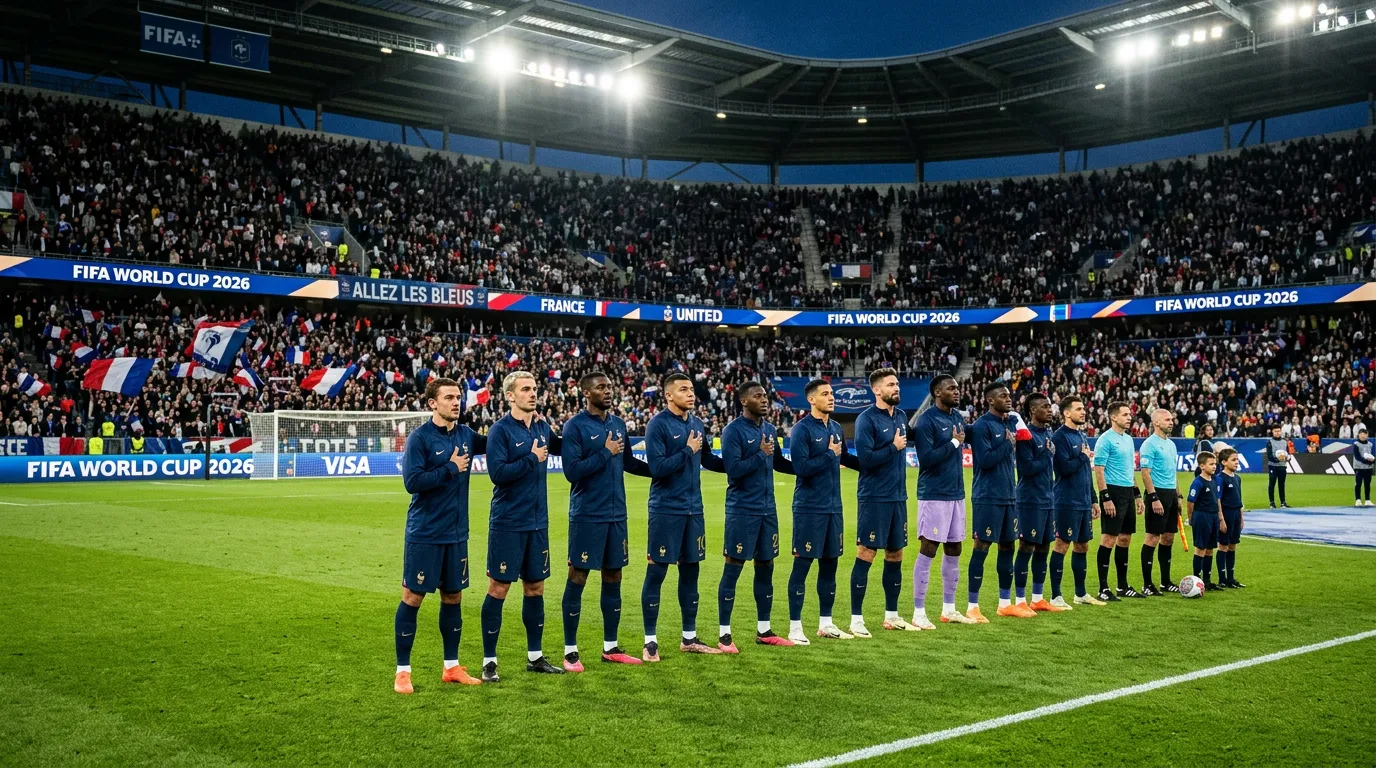
Two World Cup finals in a row. A squad so deep that players who would start for most nations cannot crack the matchday 23. And Kylian Mbappé, the most expensive footballer on the planet, entering his physical prime at 27. France at the 2026 World Cup are not just contenders — they are the standard against which every other team in the field measures itself. I have covered six World Cup cycles professionally, and I cannot recall a team arriving at a tournament with this combination of recent pedigree, squad depth, and individual brilliance. The france world cup 2026 campaign begins with the bookmakers pricing Les Bleus among the top three favourites, and for once, the market might be undervaluing them.
But there is a French paradox that recurs at major tournaments. The talent overflows, yet the internal dynamics — egos, tactical disagreements, the relationship between the coach and the senior players — have derailed French campaigns before. The 2010 World Cup mutiny in South Africa remains the most dramatic example, but even the successful 2018 and 2022 runs were marked by squad tensions that stayed behind closed doors. Didier Deschamps, now in his 14th year as manager, has mastered the art of managing these personalities, but the 2026 tournament will test that skill more than ever. What follows is my full assessment of where France stand heading into June.
How France Qualified
France topped their UEFA qualifying group with the kind of clinical efficiency that Deschamps teams have perfected. Eight wins and two draws across ten matches, 24 goals scored and five conceded, and qualification secured with two matches to spare. The numbers were impressive, but I found the underlying performances more revealing. France rarely dominated matches in the way their talent suggested they should. Instead, they ground out 1-0 wins against Greece and the Republic of Ireland through defensive discipline and moments of individual quality from Mbappé or Antoine Griezmann.
The qualifying campaign also exposed a recurring debate within French football: should this team play expansive attacking football that reflects its talent, or should Deschamps continue with the pragmatic counter-attacking approach that won the 2018 World Cup and reached the 2022 final? The French media overwhelmingly favours the former. Deschamps, characteristically, ignores the media. His qualifying approach — a compact 4-3-3 that sits in a medium block and hits on the counter through Mbappé’s pace — sacrifices aesthetics for results. It works, but it means France rarely look like the best team in the world despite having the players to justify that label.
One positive development during qualifying was the emergence of several younger players who provide tactical options Deschamps previously lacked. Aurélien Tchouaméni, already established at Real Madrid, has grown into the midfield anchor role that N’Golo Kanté occupied in 2018. Warren Zaïre-Emery, still just 20, offers a different midfield profile — more progressive, more willing to carry the ball forward and take risks with his passing. The blend of youth and experience in the midfield gives Deschamps flexibility he has not always had, and qualifying provided the competitive minutes to build those partnerships ahead of the World Cup.
The defensive record during qualifying was particularly noteworthy. Five goals conceded in ten matches gave France the joint-best defensive record in European qualifying, and four of those ten matches ended as clean sheets. Deschamps’ defensive organization — the spacing between the back four, the triggers for when full-backs should tuck in versus push forward, the communication between the centre-backs and the goalkeeper — has been refined over 14 years and represents the most polished defensive system in international football. For bettors, this defensive consistency is relevant: France’s tournament results tend to be decided by small margins, and their ability to keep clean sheets in group-stage matches has been a reliable pattern across the last three major tournaments.
Key Players — Mbappé, Tchouaméni & France’s Generational Talent
I watched Mbappé score four goals in the 2022 World Cup final — including a hat trick — and still end up on the losing side. That night in Lusail was the most extraordinary individual performance I have witnessed in a World Cup match, and it left Mbappé with a hunger that has only intensified since. His move to Real Madrid in the summer of 2024 was the defining transfer of the decade, and his first full season in La Liga produced 29 goals and 11 assists despite a period of tactical adjustment in the autumn. At 27, Mbappé combines the explosive pace that made him a teenage sensation with the tactical maturity and finishing precision that come from playing at the absolute highest level for a decade.
What makes Mbappé a unique World Cup weapon is his ability to produce in knockout situations. His World Cup record — 12 goals in 14 matches across two tournaments — is better than any active player’s and places him on a trajectory to challenge the all-time scoring record if France advance deep into the bracket. He scores in high-pressure moments, creates chances for teammates when defenders double-mark him, and carries the psychological weight of being the opposition’s primary concern without showing any sign of it affecting his performance. If France win the 2026 World Cup, Mbappé will almost certainly be the reason.
Tchouaméni provides the midfield foundation that allows Mbappé and the attacking players to operate with freedom. His positional sense — the ability to read the game two passes ahead and position himself to intercept or recover — is elite even by Real Madrid standards. In the 2022 World Cup, Tchouaméni scored a stunning long-range goal against England in the quarterfinal that demonstrated an attacking dimension his defensive reputation sometimes obscures. At 26, he is approaching his peak years and has the physical profile — tall, powerful, mobile — to dominate midfield battles against any opponent in the 2026 field.
Ousmane Dembélé, the reborn winger at Paris Saint-Germain, adds a dimension that France lacked in 2022. His dribbling statistics since joining PSG are extraordinary — he completes more take-ons per 90 minutes than any other player in Ligue 1 — and his improved decision-making in the final third means those dribbles now lead to goals and assists rather than dead ends. On the opposite flank, Marcus Thuram has established himself as a reliable scoring option from the left side of the attack, giving Deschamps a front three that can interchange positions without losing effectiveness.
The defensive spine is equally impressive. William Saliba and Dayot Upamecano form a centre-back partnership that combines Premier League physicality (Saliba at Arsenal) with Bundesliga tactical education (Upamecano at Bayern Munich). Theo Hernández at left-back provides attacking thrust that few full-backs in world football can match. Jules Koundé, now established at Barcelona, locks down the right side. And in goal, Mike Maignan has proven himself as one of the top three goalkeepers in Europe during his time at AC Milan, offering commanding presence and decisive shot-stopping that gives France’s defence an extra layer of security.
The bench is where France’s depth becomes almost unfair. Griezmann, now 35, remains available as a super-sub who understands tournament football better than almost anyone. Eduardo Camavinga can replace any of the midfield starters without a noticeable drop in quality. Randal Kolo Muani provides a physical alternative up front if the starting attackers are neutralized. No other team in the 2026 field can match France’s ability to change a game from the substitutes’ bench, and in a tournament where the expanded format demands eight matches to reach the final, squad depth becomes the deciding factor.
Group I — Senegal, Norway & Iraq
When I saw the Group I draw, my immediate reaction was that France had received one of the tougher assignments among the top seeds. Senegal are a quality African side with Premier League attackers and the defensive discipline that took them to the 2022 World Cup quarterfinals. Norway bring Erling Haaland, the most prolific striker in world football, whose mere presence forces tactical adjustments from every opponent. Iraq, the emotional qualifier who ended a 40-year World Cup absence by beating Bolivia in the intercontinental playoff, are the kind of underdog who can produce a single inspired performance.
The France-Senegal match has historical resonance. Senegal’s 1-0 victory over France in the opening match of the 2002 World Cup remains one of the great upsets in tournament history, and the current Senegalese squad is significantly stronger than the 2002 vintage. Sadio Mane may be aging, but the supporting cast — Ismaila Sarr, Nicolas Jackson, Idrissa Gueye — gives Senegal enough quality to compete with any team for 90 minutes. This is not a match France can take lightly, and the market will price Senegal at attractive underdog odds that deserve respect.
Norway’s challenge is more straightforward but no less dangerous. Haaland is a problem that no defensive strategy fully solves. Double-marking him creates space for Martin Odegaard and the supporting midfielders; playing a high line invites Haaland to run in behind; sitting deep surrenders the midfield territory that France need to control. Deschamps will likely assign Saliba as the primary marker on Haaland, with Tchouaméni dropping between the centre-backs when Norway build attacks. It is a match that could be decided by whether France can keep the ball away from Haaland for long enough to dominate possession in the other 70% of the pitch.
Iraq are the romantic story of the 2026 qualifiers, but their squad lacks the depth to sustain competitiveness across three group matches against this level of opposition. Their defensive organization under coach Jesus Casas has been effective in Asian qualification, but the step up to facing Mbappé and Dembélé in a World Cup group stage is enormous. France should win this match convincingly, and the margin of victory matters for goal difference in a group where Senegal and Norway could make the final standings tight.
France’s Betting Odds & Value Markets
France are priced at approximately 7.50 to win the 2026 World Cup outright, sitting just behind Spain and roughly level with Argentina. That implies about a 13% probability, which I believe undervalues them slightly. France’s combination of recent tournament pedigree (two finals in the last three World Cups), squad depth, and individual match-winning ability through Mbappé makes them the most dangerous single-game opponent in the field. In a knockout format where margins are thin, having a player who can produce four goals in a final is an advantage that markets struggle to price accurately.
To win Group I, France are priced at approximately 1.50 — fair given the Senegal and Norway threats. To advance from the group sits at around 1.10, reflecting the near-certainty of France finishing in the top three of a four-team group. The match-specific market that interests me most is the France-Norway under 2.5 goals at around 1.75. Deschamps teams in tournament play tend to be cautious, and Norway’s approach against top sides typically prioritizes defensive structure. A 1-0 or 1-1 result feels more likely than the 3-2 or 4-1 scoreline that the attacking talent on both sides might suggest.
In the Golden Boot market, Mbappé sits at approximately 7.00 — one of the shortest prices alongside Harry Kane and Vinícius Jr. His 12 World Cup goals in 14 career matches provide strong historical backing for this bet, and if France reach the semifinals or beyond, his scoring rate suggests five or six goals is achievable. The risk is that Deschamps rests Mbappé for the Iraq match, reducing his total minutes. Even so, Mbappé’s Golden Boot odds represent one of the more defensible futures bets in the tournament.
The prop I find most compelling is France to concede under 1.5 goals in the group stage at around 2.00. Deschamps’ tournament record shows a pattern of defensive rigidity in group matches — France conceded just one goal in the 2022 group stage and two in 2018. With Saliba, Upamecano, and Maignan forming one of the strongest defensive units in the tournament, keeping the group-stage goals-against total below two is a high-probability outcome.
Tactical Identity Under Deschamps
Deschamps has been France’s manager since 2012, which makes him the longest-serving coach of any top-tier national team currently heading to the World Cup. His longevity is both an asset and a potential weakness. The asset is obvious: the players know the system inside out, the training routines are established, and the squad dynamics have been managed through multiple tournament cycles. The weakness is that opponents also know the system inside out, and Deschamps’ tactical approach — pragmatic, counter-attack focused, reliant on individual brilliance in the final third — has been studied and prepared for by every coach in world football.
The 4-3-3 formation that Deschamps typically deploys is functionally a 4-5-1 without the ball. Mbappé, Dembélé, and Thuram (or Griezmann) form the front three on paper, but when the opposition has possession, Dembélé and Thuram drop into midfield positions, creating a compact five-man midfield block that is extremely difficult to play through. The trade-off is that France’s attacking transitions rely on Mbappé’s pace to stretch the play once possession is won — if Mbappé is marked out of the game or fatigued, France’s attacking output drops precipitously.
The question heading into 2026 is whether Deschamps will adjust this formula. The emergence of Zaïre-Emery and Camavinga as ball-progressive midfielders suggests a slight evolution toward more controlled possession in the midfield third, rather than the direct counter-attacking that defined the 2018 triumph. In the March 2026 friendlies, Deschamps experimented with a 4-2-3-1 that positioned Griezmann as a number ten behind Mbappé, with Tchouaméni and Camavinga as the double pivot. The early results were promising — France created more chances from open play and maintained higher average possession — but whether Deschamps trusts this approach in the pressure of a World Cup knockout match is uncertain. History suggests he will revert to the defensive template when the stakes are highest.
Set pieces remain a French strength, largely due to the height advantage their squad possesses. With Saliba (190 cm), Upamecano (186 cm), Tchouaméni (187 cm), and Thuram (192 cm) all attacking corners and free kicks, France win the aerial battle against most opponents. Griezmann’s delivery from set pieces is among the most accurate in international football, and the set-piece routines France have developed under Deschamps are well-drilled and consistently produce scoring opportunities. In tight knockout matches — the kind Deschamps specializes in — a set-piece goal can be the difference between the quarterfinals and the final.
How Far Does France Go?
France advance from Group I in first place with seven points — a comfortable win over Iraq, a tight 1-0 win over either Senegal or Norway, and a draw in the remaining match. The Round of 32 is straightforward, producing a 2-0 or 3-0 victory that builds confidence without revealing tactical vulnerabilities. The quarterfinal is where the tournament begins for France, likely against a strong opponent from Group J or K — potentially Portugal or Colombia. I see France navigating that match through defensive discipline and a Mbappé counter-attacking goal.
The semifinal is where I project France to peak. Against Spain, England, or Brazil — whoever emerges from the other side of the bracket — France’s tournament experience and tactical maturity give them a genuine edge. My prediction: France reach the final at MetLife Stadium in New Jersey on July 19, where they face either Spain or Argentina in a match that will define the tournament narrative. Whether France win that final depends on variables I cannot predict two months out — form, injuries, refereeing decisions, the psychological momentum of the opponent. But France’s probability of winning the 2026 World Cup is, in my assessment, closer to 16-17% than the 13% implied by their current odds.
For bettors, France to reach the final at approximately 3.50 represents the sharpest value on their board. It captures the most likely positive outcome (a deep run) without requiring France to win the single most variance-heavy match in the tournament. The full team-by-team odds breakdown shows France’s position in the market relative to the field, and the gap between France and the top-priced favourites is narrower than the odds suggest.
The North American setting works in France’s favour. The time zones align with European viewing habits, meaning France’s matches will kick off at times when French players are accustomed to performing at peak intensity. The stadiums in New York-New Jersey, Boston, and the other assigned venues are modern, well-maintained surfaces that suit France’s passing game. And the French diaspora across Canada and the United States — particularly in cities like Montreal and New York — will ensure vocal support at every match. These are marginal advantages, but at the World Cup, marginal advantages compound. France enter the tournament as the team most likely to win it, even if the market does not quite say so yet.
