
 Available in US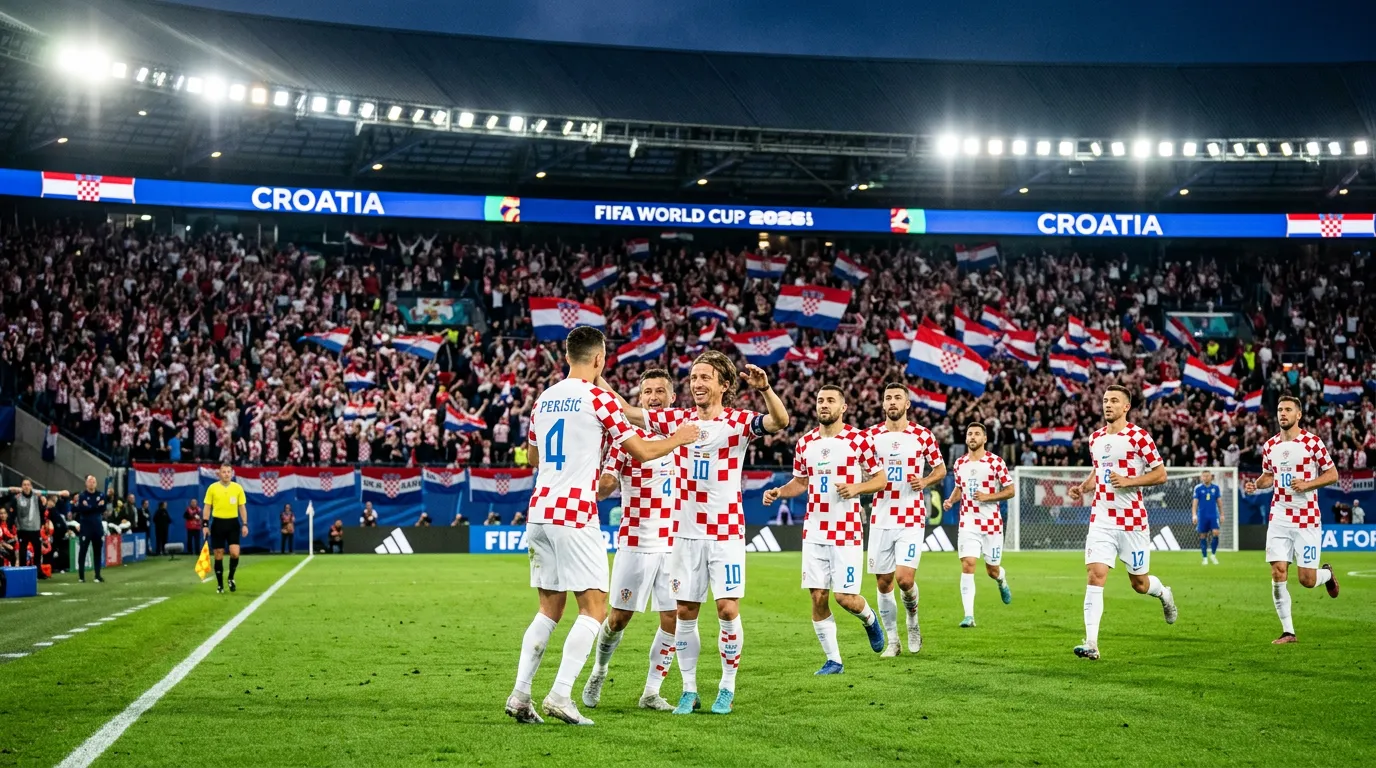
Luka Modrić will turn 41 during the 2026 World Cup. That number should disqualify any midfielder from competing at the highest level, and yet here we are — Modrić still pulling strings at Real Madrid, still dictating tempo for a national team that has become one of the great overachievers in World Cup history. Croatia at the 2026 World Cup is Modrić’s last dance, and the question surrounding the croatia world cup 2026 campaign is whether the supporting cast — younger, less experienced, less battle-tested — can compensate for what time has inevitably taken from the golden generation’s captain.
I have a deep personal interest in Croatian football. I covered the 2018 World Cup final between Croatia and France, and the semifinal against England that preceded it, and the energy that a nation of four million people generated was unlike anything I had experienced in sports journalism. Croatia’s run to the 2018 final — through penalty shootouts against Denmark and Russia, through a draining extra-time semifinal against England — was a triumph of collective will over individual talent. The 2022 third-place finish confirmed that 2018 was not a fluke. But the 2026 tournament presents a fundamentally different challenge: the core that drove those runs is aging out, and the transition to the next generation is happening in real time against the backdrop of the most demanding group draw Croatia could have received.
How Croatia Qualified
Croatia qualified through the UEFA group stage with a record of six wins, two draws, and two losses — a respectable campaign that masked some concerning performances in the final matches. The losses came against Portugal and France in the Nations League, both decided by defensive errors that highlighted the gap between Croatia’s aging back line and the attacking quality of the world’s best teams. The qualifying campaign also revealed a growing dependency on Mateo Kovacic and Marcelo Brozović in midfield, where Modrić’s reduced minutes created a creative vacuum that younger players — Lovro Majer, Mario Pasalic — struggled to fill consistently.
The positive takeaway was the emergence of Josko Gvardiol as a genuine world-class defender. His performances at Manchester City — combining physical dominance with technical ability and tactical intelligence — have placed him among the top five centre-backs in world football at just 24. Gvardiol’s ability to carry the ball out of defence, start attacks with progressive passes, and dominate aerial duels gives Croatia a defensive anchor around whom the next generation can be built. If Croatia’s 2026 campaign produces any lasting legacy, it will be the confirmation of Gvardiol as the player who carries Croatian football into the post-Modrić era.
Key Players — Modrić, Gvardiol & the Next Generation
Modrić’s role at 40-41 will be carefully managed. The expectation is that he starts two of the three group matches and is available from the bench in the third, with his knockout-round involvement dependent on how far Croatia advance and how well his body holds up under tournament conditions. His passing range — the ability to switch play with a 40-yard diagonal, to thread a through-ball between two defenders into a pocket that only he can see — remains elite even as his physical capacity to cover ground has diminished. The coaching staff will deploy Modrić in a deeper role than in previous tournaments, asking him to dictate from the base of midfield rather than arriving in the box as he did in 2018 and 2022. This conserves his energy and maximizes his playmaking impact, though it reduces his goal threat.
Kovacic provides the midfield engine that Modrić’s reduced intensity requires. His ability to carry the ball under pressure, progress play through the central zones, and contribute defensive work makes him the squad’s most important midfielder in practical terms, even if Modrić remains the most talented. The attacking options are less settled. Ivan Perišić, now 37, is unlikely to feature prominently, which shifts the creative burden to younger wide players like Martin Baturina, whose performances in the Croatian league have earned attention from top European clubs. Up front, the competition between Andrej Kramaric and younger striker options provides goals from open play, though neither possesses the clinical finishing that characterizes the top international strikers in the field.
The defensive transition — how quickly Croatia reorganize after losing the ball — is the area where Modrić’s declining physical output creates the most risk. In 2018, Modrić covered over 11 kilometres per match, pressing aggressively and recovering possession in midfield. In 2025 club matches, that figure has dropped to approximately 9 kilometres, and the difference is felt most acutely in the moments after possession is lost, when the opposing team’s counter-attack catches Croatia’s midfield in transition. Gvardiol’s pace at centre-back compensates partially, but the overall defensive structure around Modrić has become more conservative by necessity — Croatia sit five to eight metres deeper when defending than they did in 2018, conceding territory in exchange for compactness. This trade-off works against weaker opponents but becomes problematic against England, whose ball-progressive midfielders (Bellingham, Rice) exploit the space between Croatia’s midfield and defensive lines with devastating efficiency.
Group L — England, Ghana & Panama
Group L is Croatia’s toughest World Cup assignment since — well, since their entire World Cup history has consisted of tough assignments. England are the group’s heavy favourites and a team that Croatia have genuine history against: the 2018 semifinal win, the 2021 Euros group-stage defeat. The England-Croatia opener in Dallas is a fixture that carries eight years of narrative weight, and the tactical matchup — England’s aggressive pressing against Croatia’s patient possession game — produces the kind of chess match that neutrals anticipate and bettors find difficult to price accurately.
Ghana and Panama complete the group with contrasting styles. Ghana’s physicality and pace make them dangerous in transition, while Panama’s defensive discipline and CONCACAF grit make them difficult to break down. Croatia should take points from both, but neither match is a formality, and the cumulative physical demands of three competitive group matches could exhaust a squad whose key players are carrying heavy minutes from long European club seasons. Croatia’s path to advancement likely requires at least four points — a win and a draw from the Ghana and Panama matches — plus a competitive performance against England that keeps goal difference respectable even in defeat.
Croatia’s Betting Odds
Croatia are priced at approximately 34.00 to win the 2026 World Cup, which reflects their status as a team with tournament pedigree but declining physical capacity. To advance from Group L, Croatia sit at approximately 1.80, a price that accounts for the difficulty of the group and the realistic possibility that Ghana or Panama could take the third advancement spot. The value angle I see is Croatia to reach the Round of 32 at approximately 1.40 — a bet that captures their tournament experience and quality while avoiding the knockout-round uncertainty that makes deeper predictions unreliable.
Croatia at the World Cup — 2018 Final, 2022 Third Place
Croatia’s World Cup record since gaining independence in 1991 is remarkable for a nation of their size. Third place at the inaugural 1998 tournament, a group-stage exit in 2002, group-stage exits in 2006 and 2014, the extraordinary 2018 final run, and third place again in 2022 — the trajectory reads like a story of intermittent brilliance sustained by a golden generation that refused to accept the limitations their country’s population and resources might otherwise impose. That golden generation is now at its end. Modrić, Perišić, Brozović, Lovren — the players who defined Croatian football for a decade — are all 35 or older, and the 2026 World Cup is the final act of their collective career.
The emotional weight of that farewell adds an intangible dimension to Croatia’s campaign. Tournament football is not purely about tactics and talent — it is about motivation, about the willingness to run one more metre, to make one more tackle, to play through pain when the body says stop. Croatia’s golden generation has demonstrated that willingness across three consecutive World Cups, and the farewell tour provides a final reservoir of motivation that younger, more physically gifted squads may not possess. Whether that motivation is enough to overcome the talent gap against England in Group L — and against whoever Croatia would face in the knockout rounds — is the romantic question at the heart of Croatia’s 2026 campaign.
The diaspora factor matters for Croatia at this World Cup more than for most teams. North America hosts a significant Croatian community — concentrated in cities like Chicago, Pittsburgh, Toronto, and Hamilton — and the proximity of World Cup venues to these communities means that Croatia will have vocal, passionate support at their Group L matches. In Dallas for the England opener and Toronto for a potential later match, the checkered red-and-white jerseys will be visible throughout the stands, and the emotional energy that Croatian fans generate has been a measurable factor in previous World Cups. The 2018 semifinal against England in Moscow was played in front of a predominantly neutral crowd, yet Croatian fans made themselves heard above the 80,000 in attendance. In North America, where the community connection is personal and generational, that support will be even more pronounced.
Our Prediction for Croatia
Croatia finish third in Group L with three points — a loss to England, a win over Panama, and a draw with Ghana. They advance as one of the eight best third-place finishers and face a difficult Round of 32 opponent. Modrić delivers one more virtuoso performance — a match where his passing reminds the world why he is considered the greatest Croatian footballer of all time — before Croatia exit in the Round of 32 or Round of 16, ending the golden generation’s era with the dignity and competitiveness that has defined their collective career. The Group L breakdown shows where Croatia sit relative to England, Ghana, and Panama, and the margins are tight enough that any result in any match would not constitute a genuine surprise. That unpredictability is Croatia’s greatest weapon and the reason Modrić’s last dance should not be underestimated.
The tactical system Croatia deploy in 2026 will differ from the possession-dominant approach that characterized the 2018 and 2022 campaigns. With Modrić’s declining ability to cover ground in midfield, the coaching staff have shifted toward a more conservative 4-1-4-1 that positions Brozović (or his replacement) as a single pivot ahead of the defence, with Modrić and Kovacic operating in advanced midfield roles where their technical quality can be maximized without the defensive burden of a double pivot system. This adjustment reduces Croatia’s possession numbers — they averaged 58% in 2018, closer to 52% in recent matches — but improves their defensive resilience by adding an extra body between the midfield and the back line.
The set-piece threat remains significant. Croatia’s height advantage — Gvardiol, Kramaric, and several other aerial threats all stand above 185 cm — gives them a genuine weapon from corners and free kicks that compensates for the declining open-play creativity. At the 2022 World Cup, Croatia scored three of their eight goals from set-piece situations, and the coaching staff have maintained that emphasis through qualifying and into the tournament preparation. Against Panama and Ghana — teams that may struggle to contain Croatia’s aerial quality at dead-ball situations — set pieces could be the tactical lever that secures the points needed for advancement.
For Canadian bettors, Croatia’s Group L matches in Dallas and Toronto provide accessible viewing opportunities and local interest. The England-Croatia clash in Dallas will attract enormous viewership, and the emotional narrative of Modrić’s farewell adds a storyline that transcends the tactical analysis. Croatia’s odds to advance from Group L at approximately 1.80 represent a reasonable bet on a team that has defied expectations at three consecutive World Cups and whose tournament pedigree commands respect regardless of the aging squad dynamics.
The generational transition is the subplot that gives Croatia’s 2026 campaign its emotional resonance. Every World Cup squad contains a mix of veterans reaching their final tournament and younger players experiencing the stage for the first time. What makes Croatia’s version of this dynamic unique is the extraordinary standard the departing generation set. Modrić, Perišić, Brozović, and their contemporaries reached a World Cup final and finished third at the next tournament — results that a country of four million people has no statistical right to achieve. The younger players stepping into those roles — Baturina, Sucic, Gvardiol — carry the burden of living up to that standard while simultaneously developing their own identity within the national team framework. Whether they absorb the pressure or buckle under it will determine Croatia’s trajectory not just in 2026 but for the next decade of Croatian football. The 2026 World Cup is not just Modrić’s farewell. It is the bridge between Croatia’s past and future, and the tournament’s outcome will shape the expectations that the next generation carries forward.
