
 Available in US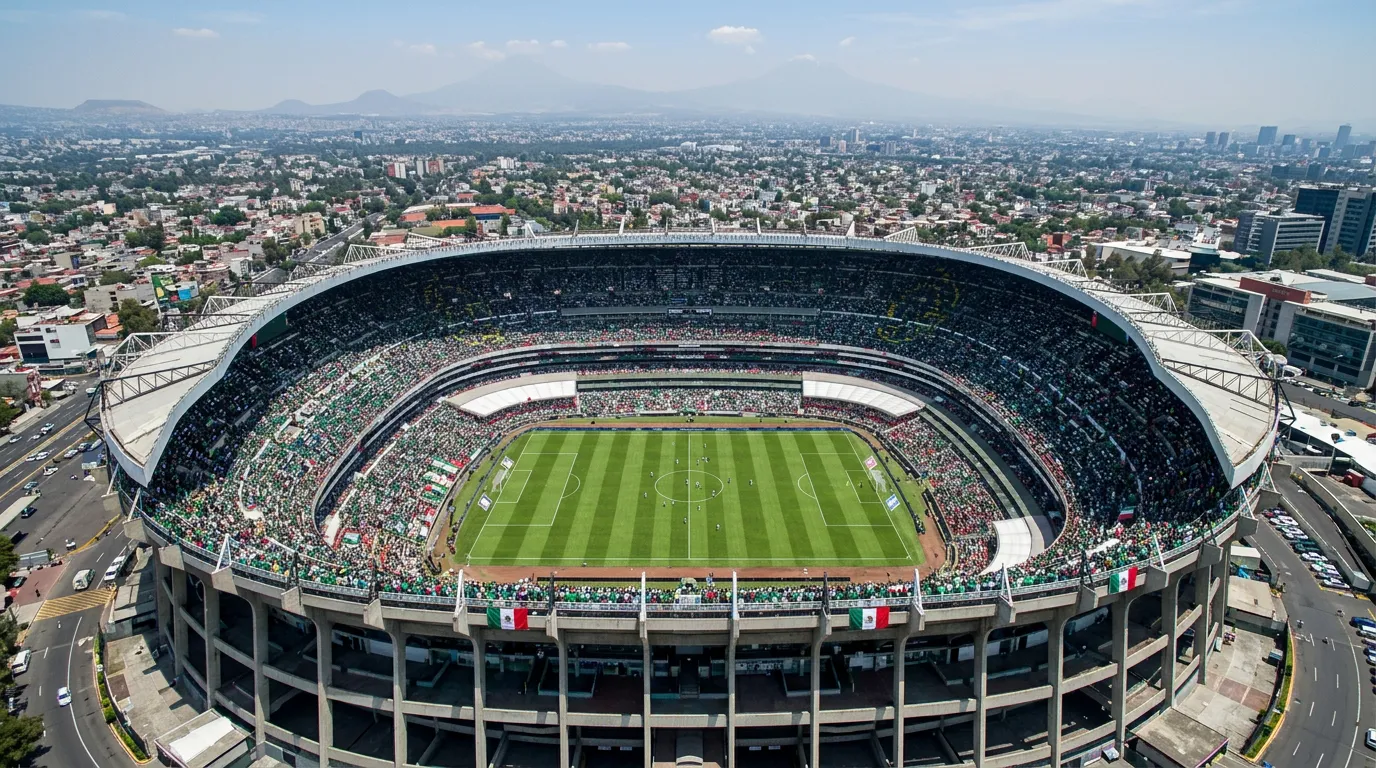
No stadium on earth has witnessed more World Cup history than Estadio Azteca. Pelé lifted the Jules Rimet Trophy here in 1970. Diego Maradona scored the “Hand of God” goal and the “Goal of the Century” here in 1986. On June 11, 2026, when Mexico kicks off against South Africa in the tournament’s opening match, Azteca will become the first and only stadium to host matches at three separate FIFA World Cups. That distinction matters beyond trivia — it speaks to a venue that has been synonymous with the sport’s most significant moments for more than half a century, and it places the 2026 tournament in a lineage that no other host country can claim.
For Canadian fans, Estadio Azteca is not a venue most will visit in person. Mexico City is a four-and-a-half-hour flight from Toronto and a six-hour flight from Vancouver, and the tournament’s structure means Canada plays all three group matches on home soil. But understanding Azteca is essential for understanding the 2026 World Cup as a whole — the stadium hosts the opening match, which sets the tournament’s emotional tone, and it hosts a Round of 32 knockout fixture that could feature any of the tournament’s top seeds. If a team Canada faces in the knockout rounds played their earlier matches at Azteca’s 2,240-metre altitude, that environmental factor will have shaped their physical conditioning and tactical approach in ways that ripple through the bracket.
About Estadio Azteca — A Three-Time World Cup Host
Azteca sits in the Coyoacán borough of southern Mexico City, surrounded by the sprawling urban landscape of a metropolitan area that is home to more than 21 million people. The stadium opened on May 29, 1966 — sixty years before the 2026 World Cup — and was designed by architect Pedro Ramírez Vázquez, whose modernist vision created a venue that was revolutionary for its era. The original capacity exceeded 105,000, making it one of the largest stadiums in the world at a time when most football venues held fewer than 60,000.
Today, following safety-driven capacity reductions implemented over several decades, Azteca holds approximately 87,000 spectators for soccer events. Even at that reduced number, it remains one of the largest and most atmospheric stadiums in the Western Hemisphere. The structure is a massive concrete bowl with a distinctive double-decker design — the lower bowl is steep and close to the pitch, while the upper tiers rise at angles that create a sense of vertical scale few modern stadiums replicate. The sight of 87,000 fans in green Mexico jerseys performing “the wave” is one of sport’s most recognizable visual signatures, and the noise generated by a full Azteca crowd is measurably louder than most European stadiums of comparable size.
Altitude is Azteca’s hidden variable. Mexico City sits at 2,240 metres above sea level — higher than any other World Cup host city by a significant margin. At that elevation, the air contains roughly 20% less oxygen than at sea level, which affects aerobic performance, ball flight, and recovery times. Teams that train at lower altitudes experience noticeable fatigue earlier in matches at Azteca, particularly in the second half. The ball travels faster and with less air resistance, making shooting more unpredictable and goalkeeping more difficult. For bettors, altitude is a quantifiable edge for the home team: Mexico’s record at Azteca in competitive matches is disproportionately strong compared to their away record, and a significant portion of that gap is attributable to altitude effects on visiting teams.
A multi-year renovation program was completed in late 2025 to prepare Azteca for the World Cup. The work included structural reinforcement, updated seating, new media facilities, and improvements to the playing surface — a natural grass pitch that has historically been one of the finest in CONCACAF. FIFA’s structural assessment confirmed the stadium’s readiness for tournament use, quieting years of speculation about whether the 60-year-old venue could meet modern hosting standards.
World Cup 2026 Matches at Estadio Azteca
Azteca hosts four matches at the 2026 World Cup — fewer than many American venues, but each one carries outsized significance. The opening match alone would justify the stadium’s inclusion in the tournament, and the knockout fixture adds a layer of competitive drama that ensures Azteca remains relevant well into the tournament’s second phase.
The tournament begins at Azteca on June 11 with Mexico versus South Africa at 3:00 PM ET (2:00 PM local time) — Match 1 of the first-ever 48-team World Cup. This fixture is a deliberate callback to the 2010 World Cup in South Africa, which also opened with a Mexico-South Africa match, albeit in Johannesburg rather than Mexico City. The second group-stage fixture at Azteca is Uzbekistan versus Colombia on June 17 at 10:00 PM ET (9:00 PM local), a Group K match that features one of the tournament’s four debutants. Czechia versus Mexico on June 24 at 9:00 PM ET (8:00 PM local) is the final Group A matchday, played simultaneously with South Africa versus South Korea in Monterrey. The knockout fixture is a Round of 32 match on June 30 at 9:00 PM ET (8:00 PM local), featuring the Group A winner against a best third-placed team.
The opening match carries the heaviest atmospheric weight. Mexico is the sentimental favourite of the entire tournament’s first week — co-hosts playing the very first match at the most storied stadium in World Cup history, with 87,000 fans creating an environment that will be broadcast to an estimated global television audience exceeding one billion. The pressure on Mexico is immense but familiar — they opened the 1970 and 1986 World Cups at Azteca as well, winning both opening fixtures. A third opening-match victory would cement Azteca’s status as the most successful opening venue in World Cup history.
World Cup History — 1970, 1986 & Now 2026
The 1970 World Cup final at Azteca is widely regarded as the greatest single match in the tournament’s history. Brazil defeated Italy 4-1 in a display of attacking football that defined the beautiful game for a generation. Pelé, Jairzinho, Gerson, Rivelino, and Carlos Alberto produced the kind of collective brilliance that transcended the sport, and the image of Carlos Alberto’s goal — a sweeping team move finished with a thunderous right-footed strike — remains the most replayed moment in World Cup history. That match occurred on June 21, 1970, and the stadium has been a pilgrimage site for football purists ever since.
Sixteen years later, the 1986 World Cup returned to Azteca, and Diego Maradona delivered two goals against England in the quarterfinal that permanently altered the stadium’s mythology. The “Hand of God” — a punch disguised as a header that beat Peter Shilton — was followed minutes later by a dribble from the halfway line that bypassed five English defenders and remains the greatest individual goal ever scored. Those two moments, separated by four minutes, captured the full spectrum of what football can be: cynical gamesmanship and transcendent genius, both on the same pitch, by the same player, in the same match. Maradona went on to lead Argentina to the title, beating West Germany 3-2 in the final at Azteca on June 29, 1986.
The 2026 tournament adds a third chapter to Azteca’s World Cup story, and the weight of that history is not lost on the players or the organizers. No other active stadium can claim a comparable connection to the tournament’s defining moments. Wembley hosted the 1966 final and the 2020 Euro final but has been rebuilt since its World Cup appearance. The Maracana hosted the 1950 and 2014 finals but was heavily renovated between those events. Azteca, despite its renovations, remains structurally and spiritually the same building that housed Pelé and Maradona — and that continuity gives the 2026 matches played there a historical resonance no other venue can offer.
Getting There from Canada — Flights & Logistics
Most Canadian fans will experience Azteca’s World Cup matches through television rather than in person, but for those planning the trip, the logistics are manageable with advance planning. Direct flights from Toronto to Mexico City operate daily on Air Canada and Aeromexico, with flight times of approximately four hours and thirty minutes. From Vancouver, direct flights take approximately five hours and thirty minutes. Montreal to Mexico City is also available as a direct route on Aeromexico and Air Canada. Flight prices during the World Cup period will be significantly inflated — booking early is not a suggestion but a financial necessity.
Mexico City’s Aeropuerto Internacional Benito Juarez (MEX) is located approximately 15 kilometres northeast of Estadio Azteca. The journey from the airport to the stadium takes 30 to 60 minutes depending on Mexico City’s famously unpredictable traffic. The city’s Metro system is the most efficient option: Line 2 runs from the airport area toward the southern boroughs, and a combination of Metro and the Azteca shuttle service that operates on match days provides the most reliable transportation. Ride-hailing apps are widely available in Mexico City and are the preferred option for visitors unfamiliar with the Metro system, though surge pricing on match days can double or triple normal fares.
Canadian citizens do not require a visa to enter Mexico for stays of up to 180 days, but a valid passport is required. The currency is the Mexican peso (MXN), and credit cards are widely accepted at the stadium and surrounding commercial areas. Mexico City’s altitude of 2,240 metres can cause mild altitude sickness in visitors arriving from sea level — symptoms include headache, fatigue, and shortness of breath — and health professionals recommend arriving at least 24 hours before a match to acclimatize. Staying hydrated and avoiding alcohol in the first few hours after arrival significantly reduces altitude-related discomfort.
For fans attending the opening match on June 11, the surrounding neighbourhood of Coyoacán offers one of Mexico City’s most charming pre-match experiences — cobblestone streets, outdoor cafes, the Frida Kahlo Museum, and a vibrant local atmosphere that is dramatically different from the concrete sports complexes that surround most North American stadiums. Arriving in Coyoacán early, exploring the neighbourhood, and walking to Azteca is the kind of World Cup experience that money cannot buy and that television cannot replicate.
