
 Available in US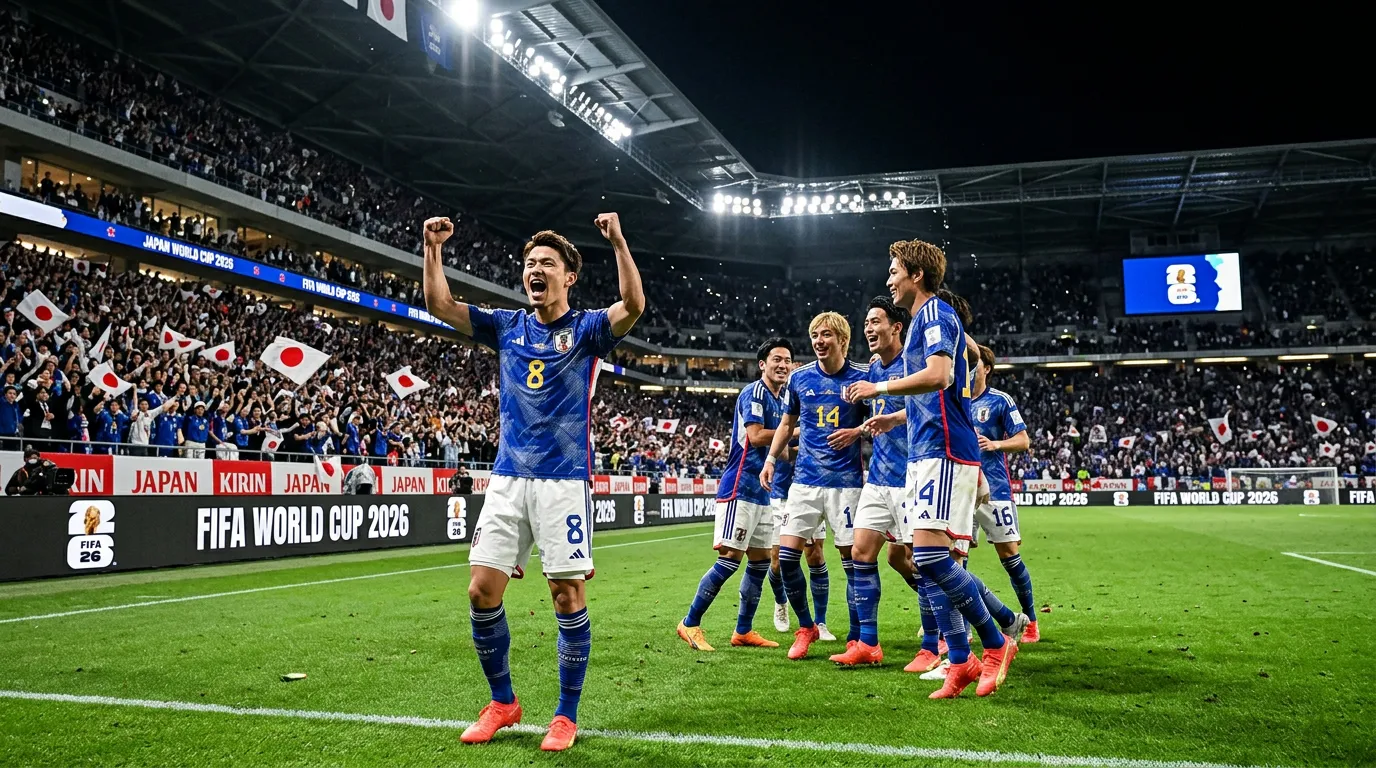
When Japan beat both Germany and Spain in the 2022 World Cup group stage, the global reaction oscillated between shock and admiration. When they then lost to Croatia on penalties in the Round of 16, the reaction shifted to something else entirely: recognition that Japan were no longer a novelty act at World Cups but a genuine contender capable of beating any team in the field on any given day. The japan world cup 2026 campaign builds on that foundation with a squad that is even stronger than the one that stunned the world in Qatar — more European experience, more tactical sophistication, and a coaching setup that has refined the high-pressing system that made Japan the most dangerous underdog at the last tournament.
I built a model after the 2022 World Cup to identify which teams had the steepest improvement trajectories heading into 2026, and Japan topped the list by a significant margin. The number of Japanese players earning regular minutes at top-five European leagues has nearly doubled since 2022 — from approximately 15 to over 25 — and the collective quality of those placements has improved dramatically. Kaoru Mitoma at Brighton, Takefusa Kubo at Real Sociedad, Wataru Endo at Liverpool, Takehiro Tomiyasu at Arsenal — these are not squad players filling gaps at mid-table clubs. They are starters at elite institutions who compete in the Champions League, the Premier League, and La Liga every week. That exposure to the highest level of club football translates directly to international performance, and Japan’s qualifying campaign demonstrated exactly how that translation works in practice.
How Japan Qualified — AFC Dominance
Japan were the first team in the world to qualify for the 2026 World Cup, clinching their spot in March 2025 with four matches still to play in the AFC third round. The dominance was total: Japan won 14 of their 18 qualifying matches, drew three, and lost just once — a 2-1 defeat in Saudi Arabia that was widely considered a tactical experiment gone wrong rather than a genuine competitive failure. The goal difference was staggering: 53 scored, 8 conceded, a record that surpassed any previous Asian qualifying campaign in World Cup history. Japan did not just qualify from Asia — they made qualifying look like a formality against opposition that included Australia, Saudi Arabia, and Iran.
The tactical system that produced these results is based on aggressive, coordinated pressing that suffocates opponents in their own half. Japan’s pressing triggers — keyed to the opposing goalkeeper’s distribution and the centre-backs’ body positioning — force turnovers in the most dangerous areas of the pitch, and the speed of the transition from defensive press to attacking shot is among the fastest in international football. The data from qualifying showed that Japan created over 40% of their scoring chances from turnovers won in the opponent’s defensive third, a figure that exceeds even the most pressing-intensive club sides in Europe. This system is physically demanding — it requires every outfield player to cover ground at high intensity for 90 minutes — and the concern is whether Japan can sustain it across seven or eight matches in the expanded World Cup format.
Key Players — Mitoma, Kubo & Japan’s European Core
Mitoma’s dribbling is unlike anything else in the 2026 World Cup field. His technique — carrying the ball at full speed with touches so light that defenders cannot predict which direction the next one will take — produces highlight-reel moments on a weekly basis in the Premier League. At Brighton, Mitoma has averaged over three successful take-ons per match, ranking him among the top five dribblers in the league, and his ability to beat defenders one-on-one in the final third creates scoring opportunities that Japan’s previous generations simply could not manufacture. His left foot produces crosses, shots, and through-balls with equal precision, and his work rate without the ball — tracking back to help the left-back, pressing the opposing right-back — makes him a complete winger rather than just an attacking luxury.
Kubo provides the creative intelligence from the right side or as a number ten. His vision — the ability to see passes that other players do not — gives Japan an attacking dimension that compensates for the directness of the pressing system. When Japan win the ball and transition into attack, Kubo is the player who decides whether the ball goes forward immediately or whether the team recycles possession and builds more patiently. That decision-making has matured significantly since the 2022 World Cup, and his La Liga experience at Real Sociedad — where he has become a key creative player in a team that regularly competes in the Champions League — has added consistency to the flashes of brilliance that characterized his younger years.
Wataru Endo anchors the midfield with the defensive discipline and tactical awareness that Liverpool demand. His reading of the game — intercepting passes, positioning himself to block passing lanes, winning headers in the midfield zone — provides the foundation that allows Mitoma and Kubo to express themselves in the final third without leaving Japan exposed defensively. The centre-back pairing of Tomiyasu and Ko Itakura combines Premier League physicality with Bundesliga tactical education, and goalkeeper Zion Suzuki has emerged as one of the most promising young goalkeepers in European football during his time in Serie A. This squad’s collective European experience — over 500 top-five league appearances among the starting eleven — gives Japan a baseline of quality that no previous Japanese World Cup squad has possessed.
The depth chart tells the story of Japan’s transformation. Beyond Mitoma, Kubo, and Endo, the squad includes Ao Tanaka in midfield (a Bundesliga regular whose positional intelligence complements Endo’s defensive work), Daichi Kamada (providing experience from his time in Serie A and the Bundesliga), and Ayase Ueda (a clinical striker who has found his scoring touch in European football). The full-back positions are covered by players from the Premier League and Bundesliga, and the goalkeeping situation features Suzuki as first choice with experienced backup from the J-League. This is not a team that relies on two or three stars and hopes for the best. This is a squad where 18 or 19 players could start for most national teams at the tournament, and that depth — more than any individual talent — is what makes Japan’s dark horse candidacy legitimate rather than aspirational.
Group F — Netherlands, Sweden & Tunisia
Japan’s Group F assignment is the toughest draw they could have received, and that is exactly what makes them dangerous. Japan thrive as underdogs — the 2022 wins over Germany and Spain both came from positions where Japan were written off before kick-off — and the pressure of facing the Netherlands, Sweden, and Tunisia as the group’s second seed suits their tactical approach perfectly. The high-pressing system is most effective against teams that try to build from the back, and both the Netherlands and Sweden prioritize possession-based approaches that create the turnovers Japan’s press is designed to exploit.
The Netherlands-Japan match is the group’s defining fixture. I have analyzed the tactical matchup extensively, and my conclusion is that Japan have a genuine 40-45% chance of winning this match — significantly higher than the bookmakers’ implied probability of around 25-30%. The Netherlands’ vulnerability in defensive transitions, combined with the pace of Mitoma and Kubo through those transitions, creates a matchup that favours Japan’s style. Sweden provide a different challenge — physical, aerial, and set-piece oriented — that tests Japan’s ability to compete in areas where their smaller physical stature is typically a disadvantage. Tunisia are the group’s most predictable opponent: organized, defensively disciplined, and dangerous on the counter through African Cup of Nations experience.
Japan’s Betting Odds
Japan are priced at approximately 26.00 to win the 2026 World Cup, which places them alongside the USA as the highest-priced realistic contenders. That implies roughly a 3.8% probability, which I consider significantly low given Japan’s tactical system, their European-quality squad, and their recent track record of beating top-tier opposition at World Cups. To win Group F, Japan sit at approximately 3.00 — a price that offers genuine value if you believe, as I do, that Japan’s pressing system is specifically designed to exploit the weaknesses of possession-heavy European teams like the Netherlands.
The value play on Japan’s board is straightforward: Japan to advance from Group F at approximately 1.50 represents excellent value for a team that has beaten Germany, Spain, and competed with Croatia at the last World Cup. The match-specific bet I like most is Japan to beat the Netherlands at approximately 3.50 — a price that underestimates Japan’s tactical suitability for this matchup and overweights the Netherlands’ reputation relative to their current form. Japan’s moneyline against Tunisia at around 1.60 is also worth considering as a more conservative play.
Why Japan Is the Dark Horse Everyone Fears
Dark horse status at a World Cup requires three ingredients: a squad with enough quality to compete at the highest level, a tactical system that is specifically effective against the tournament’s strongest teams, and the psychological freedom that comes from having nothing to lose. Japan possess all three. The European core provides the quality. The pressing system provides the tactical edge. And the cultural approach to competition — where collective effort and disciplined execution are valued above individual brilliance — provides the psychological framework that sustains performance across multiple high-stakes matches.
The 2022 World Cup demonstrated what Japan can achieve in a single match. The 2026 World Cup will test whether they can sustain that level across a tournament. The physical demands of the pressing system are the primary concern — Japan’s players will cover more ground per match than almost any other team in the field, and the cumulative fatigue of five, six, or seven high-intensity matches could degrade the pressing quality in the knockout rounds. But Japan’s squad depth, bolstered by the influx of European-based players, provides rotation options that were not available in 2022, and the coaching staff’s willingness to adjust the pressing intensity based on the opponent and the tournament context suggests a tactical maturity that goes beyond the one-dimensional “press everything” approach that some analysts attribute to Japanese football.
Our Prediction for Japan
Japan top Group F ahead of the Netherlands, winning two matches and drawing one. The Round of 32 produces a confident victory, and the Round of 16 pits Japan against a strong opponent — potentially Brazil or another Group C/D survivor. My prediction is that Japan reach the quarterfinals, matching their best-ever World Cup result and confirming their status as the strongest Asian team in World Cup history. A quarterfinal exit to a top-three favourite — Spain, France, or Argentina — ends the run, but the performance establishes Japan as a team that belongs in the conversation about genuine contenders for 2030 and beyond. At 26.00 outright, Japan offer the best value among any team outside the traditional top six, and the full team-by-team breakdown confirms that the market is slow to adjust to Japan’s rapidly improving trajectory.
The Japanese diaspora in Canada adds a local dimension to Japan’s World Cup campaign. Vancouver, Toronto, and Montreal all have substantial Japanese-Canadian communities, and the cultural exchange between Japanese and Canadian football — visible in the J-League-MLS partnerships and the shared passion for technical, attractive football — ensures that Japan’s matches will attract significant Canadian viewership beyond the neutral audience. Japanese restaurants and cultural centres across Canadian cities will serve as gathering points for matches, creating a communal viewing experience that amplifies the tournament’s cultural impact. For bettors accessing Ontario’s open sportsbook market, Japan represent one of the most interesting value plays in the tournament — a team priced as an outsider that plays like a contender, with a tactical system specifically designed to disrupt the European-style build-up football that most top-seeded opponents rely on. The gap between Japan’s reputation and their actual quality is the gap where smart money finds its edge.
