
 Available in US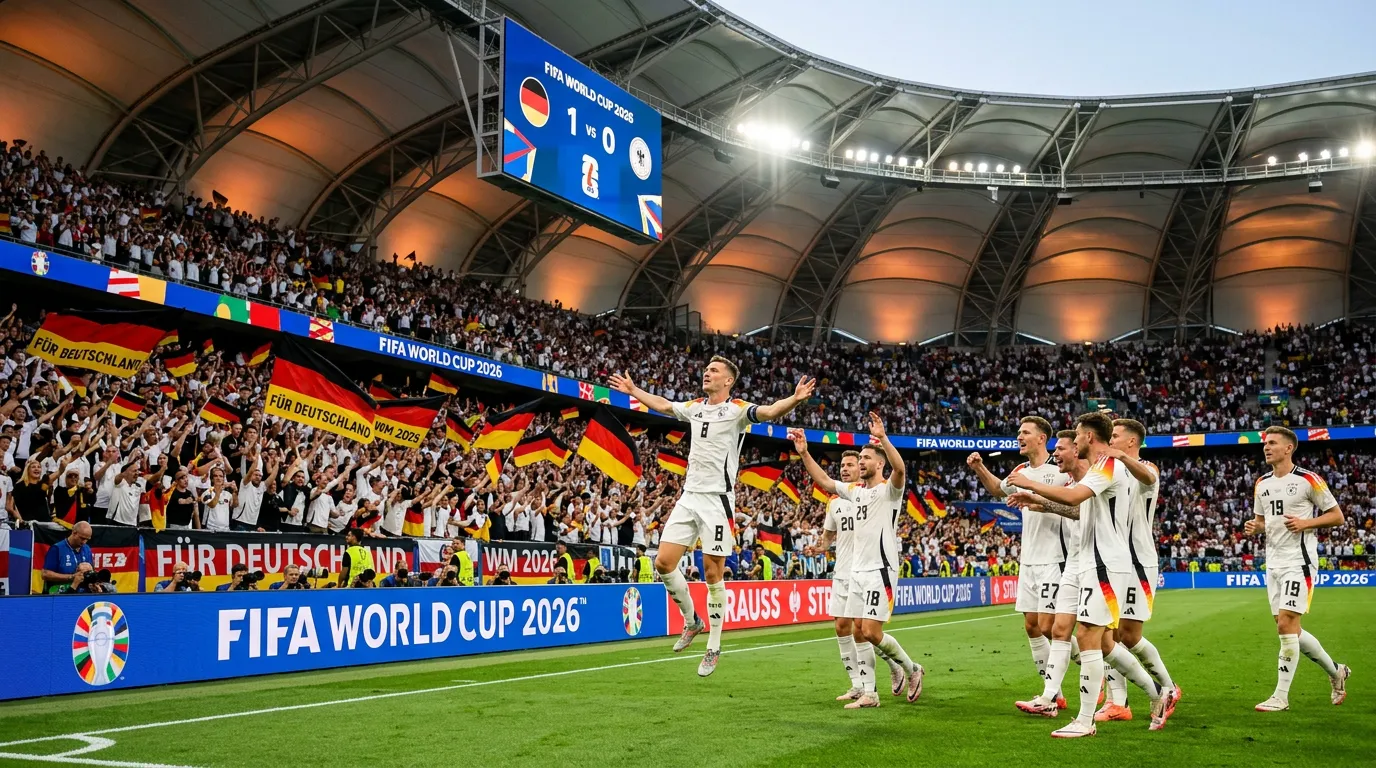
Back-to-back group stage exits. For Brazil or Argentina, that record would provoke a national crisis. For Germany — four-time World Cup champions, the most consistently competitive European side in tournament history — it has provoked something closer to an identity reckoning. The 2018 debacle in Russia, where Germany finished last in their group behind South Korea, Mexico, and Sweden, was supposed to be an aberration. Then 2022 happened: another group-stage exit, this time in Qatar, despite beating Spain 1-1 and pushing Costa Rica before mathematical elimination became unavoidable. Two consecutive failures at the biggest stage in football forced German football to ask uncomfortable questions about its development pipeline, its tactical philosophy, and whether the Nationalmannschaft could still compete with the sport’s elite. The germany world cup 2026 campaign is, in the most literal sense, a redemption bid.
What makes this redemption narrative compelling rather than hollow is the talent that has emerged since Qatar. Jamal Musiala and Florian Wirtz — two players who were teenagers during the 2022 World Cup — have become the most exciting attacking duo in European football. Musiala’s dribbling and Wirtz’s vision have transformed Germany’s attacking identity from the functional efficiency of the Joachim Low era into something more dynamic, more unpredictable, and more dangerous. The question is whether the talent around them — particularly in defence and goalkeeping — is strong enough to support a deep tournament run. Group E, featuring Curaçao, Ivory Coast, and Ecuador, gives Germany the easiest draw of any major seed, which provides a runway to build confidence before the knockout rounds test whether the redemption is real.
How Germany Qualified
Germany topped their UEFA qualifying group without losing a match — seven wins and three draws across ten fixtures, with 22 goals scored and eight conceded. The results were solid, but the underlying performance data told a more nuanced story. Germany dominated possession in every match (averaging 64% across the campaign) but struggled to convert that dominance into convincing victories. Five of their seven wins were by a single goal, suggesting that while Germany controlled matches, they lacked the clinical finishing that separates good teams from great ones. The introduction of Musiala and Wirtz as the primary creative forces improved the attacking output in the second half of qualifying, and their partnership — which I believe is the most exciting international attack partnership since Messi and Di Maria — generated 11 of Germany’s 22 qualifying goals through direct contributions.
The coaching situation stabilized during qualifying in ways that benefited the squad’s cohesion. After the turbulence of the post-Low transition, the current setup emphasizes a 4-2-3-1 formation that positions Musiala behind the striker and Wirtz on the right side of a narrow attacking band. The double pivot — typically Ilkay Gündoğan (in his final tournament at 35) and Joshua Kimmich — provides the defensive screening that allows the attacking players freedom. The system is not revolutionary, but it is functional, and functionality has been Germany’s primary deficit at recent World Cups. When the system works, Germany look like potential champions. When it breaks down — usually through counter-attacks that exploit the space behind Musiala and Wirtz, who do not always track back — the defensive fragility that plagued the 2018 and 2022 campaigns reappears.
The qualifying campaign also featured an important psychological development: Germany learned to win ugly. The 1-0 victories over Turkey, Scotland, and Hungary — all achieved through second-half goals after frustrating first halves — demonstrated a resilience that the 2018 and 2022 squads conspicuously lacked. At World Cups, the ability to grind out results when the football is not flowing is as important as the ability to play brilliantly, and Germany’s qualifying campaign suggests they have developed that quality. Whether it holds under the amplified pressure of a World Cup knockout match remains to be seen.
Key Players — Musiala, Wirtz & Germany’s Young Core
I watched Musiala play in person for the first time during Bayern Munich’s Champions League quarterfinal in 2025, and the thing that struck me was not the dribbling — everyone knows he can dribble — but the calmness under physical pressure. Defenders were fouling him, grabbing his shirt, stepping on his feet, and Musiala simply absorbed the contact and kept going. At 23, he has the technical ceiling of a generational talent and the physical durability to withstand the punishment that tournament football delivers. His best attribute for the World Cup specifically is his ability to operate in tight spaces — the kind of congested central areas that knockout matches produce when both teams are defensively cautious. Where other players need room to work, Musiala creates his own.
Wirtz is the creative complement. His first two seasons at Bayer Leverkusen were extraordinary — a Bundesliga title in 2024 followed by another title challenge in 2025, with Wirtz contributing over 30 goal involvements across both seasons. His passing range, from short combinations to defence-splitting through-balls, gives Germany a creative dimension they have not possessed since Mesut Özil’s peak. Wirtz’s set-piece delivery — corners and free kicks from both sides — adds a practical value that supplements his creative artistry. At 23, he enters the World Cup alongside Musiala as the face of Germany’s future, and their partnership in the number ten and right-inside-forward positions is the tactical relationship around which the entire German attack is constructed.
Kimmich provides the leadership and tactical intelligence that any World Cup campaign requires. His versatility — capable of playing right-back, central midfield, or defensive midfield — gives the coaching staff options that few other players in the squad can provide. At 31, this is likely Kimmich’s peak World Cup, and his 80-plus caps provide the kind of international experience that Germany’s younger players need beside them. Kai Havertz, now at Arsenal, offers a different attacking profile as the central striker — his movement and link-up play are better than his goalscoring numbers suggest, and he has a knack for scoring in big matches that defies the statistical models I typically rely on.
The defensive unit is where Germany’s rebuild has been most uncertain. Antonio Rudiger at Real Madrid provides a world-class centre-back option, but the partnership alongside him has rotated between Jonathan Tah, Nico Schlotterbeck, and younger options without settling on a definitive pairing. The full-back positions are similarly fluid, with Kimmich’s positional flexibility complicating the selection picture. In goal, Marc-Andre ter Stegen’s Barcelona career has provided world-class shot-stopping, and his distribution with his feet is among the best of any goalkeeper at the tournament. If Germany’s defensive structure holds — particularly in the transition moments when their attacking commitment creates counter-attacking opportunities for opponents — the squad is capable of matching any team in the field.
Leroy Sane adds a dimension of raw pace and directness that Germany can deploy from the bench or in specific tactical matchups. His inconsistency at Bayern Munich has frustrated club supporters, but his international record — particularly in the 2024 European Championship where he delivered decisive performances against Denmark and Spain — shows that tournament football can bring out his best qualities. The ability to introduce Sane as a substitute in the second half, when defenders are tiring and spaces between the lines widen, gives Germany a tactical option that most teams lack. Similarly, the emergence of Youssoufa Moukoko as a striker option behind Havertz provides depth in the number nine position that Germany desperately needed after the retirements of Thomas Müller and the aging out of Timo Werner. This squad has the attacking weapons to overwhelm opponents when everything clicks — the uncertainty lies entirely in whether the defensive foundation can support those weapons through seven matches against increasingly difficult opposition.
Group E — Curaçao, Ivory Coast & Ecuador
Germany received the kindest draw of any top-seeded team, and it is not particularly close. Curaçao, the smallest nation by population ever to qualify for a World Cup, are making their tournament debut and sit roughly 70 places below Germany in the FIFA rankings. Ivory Coast, runners-up at the 2024 Africa Cup of Nations, are the strongest opponent but lack the squad depth to sustain competitiveness across three group matches against this level of opposition. Ecuador, who performed admirably at the 2022 World Cup before bowing out in the group stage, bring South American grit and qualifying experience but have declined since their 2022 peak with several key players aging out of the squad.
The danger of an easy group is complacency. Germany’s 2018 implosion happened in a group (Mexico, Sweden, South Korea) that they were expected to navigate comfortably, and the assumption of superiority contributed to the lackadaisical approach that produced defeats in two of three matches. The coaching staff will be acutely aware of this precedent, and the opening match against Curaçao — where Germany are expected to win by three or four goals — sets the tone for the group stage. A dominant, clinical performance on matchday one builds momentum; a scrappy 1-0 or 2-1 win creates doubt.
Ivory Coast represent the strongest test, with Nicolas Pepe, Franck Kessie, and Sebastien Haller providing enough attacking quality to punish any defensive lapses. The Ivory Coast’s tactical approach under their current coaching setup is aggressive and direct, relying on pace through the wide areas and physicality through the central channels. Germany’s defensive transition — the speed at which they reorganize after losing the ball in the attacking third — will be tested, and this match serves as the group-stage dress rehearsal for the knockout-round challenges that follow.
Ecuador’s European-based contingent — including Brighton’s Moises Caicedo and Bayern Leverkusen’s Piero Hincapié — ensures they will not be overwhelmed technically, but their squad depth drops off sharply after the first eleven. Germany should secure qualification with a match to spare, allowing rotation in the final group game and fresh legs heading into the Round of 32. The real tournament for Germany begins in the knockout rounds, where the opposition quality increases dramatically and the margin for defensive error disappears.
Germany’s Betting Odds
Germany are priced at approximately 11.00 to win the 2026 World Cup outright, placing them in the second tier of favourites behind Spain, France, Argentina, England, and Brazil. That implies roughly a 9% probability, which I consider fair given the squad’s talent ceiling but defensive uncertainties. The easy group draw helps: Germany to win Group E at 1.25 is the shortest-priced group winner in the tournament and reflects the massive quality gap between Germany and their opponents. To advance from the group is priced at 1.05 — essentially a certainty.
The value at 11.00 outright depends entirely on whether you believe the defensive issues have been resolved. Germany’s attacking quality is World Cup-winning level — Musiala and Wirtz can match any attacking duo in the field, and the supporting cast of Havertz, Sane, and Gündoğan provides options that most teams would envy. But World Cups are won by teams that defend well under pressure, and Germany’s record of conceding in high-stakes matches (five goals against Japan and Costa Rica across two matches in 2022) remains a legitimate concern. I am pricing Germany at closer to 8% probability than the 9% the market implies, which means the 11.00 is marginally generous but not a screaming value play.
The match-specific market I find most interesting is Germany total group-stage goals over 7.5 at approximately 2.00. Against Curaçao, Ivory Coast, and Ecuador, Germany’s attacking firepower should produce at least eight goals across three matches — potentially three or four against Curaçao alone. Musiala’s individual scoring market for the tournament at around 12.00 represents a value play if Germany advance to the quarterfinals, where his involvement in the final third should produce at least two or three goals across five-plus matches. Wirtz to register more than 1.5 assists in the tournament at approximately 2.50 is another angle I find attractive — his creative output in Bundesliga matches suggests he will manufacture at least two clear goal-scoring opportunities for teammates in every match Germany play, and converting those into official assists over five or six matches is a high-probability outcome.
For Canadian bettors specifically, the Germany angle worth watching is the Ivory Coast match. This fixture pits German tactical organization against African athleticism and flair in a match that historically produces entertaining, open football. The over 2.5 goals market at around 1.65 for this specific match offers decent value, and both teams to score at approximately 1.90 reflects the realistic scenario where Ivory Coast find a goal through pace or set pieces even as Germany control the majority of the match.
The Redemption Factor — Can Germany Bounce Back?
German football has a historical pattern of responding to tournament failures with immediate improvement. After the 2004 European Championship — an early exit that prompted widespread criticism — Germany reached the 2006 World Cup semifinals on home soil. After the 2000 European Championship — their worst major tournament result at that point — Germany rebuilt and reached the 2002 World Cup final. The question is whether the 2018-2022 double failure follows this pattern or represents a deeper structural decline.
The evidence suggests recovery. The Bundesliga remains one of Europe’s top three leagues, producing world-class talents at a rate that few countries can match. The youth development system — the same system that produced the 2014 World Cup-winning squad — continues to generate players like Musiala, Wirtz, and their contemporaries. The coaching infrastructure at club level, with tactical innovators like Julian Nagelsmann, Xabi Alonso, and Vincent Kompany working in German football, ensures that the national team’s players are exposed to cutting-edge tactical ideas every week.
What Germany lack — and what may prevent a true redemption arc in 2026 — is the defensive stability that characterized their greatest World Cup squads. The 2014 team had Jerome Boateng, Mats Hummels, and Philipp Lahm forming one of the most organized defensive units in World Cup history. The current back line, while individually talented, has not been tested as a collective in high-pressure tournament situations. If the defence holds, Germany’s attacking quality makes them genuine contenders. If it does not, the redemption narrative becomes another chapter in a story of unfulfilled potential that has defined German football since the Russia debacle.
The Euro 2024 home tournament provides the most relevant data point. Germany’s performances as hosts — reaching the quarterfinals before a narrow loss to Spain in extra time — demonstrated that the squad could perform under the pressure of a major tournament with home expectations. The defensive record across five matches was improved, conceding just four goals, and the attacking output with Musiala and Wirtz was consistently threatening. That tournament, more than the qualifying campaign, offers the template for what Germany can achieve in 2026 if the balance between attacking ambition and defensive discipline is maintained. The difference, of course, is that Euro 2024 was a home tournament with all the atmospheric advantages that provides. In North America, Germany will be away from home in every meaningful sense, and the extra comfort that domestic support provides — the boost in confidence during difficult moments, the crowd’s energy when fatigue sets in — will be absent. Germany’s ability to perform without that safety net is the final unanswered question before the tournament begins.
How Far Does Germany Go?
Germany cruise through Group E with nine points and a goal difference north of plus-eight, with Musiala scoring at least twice and Wirtz providing three assists. The Round of 32 produces a comfortable win against a third-place qualifier from a tougher group. The quarterfinal is where the tournament crystallizes — likely against a genuine contender from Group F (Netherlands or Japan) or Group G (Belgium). I see Germany reaching the quarterfinals with relative ease and facing their first true test there.
My prediction is a quarterfinal exit, decided by the defensive vulnerability that has plagued this generation. The opponent exposes Germany on the counter, scores two goals through transitions that a better-organized defence would prevent, and Germany’s attacking brilliance — a Musiala goal, a Wirtz assist — is not enough to overcome the deficit. It is a respectable result that demonstrates progress from the group-stage exits of 2018 and 2022, but it falls short of the semifinal or beyond that Germany’s attacking talent deserves. The odds comparison table shows where Germany sit in the hierarchy — talented enough to win any single match but lacking the defensive consistency to sustain a seven-match winning run through the world’s best teams. For bettors, Germany to reach the quarterfinals at approximately 1.60 is the safest play on their board, capturing the easy group draw while avoiding the defensive uncertainty that makes deeper predictions unreliable.
