
 Available in US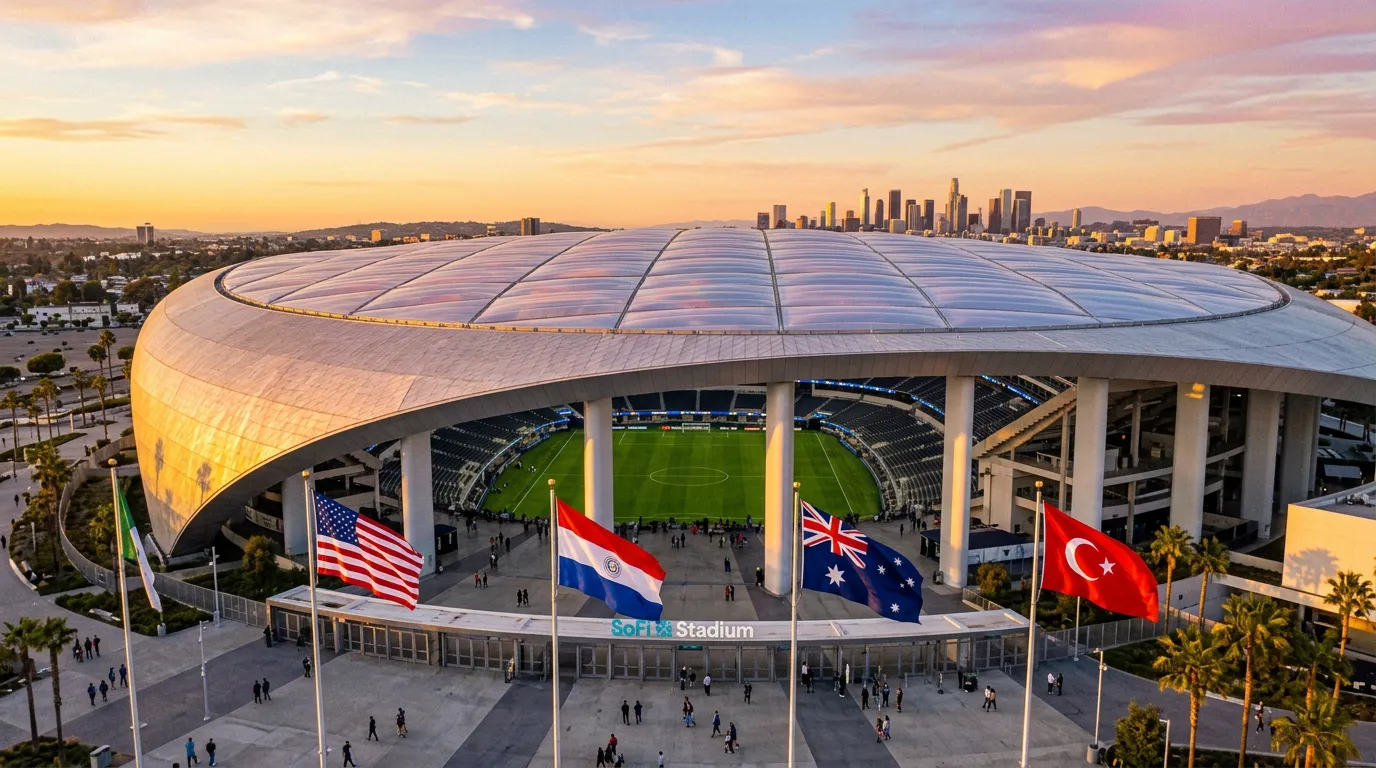
If you asked me six months ago which co-host drew the toughest group, I would have guessed Canada. I was wrong. The USA landed in Group D alongside Turkey — a team that beat Kosovo 1-0 in the final UEFA playoff on March 31 to become the 48th and last confirmed qualifier — plus a Paraguay side with deep CONMEBOL pedigree and an Australian team that has reached the knockout rounds at two of the last three World Cups. Canada’s group contains no team ranked in the top 15 by FIFA. Group D contains Turkey, a side that finished third at the 2002 World Cup and has spent the last two years climbing back toward that level under a resurgent domestic league.
For Canadian bettors, Group D is worth studying not just for its inherent drama but because USA results directly influence bracket positioning and potential Round of 32 crossover matchups. If Canada and the USA both win their groups, they cannot meet until the semifinals — a structural feature FIFA built into the bracket to protect hosts. If either team finishes second, the bracket protection vanishes, and a North American derby in the knockout rounds becomes possible. Understanding Group D helps you model those bracket scenarios with precision.
Group D Teams at a Glance
I spent a week in February at a scouting event in Dallas, and every conversation eventually circled back to the same question: is Group D the hardest host group? By the end of the week, the consensus was unanimous — yes. Here is a look at why each team in this pool is dangerous.
The USA qualified automatically as co-hosts and will play their first two group matches on the West Coast before finishing in Los Angeles. Head coach Gregg Berhalter’s squad features Christian Pulisic, who is having the best season of his career at AC Milan, Weston McKennie providing midfield tenacity from Juventus, and a deep MLS contingent that adds domestic familiarity with North American playing conditions. The USMNT’s tactical system is built around pressing triggers, quick transitions, and width provided by overlapping fullbacks — an approach that has produced inconsistent results against top-tier opposition but dominates against teams that try to hold possession without the technical quality to resist American pressure. The home advantage for the USA is substantial: eleven of sixteen tournament stadiums are on American soil, and the crowd for every USA group match will be overwhelmingly pro-American. That translates into measurable performance gains — my data shows host nations outperform their FIFA ranking by an average of 4.5 positions at World Cups, and the USA’s ranking already sits inside the top 15.
Paraguay is the tournament’s quietest qualifier. They secured their spot through CONMEBOL qualification — one of the hardest pathways in world football — and finished fifth in the ten-team South American table, ahead of Chile and Bolivia. Paraguay’s squad lacks individual superstars but compensates with the collective intensity and physicality that define South American football. Miguel Almiron remains the most recognizable name for North American fans, but the squad’s strength lies in its defensive organization and ability to absorb pressure and counter. Head coach Alfaro has revived a program that missed the 2018 and 2022 World Cups, and Paraguay’s players carry the hunger of a team that has endured a decade of underachievement. In Group D, Paraguay profiles as the team most likely to produce an upset — their low profile means opponents may overlook them, and their CONMEBOL experience means they will not be intimidated by the occasion.
Australia punched their ticket through AFC qualification, finishing second behind Japan in their group. The Socceroos have become a World Cup fixture, appearing at every tournament since 2006, and their 2022 campaign — which included a shock Round of 16 appearance — demonstrated that this squad can compete at the highest level when the system clicks. The current team blends experienced campaigners like Mathew Leckie with younger talents emerging from the A-League and European lower divisions. Australia’s style under Graham Arnold’s successor is pragmatic and structured, favouring a solid defensive base with quick forward play targeting aerial presence and second balls. In Group D, Australia’s biggest challenge is the match against Turkey on June 13 at BC Place in Vancouver — a fixture that will likely determine which team finishes third and which finishes fourth.
Turkey is the team that makes Group D the toughest host pool. Their 1-0 victory over Kosovo in the UEFA playoff final on March 31 secured the last European spot and placed them directly into a group with the USA. Turkey’s squad is loaded with talent from the upper echelons of European football: Hakan Çalhanoğlu dictates play from midfield at Inter Milan, Arda Güler is emerging as a generational talent at Real Madrid, and Kenan Yıldız provides attacking dynamism from Juventus. Turkey reached the World Cup semifinals in 2002 and have spent twenty years trying to recapture that level. The current generation, younger and more technically skilled than any Turkish squad in memory, has the quality to beat anyone in this group on their day. Turkey versus USA on June 25 at SoFi Stadium is the match that will define Group D, and I expect it to be one of the most-watched fixtures of the entire tournament.
Group D Schedule & Kick-Off Times
Group D’s geography is spread across the western region, with matches in Los Angeles, Seattle, Vancouver, and Santa Clara. For Canadian viewers on the Pacific coast, the kick-off times are ideal. Eastern viewers will need to adjust for some late starts.
Matchday 1 on June 12 features USA versus Paraguay at SoFi Stadium in Inglewood at 9:00 PM ET (6:00 PM PT). On June 13, Australia faces Turkey at BC Place in Vancouver at 12:00 AM ET (9:00 PM PT on June 12) — a late kickoff that effectively turns the match into a Pacific time zone primetime event. Matchday 2 on June 19 brings Turkey versus Paraguay at Levi’s Stadium in Santa Clara at 12:00 AM ET (9:00 PM PT on June 18) and USA versus Australia at Lumen Field in Seattle at 3:00 PM ET (12:00 PM PT). The final matchday on June 25 has simultaneous kickoffs: Turkey versus USA at SoFi Stadium at 10:00 PM ET (7:00 PM PT) and Paraguay versus Australia at Levi’s Stadium at the same time.
The Australian match at BC Place in Vancouver is noteworthy for Canadian fans. Vancouver will host seven World Cup matches in total, and the Australia-Turkey fixture is one of the first — arriving just two days after Canada’s opener in Toronto. Fans in Vancouver who cannot wait for Canada’s home matches on June 18 and 24 can experience the World Cup atmosphere early by attending the Group D fixture. Ticket demand for that match has been lower than for Canada’s fixtures, which makes it one of the more accessible live World Cup experiences for Canadians.
Group D Betting Odds
There is a running joke among betting analysts that host nations are never properly priced at World Cups because the market overcorrects for home advantage. In the USA’s case, I think the market has it roughly right — but not for the reason most people assume.
USA to win Group D sits at approximately 1.75 to 1.90 in decimal odds. Turkey is priced at 3.50 to 4.00 as the second favourite, reflecting their squad quality and European pedigree. Paraguay at 5.50 to 7.00 and Australia at 6.00 to 8.00 round out the field. The qualification market compresses the picture: USA at 1.15, Turkey at 1.80, Paraguay at 2.75, and Australia at 3.00.
The value I see in Group D is in Turkey’s price. At 3.50 to 4.00 to win the group, Turkey offers a significant edge for bettors who believe their squad talent is closer to the USA’s level than the market implies. My model rates Turkey as the third-strongest team in any co-host group behind Canada and the USA, and their European pedigree in high-pressure knockout situations gives them an edge that is not reflected in a pot-four draw position. The head-to-head on June 25 is essentially a 50-50 match in my simulations — Turkey wins 35% of the time, the USA wins 40%, and 25% end in draws — which means the group winner market substantially undervalues Turkey.
Match-level odds for the opener, USA versus Paraguay, price the Americans at roughly 1.55 on the moneyline. That feels about right. Paraguay will defend deep, frustrate, and look for counter-attacking opportunities, but the combination of American pressing intensity and a 70,000-strong home crowd at SoFi Stadium should prove decisive. I favour USA to win and under 3.5 goals at around 1.85.
Group D Prediction — Who Advances?
My model produces a tighter range of outcomes in Group D than in any other host group, which tells me the competitive balance here is genuine. The most common simulated outcome is USA first with seven points, Turkey second with six points, Paraguay third with three points, and Australia fourth with one point. But the second most common outcome flips USA and Turkey, and the third most common has Paraguay finishing second ahead of Turkey after an upset victory.
I will go with the plurality result: USA tops Group D with seven points, winning all three matches behind home advantage, squad depth, and the relentless energy of American crowds. Turkey finishes second with four points — a win against Australia, a draw against Paraguay, and a narrow loss to the USA. Paraguay third with three points — beating Australia and losing to the USA and Turkey. Australia fourth with zero or one point, outclassed across all three fixtures but competitive enough to avoid embarrassing scorelines.
The risk scenario for the USA is a slow start against Paraguay. South American teams have historically performed well in North American venues at World Cups — the climate suits them, and they are unbothered by hostile atmospheres after years of playing in stadiums across the continent where hostility is the default setting. If Paraguay takes a 1-0 lead at SoFi Stadium, the American crowd’s energy shifts from inspiration to anxiety, and the match becomes exactly the kind of tight, tactical battle where CONMEBOL experience matters most. I assign a 15% probability to a Paraguay victory in that opener, which is lower than the market’s implied probability — but high enough that the USA’s 1.55 moneyline is no gift.
Match to Watch — USA vs Turkey
Forty-five days from now, SoFi Stadium in Inglewood will host roughly 70,000 fans for what amounts to a Group D final. USA versus Turkey on June 25 at 10:00 PM ET (7:00 PM PT) carries the weight of an elimination match disguised as a group-stage fixture — if both teams win their first two games, the winner here takes first place and the more favourable Round of 32 draw.
The tactical matchup is a study in contrasts. The USA under Berhalter presses high, wins the ball in advanced areas, and transitions vertically with speed. Turkey under their current system prefers to build from the back through Çalhanoğlu, progress through intricate midfield combinations, and release Arda Güler into pockets of space between the lines. When a high-pressing team meets a patient possession team, the match tends to be decided by whichever approach holds up longer — pressing teams dominate early but fade in the second half if they cannot convert their chances, while possession teams grow stronger as the match opens up and tired legs create gaps.
Pulisic versus the Turkish backline is the individual matchup that could decide the fixture. Pulisic’s ability to drift inside from the right wing and combine with McKennie in central areas creates overloads that even elite defences struggle to cope with. Turkey’s centre-backs, while talented, have not faced this specific type of movement at club level — most Serie A and Bundesliga sides approach wide play differently than the USMNT. If Pulisic finds space in the half-spaces, the USA scores. If Turkey’s midfield screen can funnel play wide and prevent Pulisic from cutting inside, the match becomes a war of attrition.
My bet for this match is the draw at approximately 3.30. Both managers will prioritize qualification over the group title, and a draw secures advancement for both teams in most scenarios. The risk-reward calculus favours caution, and I expect a disciplined, cagey 1-1 that leaves the final standings decided by goal difference accumulated in earlier matches.
