
 Available in US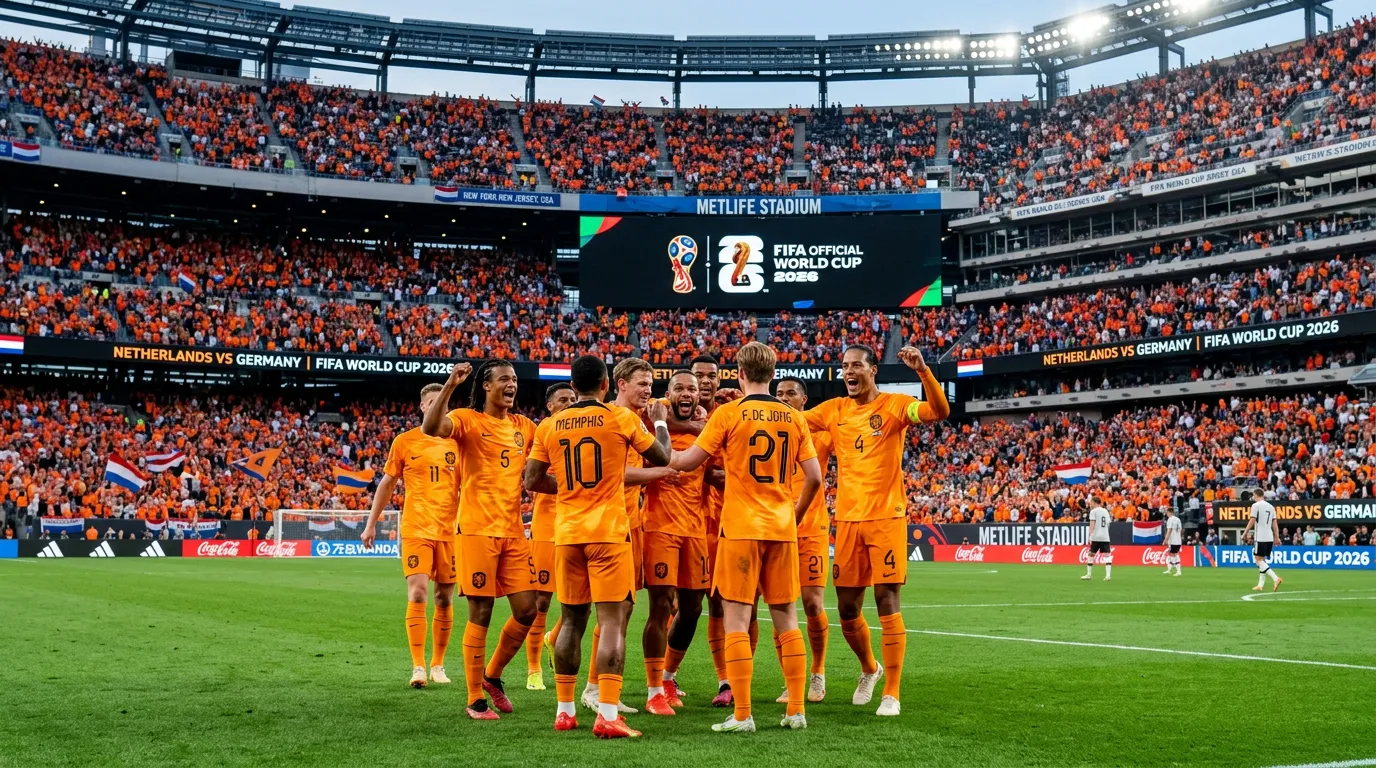
Dutch football has always operated on a fundamental tension: the pursuit of beautiful, attacking football versus the pragmatic reality that tournaments are won by teams who defend well under pressure. The netherlands world cup 2026 campaign arrives at a moment when that tension is more acute than ever. The Oranje possess genuinely world-class players across multiple positions — Virgil van Dijk commanding the defence, Cody Gakpo terrorizing defenders from the left, and Frenkie de Jong orchestrating from midfield — but the coaching setup has oscillated between attacking idealism and defensive pragmatism in ways that have left the squad’s identity somewhat unclear heading into the tournament.
I tracked the Netherlands through their 2024 European Championship run, where they reached the semifinals before losing to England, and the most consistent thread was inconsistency itself. The Oranje produced a brilliant 3-0 win over Romania followed by a sluggish, unconvincing performance against Turkey that they barely scraped through. That pattern — brilliance mixed with mediocrity, sometimes within the same match — defines this Dutch squad and makes them both an exciting and frustrating team to analyze from a betting perspective. Group F, featuring Japan, Sweden, and Tunisia, is competitive enough to demand consistent performances from the opening whistle, and the Netherlands-Japan match is already being labelled one of the group stage’s must-watch fixtures.
How the Netherlands Qualified
The Netherlands topped their UEFA qualifying group with six wins, three draws, and one loss, securing qualification with a match to spare. The campaign was effective rather than spectacular — the Oranje scored 20 goals while conceding nine, producing clean sheets in just four of their ten matches. The defensive record raised concerns that persisted from Euro 2024, where the Netherlands conceded in five of their six matches despite having one of the best centre-backs in world football leading the line. Van Dijk’s positional excellence masks some of the organizational issues that exist around him, particularly in the full-back areas where the Netherlands have struggled to find consistent performers since the golden generation retired.
The most encouraging development during qualifying was Gakpo’s evolution into a complete forward. His 11 goals across the qualifying campaign — making him the Netherlands’ top scorer by a significant margin — demonstrated a clinical finishing ability that supplements his dribbling and creative skills. Playing on the left side of a front three, Gakpo has developed the knack of arriving in the penalty area at precisely the right moment, converting half-chances that other players would not even attempt. His partnership with Memphis Depay through the centre and Donyell Malen on the right gives the Netherlands an attacking trident that can match most opponents in the 2026 field for raw talent, even if the collective defensive work rate of that front three remains a concern when facing high-pressing opposition like Japan.
Key Players — Van Dijk, Gakpo & the Dutch Core
Van Dijk at 34 remains one of the best centre-backs in world football. His aerial dominance — he wins approximately 75% of his aerial duels in Premier League matches — his reading of the game, and his ability to start attacking moves with progressive passes from the back make him the foundation of everything the Netherlands do defensively and in the build-up. This is likely Van Dijk’s last World Cup, and the motivation to deliver a defining tournament performance after the near-miss at Euro 2024 will drive his preparation. The concern is the pace factor: Van Dijk’s recovery speed has declined marginally since his ACL injury in 2020, and against the fastest forwards in the tournament — Mbappé, Vinícius Jr., Yamal — that decline could be exploited in behind the Dutch defensive line.
Frenkie de Jong’s fitness is the second critical variable. His ankle injury history — which cost him significant time at Euro 2024 and has recurred periodically at Barcelona — means that every Netherlands preview must include the caveat “if de Jong is fit.” When healthy, de Jong’s ability to receive the ball under pressure, turn past opponents, and drive forward with progressive carries is unmatched by any other Dutch midfielder. His absence forces the Netherlands to play a more direct, less possession-oriented style that does not suit the squad’s strengths. The coaching staff have developed contingency plans — moving Tijjani Reijnders into a deeper role or using Ryan Gravenberch as the ball-carrying midfielder — but neither alternative replicates de Jong’s unique combination of skills.
Xavi Simons has emerged as the Netherlands’ most exciting young talent, providing creative spark from a number ten position. His season at RB Leipzig produced double-digit goals and assists, and his ability to shoot from distance and deliver incisive through-balls gives the Oranje an attacking dimension that previous Dutch squads lacked between the lines. At 23, Simons enters the World Cup with the confidence and form to deliver match-defining performances. The supporting cast rounds out with Denzel Dumfries providing overlapping runs from right wing-back, Nathan Ake offering defensive versatility across the back line, and Bart Verbruggen establishing himself as a reliable young goalkeeper who has handled the step up from the Eredivisie to the Premier League at Brighton without difficulty.
Group F — Japan, Sweden & Tunisia
Group F is widely considered one of the toughest in the 2026 World Cup, and the Netherlands-Japan match is the fixture that could determine the group winner. Japan are the strongest Asian team in the field — ranked in the top 15 globally, armed with a squad of European-based players, and capable of beating any team on their day, as Germany and Spain discovered at the 2022 World Cup. Sweden, who qualified through the UEFA playoffs by beating Poland, bring Scandinavian physicality and set-piece quality that has historically troubled technically superior teams. Tunisia are the weakest side on paper but have a history of competitive World Cup performances — they beat France in the 2022 group stage — that makes them dangerous underdogs in any single match.
The Japan challenge is particularly significant because the tactical matchup exposes the Netherlands’ primary weakness. Japan play with the kind of high-intensity pressing and rapid transitions that have historically troubled Dutch teams — both Germany and Spain lost to Japan in 2022 when they failed to cope with the pressing intensity. The Netherlands’ preference for building from the back through Van Dijk and de Jong creates opportunities for Japan’s press to force turnovers in dangerous areas, and the speed of Japan’s forwards — Kaoru Mitoma, Takefusa Kubo — through the transition is fast enough to punish those turnovers before the Dutch defence can reorganize. This is a match where the Netherlands’ tactical approach will determine the result: press high and risk leaving space behind, or sit deeper and surrender the initiative to a Japanese team that thrives with the ball.
Sweden bring a different challenge: aerial quality, set-piece dominance, and the physical intensity to compete in every duel. Their playoff qualification demonstrated resilience, and their squad includes Premier League players who will not be intimidated. Tunisia complete the group with the defensive organization and counter-attacking speed that African teams typically bring to World Cup matches. The Netherlands should advance from Group F, but topping the group is far from guaranteed, and a second-place finish behind Japan is a live possibility that would place the Oranje in a more difficult Round of 32 matchup.
Netherlands’ Betting Odds
The Netherlands are priced at approximately 13.00 to win the 2026 World Cup, placing them in the second tier alongside Germany and Portugal. That implies roughly a 7.5% probability, which I consider slightly generous given the defensive concerns and the difficulty of Group F. To win Group F, the odds sit at approximately 1.90 — a price that reflects Japan’s genuine quality and the competitiveness of the group. To advance from the group, the Netherlands are priced at approximately 1.25, reflecting the expectation that even a third-place finish would be sufficient under the expanded format.
The match-specific value I see is Netherlands-Japan under 2.5 goals at approximately 1.70. Both teams prioritize defensive structure in high-stakes matches — Japan’s organized pressing and the Netherlands’ reliance on Van Dijk’s organizational quality suggest a tight, tactically disciplined encounter that could easily end 1-0 or 1-1. The Netherlands to reach the quarterfinals at approximately 1.70 is a reasonable play that captures the group-stage advancement and one knockout-round win without requiring the deep run that their defensive issues make unlikely. Gakpo as anytime tournament scorer at 1.40 is practically a certainty given his scoring rate and his central role in the Dutch attack across five or more matches.
Our Prediction for the Netherlands
The Netherlands advance from Group F in second place behind Japan, with four or five points from three matches. A tight 1-0 win over Tunisia, a draw with Sweden, and a narrow loss or draw against Japan is my base case for the group stage. The Round of 32 produces a victory against a third-place qualifier, and the quarterfinal — likely against a strong European or South American opponent from the bracket’s opposite side — is where the campaign ends. The defensive vulnerability against pace, the inconsistency that has defined this squad for the last three tournaments, and the tactical tension between attacking idealism and defensive pragmatism all converge in a quarterfinal loss that feels familiar to Dutch football fans.
Van Dijk’s farewell tournament ends with dignity but without the trophy, and the post-tournament conversation focuses on the next generation — Simons, Gravenberch, and their contemporaries — who will lead the Netherlands into the 2030 cycle with lessons learned from 2026. For bettors, the Netherlands are a team to approach with caution: their ceiling is the semifinals, their floor is a group-stage exit in one of the tournament’s toughest groups, and the gap between those outcomes is wider than for most teams at their price point. Selective match-specific bets and the quarterfinal advancement market offer better risk-adjusted returns than the outright winner at 13.00.
The Canadian connection to the Netherlands is worth noting for the domestic audience. The Dutch diaspora in Canada — particularly concentrated in Ontario and Alberta — is one of the largest outside of Europe, dating back to post-World War II immigration waves that brought hundreds of thousands of Dutch families to Canadian soil. That historical relationship means Netherlands matches at the 2026 World Cup will attract significant Canadian viewership beyond the neutral interest that the Oranje’s attacking style typically generates. If the Netherlands play a knockout-round match in Toronto or another Canadian venue, the orange-clad supporters in attendance will create an atmosphere that rivals any club match in Amsterdam. For bettors, this diaspora factor does not directly affect on-pitch results, but it adds to the narrative interest that drives public money toward the Netherlands in outright and match-specific markets, which can create value on the other side of those bets when the market overreacts to sentiment rather than substance. The Netherlands remain a team that captures the imagination without always delivering the results, and the 2026 World Cup is unlikely to change that fundamental dynamic.
