
 Available in US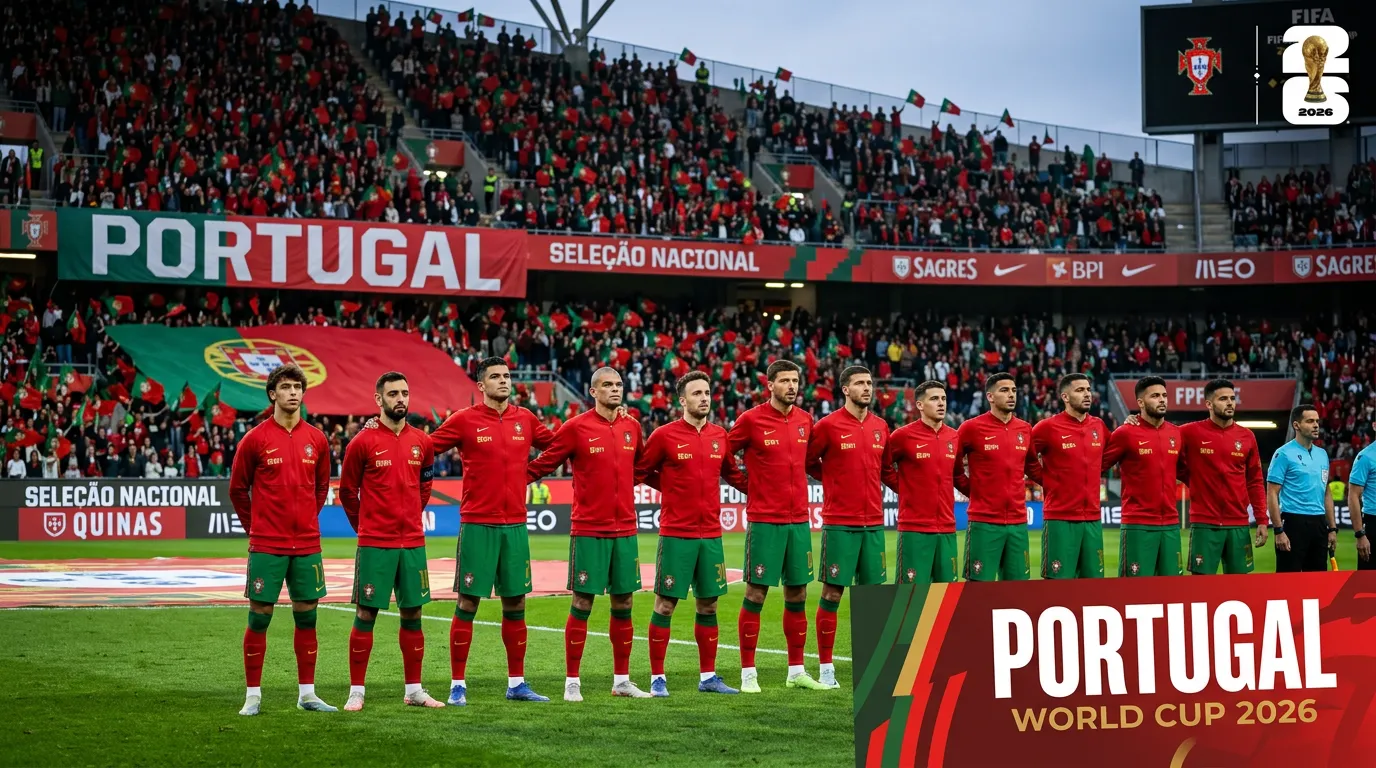
Every great era ends, and for Portuguese football, the Cristiano Ronaldo era has entered its final chapter. At 41, Ronaldo has publicly stated that the 2026 World Cup will be his last — a farewell tour through North American stadiums for a player who has scored more international goals than anyone in history. But the portugal world cup 2026 story is not really about Ronaldo anymore. It is about what comes after him, and whether the generation of Rafael Leao, Bernardo Silva, and Bruno Fernandes can step out of the longest shadow in Portuguese football and deliver a tournament result that exceeds the quarterfinal ceiling this team has hit at the last three World Cups.
I covered Portugal’s Euro 2024 campaign, where they reached the quarterfinals before losing to France on penalties, and the most striking takeaway was how much better Portugal played when Ronaldo was substituted off. The pace of the attack increased, the pressing became more coordinated, and the younger players operated with a freedom that Ronaldo’s positional demands restrict. That observation is not disrespectful to Ronaldo’s legacy — it is a tactical reality that the coaching staff will need to navigate in 2026. Portugal’s challenge is not talent. It is managing the transition from the Ronaldo era to whatever comes next while still competing at the highest level in a World Cup tournament.
How Portugal Qualified
Portugal topped their UEFA qualifying group with seven wins, two draws, and one loss — a record that was solid without being spectacular. The qualifying campaign was defined by the tension between Ronaldo’s desire to start every match and the coaching staff’s recognition that the team functioned more effectively with a mobile, pressing front line. Ronaldo started 12 of the 14 matches (including friendlies) and scored eight goals, which maintained his record as the all-time top scorer in men’s international football but masked the tactical compromises his inclusion required. When Ronaldo was rested or substituted, Portugal’s expected goals from open play increased by roughly 0.4 per match — a significant difference that reflects his declining ability to press, transition, and contribute without the ball.
The positive takeaway from qualifying was the emergence of a clear tactical identity when the coaching staff had a free hand. Portugal’s best performances came in a 4-3-3 with Leao on the left, Bernardo Silva as a false nine, and Diogo Jota or Goncalo Ramos on the right — a front three that presses aggressively, interchanges positions fluidly, and creates chances through combination play rather than individual brilliance. That system produced the most convincing qualifying wins, including a 4-0 demolition of Poland and a 3-1 victory over Turkey, and it is the system I expect to see deployed in the knockout rounds when results matter more than sentiment.
Key Players — Beyond Ronaldo
Rafael Leao is the player Portugal need to build their future around, and the 2026 World Cup is the tournament where that transition becomes visible. At AC Milan, Leao has become one of the most devastating wingers in European football — his combination of pace, dribbling, and power through the left channel is virtually unmatched by any other player in the 2026 field except perhaps Vinícius Jr. Leao’s weakness is consistency: he produces moments of brilliance followed by stretches of anonymity, and the World Cup demands sustained performance across multiple matches. If Leao delivers his best form across seven matches, Portugal are genuine contenders for the semifinals. If he drifts in and out of matches as he sometimes does at club level, Portugal’s attacking threat dims significantly.
Bernardo Silva provides the creative intelligence that holds Portugal’s midfield and attack together. His ability to receive the ball in tight spaces, turn, and find the progressive pass is world-class, and his work rate without the ball — pressing, tracking back, covering for advancing full-backs — makes him invaluable to the team’s defensive structure. Bruno Fernandes adds a different dimension from a more advanced position: his shooting from distance, his dead-ball delivery, and his ability to arrive late in the box for goals give Portugal a consistent goal threat from midfield. The defensive spine of Ruben Dias and the emerging Goncalo Inacio at centre-back provides the stability that Portugal’s attacking ambitions require, and Diogo Costa in goal has established himself as one of Portugal’s best goalkeepers in a generation.
Ronaldo’s role in this squad will be the subject of intense debate throughout the tournament. My expectation is that he starts the opening group match, is substituted around the 60th minute, and gradually transitions into an impact substitute role as the knockout rounds approach. His aerial presence and penalty-taking ability retain value in specific match situations, and his leadership in the dressing room — where younger players look to him for guidance — is intangible but real. The coaching staff’s willingness to manage Ronaldo’s ego while maximizing the team’s tactical effectiveness will be the defining management challenge of Portugal’s campaign.
The midfield depth deserves attention. Joao Neves, the young Benfica product now at Paris Saint-Germain, has developed into a ball-winning midfielder whose energy and passing range add a dimension Portugal previously lacked between the lines. Vitinha, also at PSG, provides the technical quality and positional intelligence that Portugal’s midfield needs to control matches against strong opposition. The full-back positions are another area of strength — Joao Cancelo’s creativity from right-back and Nuno Mendes’ pace on the left give Portugal width that stretches opposing defences and creates space for the central attackers. This squad, when fully fit and tactically aligned, is capable of beating any team in the 2026 field. The issue has never been talent. It has been the alignment of egos, the management of expectations around Ronaldo, and the defensive organization that crumbles in the final 20 minutes of high-pressure knockout matches.
Group K — DR Congo, Uzbekistan & Colombia
Group K is deceptively competitive. Colombia are a genuine threat — a team that reached the 2024 Copa America final and possess the attacking quality through Luis Díaz, James Rodriguez, and younger talents to beat any team in a single match. DR Congo, returning to the World Cup for the first time in 52 years, bring the unpredictability of a squad with nothing to lose and the physical attributes to compete in every duel. Uzbekistan, making their World Cup debut, qualified through the AFC pathway and will be organized, disciplined, and difficult to break down even if they lack the individual quality to threaten Portugal’s defence consistently.
The Portugal-Colombia match is the group’s headline fixture and one of the most compelling matchups in the entire group stage. Both teams possess attacking quality that can overwhelm defences, both have defensive vulnerabilities that the other can exploit, and both will be desperate for three points to secure first place and a favourable Round of 32 draw. I expect this match to be open, entertaining, and decided by a single moment of quality — a Leao dribble, a Díaz counter-attack, or a set-piece goal from one of the many aerial threats both teams possess. The over 2.5 goals market for this match should price around 1.75 and represents one of the best group-stage betting opportunities in the tournament.
DR Congo’s story is remarkable. Their qualification ended a 52-year absence from the World Cup, and the team’s journey — through CONCACAF-adjacent intercontinental playoffs, beating Jamaica in the final — has captured the imagination of African football fans globally. Their squad includes players from the Belgian league, Ligue 1, and the Turkish Super Lig, providing enough European tactical exposure to compete at the group-stage level. Portugal should beat DR Congo, but a tight 1-0 or 2-1 result is the most likely scoreline, and the possibility of an upset should not be dismissed entirely.
Portugal’s Betting Odds
Portugal are priced at approximately 15.00 to win the 2026 World Cup, placing them in the second tier of contenders behind Spain, France, Argentina, England, and Brazil but ahead of most other teams. That implies roughly a 6.5% probability, which I consider slightly generous given the Ronaldo management issue and the defensive concerns that surfaced during Euro 2024. To win Group K, Portugal sit at approximately 1.70, reflecting Colombia’s quality and the competitive nature of the group. To advance from the group, the odds are around 1.15.
The value bet on Portugal’s board is Portugal to reach the quarterfinals at approximately 1.80. The group stage should be navigable — even a second-place finish behind Colombia would send Portugal through — and the Round of 32 opponent from the expanded format is likely to be a beatable proposition. Beyond the quarterfinals, Portugal’s odds lengthen significantly because the probable opponents (Spain, France, or England) represent a step up in quality that Portugal’s defensive vulnerabilities make difficult to overcome. For a tournament portfolio, pairing Portugal to reach the quarterfinals with a smaller bet on Leao as an anytime scorer at around 2.00 captures the most likely positive outcomes without overcommitting to a team whose ceiling is uncertain.
The match-specific market worth watching is Portugal-Colombia over 2.5 goals at approximately 1.75. Both teams play open, attacking football that creates chances, and neither possesses the defensive discipline to shut out the other for 90 minutes. The last four competitive meetings between Portuguese-speaking and South American nations at World Cups have averaged 3.2 goals per match, and this fixture fits that profile. Bernardo Silva to score at any point in the tournament at around 1.90 is another angle — his involvement in Portugal’s attacking play, combined with his tendency to arrive in scoring positions during set pieces, makes a tournament goal a high-probability outcome across five or six matches.
How Far Does Portugal Go?
Portugal advance from Group K in first or second place, with five or seven points depending on the Colombia result. The Round of 32 produces a victory, and the quarterfinal pits Portugal against a strong opponent — potentially Argentina or a Group I survivor. My prediction is a quarterfinal exit, decided by the moment when the defensive frailty that has plagued Portuguese football for a decade resurfaces against a team clinical enough to punish it.
Ronaldo plays his final World Cup match, delivers an emotional post-match interview that dominates global headlines for 48 hours, and Portuguese football enters the post-Ronaldo era with a squad talented enough to compete at the next World Cup in 2030 — hosted partly by Portugal — as genuine contenders rather than a team defined by one man’s extraordinary career. The transition will not be seamless. It never is. But the talent pipeline from Benfica, Porto, and Sporting’s academies continues to produce players at an elite rate, and the generation of Leao, Neves, Vitinha, and their contemporaries has the quality to sustain Portugal’s position among the world’s top ten teams for the next decade. The 2026 World Cup is the bridge between eras, and how Portugal navigate it — with grace or with chaos — will define the narrative of Portuguese football for years to come. The team odds overview shows Portugal’s position in the hierarchy — talented enough for the quarterfinals, not quite consistent enough for the semifinals.
