
 Available in US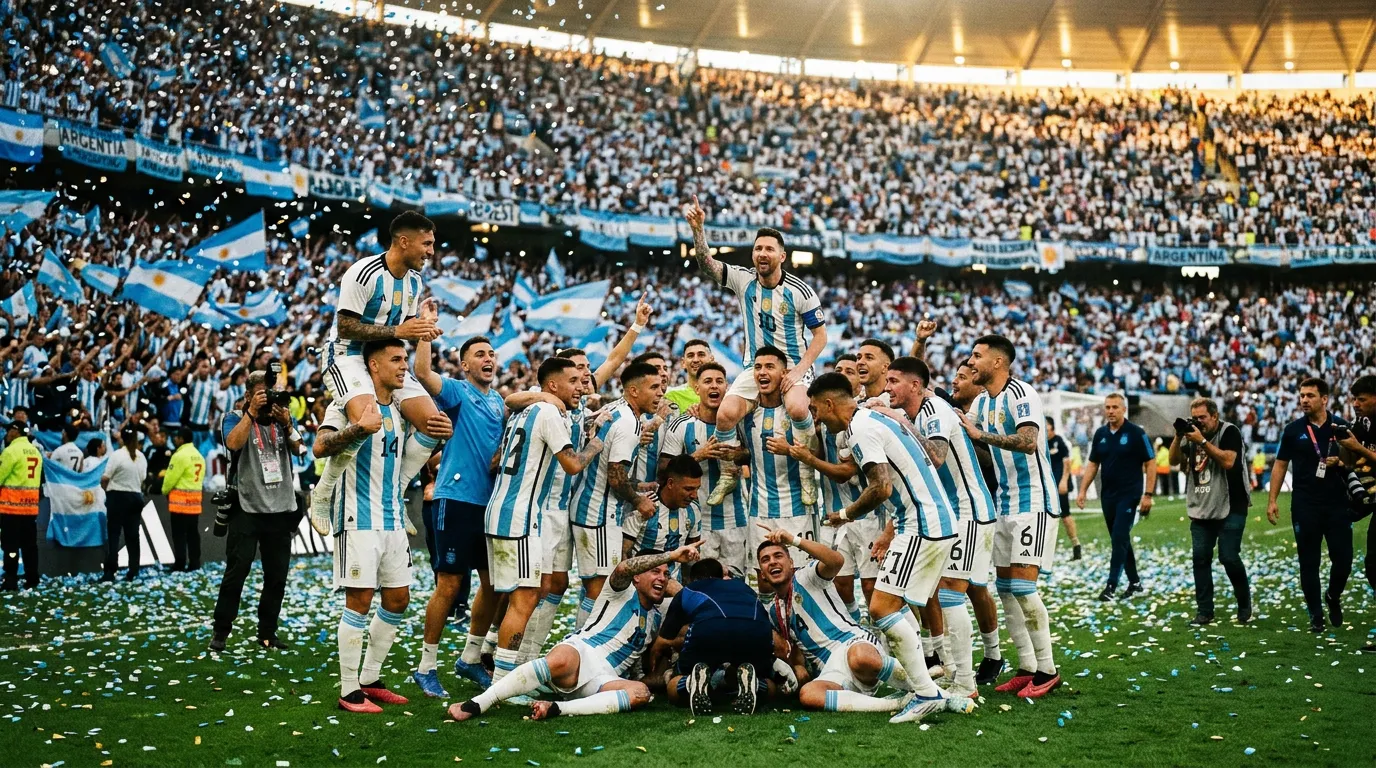
No team has won back-to-back World Cups since Brazil managed it in 1958 and 1962. That statistic alone tells you everything about how difficult it is to defend the trophy — the increased scrutiny, the tactical adjustments opponents make, the psychological burden of being the team everyone wants to beat. Argentina arrive at the 2026 World Cup as defending champions, fresh from that unforgettable December night in Lusail where Lionel Messi finally lifted the trophy that defined his career. But the question hovering over the entire Argentina world cup 2026 campaign is not whether they can compete. It is whether an aging core can summon one more run, and whether the next generation is ready to carry the weight if Messi’s body says no.
I have built models for predicting World Cup outcomes for nearly a decade, and Argentina present the most fascinating puzzle of any team in the 2026 field. The talent is there — Julian Alvarez, Enzo Fernandez, and Alexis Mac Allister have matured into world-class players since Qatar. The coaching, under Lionel Scaloni, has been the most consistent and successful in Argentine football history. But the squad is navigating a generational transition in real time, and transitions at World Cups tend to produce heartbreak rather than glory. The defending champions have been drawn into Group J alongside Algeria, Austria, and Jordan — a group that looks manageable on paper but contains enough tactical variety to expose any weaknesses in Argentina’s preparation.
How Argentina Qualified — CONMEBOL Campaign
There was a stretch during CONMEBOL qualifying when Argentina looked genuinely vulnerable. Five matches into the campaign, they had drawn three and lost one, sitting fourth in the table with Colombia and Uruguay pulling ahead. I tracked those early results closely because they revealed something the 2022 World Cup triumph had masked: this squad’s reliance on a small group of players who were being asked to perform at peak intensity for both club and country across 60-plus matches per season. Fatigue, not talent, was the enemy.
Scaloni responded by rotating more aggressively than any previous Argentina coach. He used 28 different players across 18 qualifiers, blooding younger options like Nico Paz, Alejandro Garnacho, and Thiago Almada in competitive matches rather than waiting for friendlies. The results improved dramatically in the second half of the campaign — six wins from the final eight matches, including convincing victories over Brazil in Buenos Aires and Colombia in Barranquilla. Argentina finished second in the CONMEBOL standings behind Uruguay on goal difference, which mattered less than the tactical flexibility Scaloni had built by the end of the cycle.
The Messi factor during qualifying was managed carefully. He started nine of the 18 matches, was substituted before the 70th minute in six of those, and missed four matches entirely due to what the AFA described as “load management.” The message was clear: everything is being calibrated for the World Cup. Messi’s minutes in the MLS regular season with Inter Miami were similarly controlled, with the club protecting him from the worst of the summer heat and the longer road trips. Whether an athlete turning 39 during the tournament can deliver at the required intensity for up to eight matches is the single biggest variable in Argentina’s campaign — and one that no model can accurately predict.
The defensive record in qualifying was a concern early but stabilized as the campaign progressed. Argentina conceded 14 goals across 18 CONMEBOL qualifiers, which is respectable given the quality of opposition but not elite by world standards. The centre-back pairing of Cristian Romero and Lisandro Martinez, when fit and available together, conceded just three goals in seven starts. The issue was availability — injuries disrupted the partnership in five matches, forcing Scaloni to use backup options that lack the same chemistry and communication. For the World Cup, the health of Romero and Martinez will matter almost as much as the Messi question.
Key Players — Post-Messi Era or One More Dance?
I sat next to an Argentine journalist at the Copa America final in 2024 — Argentina beat Colombia 1-0 in extra time — and asked him when the post-Messi era truly begins. His answer was immediate: “When he decides, not when we decide.” That captured the dynamic perfectly. Messi will be in the 2026 squad. He will start at least some matches. But the Argentina that reaches the latter stages of this tournament will be the Argentina that does not need him for 90 minutes every game.
Julian Alvarez has become the player best positioned to shoulder that responsibility. His goalscoring record since the 2022 World Cup — over 60 goals across all competitions in three club seasons — demonstrates his ability to perform at the highest level, and his 2022 World Cup was arguably more impactful than Messi’s in terms of total contribution across all phases of play. Alvarez presses from the front, links play through the channels, and finishes with the kind of composure that Argentina have rarely produced from a centre-forward since Gabriel Batistuta. At 26, he enters the 2026 World Cup at the peak of his powers and with the tactical intelligence to lead the line whether Messi starts behind him or watches from the bench.
Enzo Fernandez has developed into one of the best midfielders in European football since his breakout at the 2022 World Cup. His range of passing — short combinations to feet, long diagonals over the top, disguised through-balls into the channels — gives Argentina a playmaking option that does not depend on Messi dropping deep. At Chelsea, Fernandez has added defensive intensity to his game, winning tackles and intercepting passes at a rate that ranks him in the top quartile of Premier League central midfielders. He is the player around whom post-Messi Argentina will be built, and the 2026 World Cup is where that transition accelerates.
Alexis Mac Allister provides the balance. At Liverpool, he has become the kind of midfielder who does everything well without doing anything spectacularly — the glue player who connects the defence to the attack with efficient passing and intelligent movement. Defensively, Mac Allister covers more ground than any other Argentine outfield player, averaging over 11 kilometres per match in competitive fixtures. His partnership with Fernandez in the double pivot gives Argentina a midfield pairing that can compete physically with European opposition while maintaining the technical standard that South American football demands.
The defensive core remains experienced. Cristian Romero of Tottenham has established himself as the first-choice centre-back, pairing aggression with positional intelligence in a way that suits Scaloni’s moderately high defensive line. Lisandro Martinez offers versatility at left centre-back or left-back, and his experience in high-pressure Premier League matches translates directly to knockout football at the World Cup. Goalkeeper Emiliano Martinez — the hero of the 2022 penalty shootout against France — brings a psychological edge that cannot be quantified. His ability to distract opposing penalty takers and his shot-stopping form at Aston Villa make Argentina’s goalkeeper position one of their strongest.
Group J — Algeria, Austria & Jordan
Group J has a straightforward hierarchy. Argentina are heavy favourites, Austria are the clear second seed, Algeria possess enough quality to cause problems in a single match, and Jordan — making their World Cup debut — are the outsiders. The draw could have been much worse. Had Argentina landed in a group with two European sides, the group stage would have demanded peak performance from the opening whistle. Instead, Scaloni has the luxury of managing minutes and building form gradually.
Austria are the opponent I am watching most carefully. Ralf Rangnick’s tenure as Austria coach has transformed them from a talented but underachieving squad into one of Europe’s most organized pressing teams. Austria’s high-pressing system — inspired by Rangnick’s foundational work with Red Bull’s football philosophy — creates turnovers in the opponent’s defensive third at a rate that ranks among the top five national teams globally. If Argentina try to play out from the back against Austria’s press, mistakes will happen. The counter to that press is Messi — who draws defenders with his movement and creates space for teammates through positioning alone — but if Messi is rested for this match, Argentina’s build-up could be disrupted.
Algeria bring pace and technical quality through the wide areas, with players from Ligue 1 and the Saudi Pro League forming the spine of their squad. Their qualification through the CAF pathway included a competitive final round, and they have tournament experience from the 2014 World Cup and the 2019 Africa Cup of Nations triumph. Algeria’s primary tactical approach — a deep defensive block with rapid transitions through the flanks — is designed to frustrate superior opponents, and Argentina have historically struggled against teams that refuse to engage in open play. The 2014 World Cup Round of 16 match between these two teams went to extra time before Argentina won 2-1 through a Messi moment of individual brilliance.
Jordan are the wild card. As World Cup debutants, they carry no historical baggage and no tactical template for opponents to study. Their qualification through the AFC pathway was impressive — they reached the 2024 Asian Cup final — and their defensive organization is better than their FIFA ranking suggests. Argentina should handle Jordan comfortably, but the expanded 48-team format means that goal difference could become relevant in determining Round of 32 seedings, so a comprehensive victory matters beyond just collecting three points.
Argentina’s Betting Odds — Still the Favourites?
The defending champions tag carries an interesting market dynamic. Before the draw, Argentina were co-favourites with Spain at around 6.50. After the draw settled and Messi’s fitness became a recurring media topic, their odds drifted to approximately 7.00, implying roughly a 14% probability of winning the tournament. At that price, Argentina sit behind Spain (approximately 6.00) and level with France. I consider 7.00 marginally generous given the age profile of key players and the uncertainty around Messi’s fitness, but not egregiously so — Scaloni’s tactical record and Argentina’s knockout-round experience justify the short odds.
To win Group J, Argentina are priced at 1.35 — very short, reflecting the quality gap between them and Austria. To advance from the group is priced at 1.08, essentially a certainty in the market’s view. The more interesting bets sit in the knockout-round markets. Argentina to reach the quarterfinals prices at approximately 1.50, and to reach the semifinals at around 2.20. Both are reasonable given Argentina’s quality, but neither offers the kind of value that makes me want to commit significant capital.
The player prop market is where I see the sharpest angles. Alvarez to finish as Argentina’s top scorer in the tournament at 2.50 represents excellent value — he will play more minutes than Messi and occupies the central striking role that produces the most scoring opportunities. Messi to score in any group-stage match at approximately 1.80 is a bet I like despite the fitness concerns; even with reduced minutes, Messi’s positioning in and around the penalty area creates chances that most players never see. Fernandez to register an assist in the tournament at around 1.60 is practically a formality given his passing range and set-piece delivery responsibilities.
The value angle I like most is Argentina to win the World Cup at 7.00 paired with Argentina to be eliminated in the quarterfinals at 3.50 — a hedge that covers the most likely negative outcome while retaining the upside of the outright. If Argentina reach the semis, both bets become live, and the risk-reward profile improves dramatically. This kind of portfolio approach suits a tournament where knockout-round variance is high and single-game elimination creates unpredictable outcomes.
Argentina at the World Cup — Three Stars & Counting
There is a photograph from the 1986 World Cup final that I keep coming back to — Maradona lifting the trophy with that half-smile that defined his entire career. Argentina’s World Cup history is inseparable from its greatest players: Maradona in 1986, Kempes in 1978, and Messi in 2022. Three titles, three iconic moments, three players who transcended the sport during the tournament that matters most. The 2026 World Cup offers the possibility of a fourth star on the shirt, and the narrative of Messi bookending his career with two World Cup titles is the kind of story that football writes better than any screenwriter could.
But history also warns against romanticizing. Brazil’s back-to-back wins in 1958-1962 came with a younger Pele — 17 and 21, respectively — not a 39-year-old managing his body through a seven-week tournament. The closest comparison might be Germany’s failed 2018 defence, where an aging squad that had won the previous tournament was eliminated in the group stage after losing to Mexico and South Korea. Argentina are better than that 2018 Germany team — the talent is deeper, the coaching is sharper, and the midfield core of Fernandez, Mac Allister, and Alvarez are all in their mid-twenties. But the cautionary tale applies. Defending champions who arrive with a sense of entitlement rather than hunger tend to exit early.
Argentina’s 2024 Copa America triumph — winning on home soil in the United States, beating Ecuador, Colombia, and Brazil en route to the title — provided evidence that this squad has not become complacent. The celebrations were passionate, the performances were gritty, and the tactical evolution from the 2022 World Cup was clear. Scaloni has not stood still. He has adapted his system to account for the aging of certain players while maximizing the qualities of the newer additions. That adaptability is Argentina’s greatest asset heading into 2026 and the reason I believe they will be competitive deep into the knockout rounds.
The X Factor — Can They Repeat?
Repeating as World Cup champions requires navigating a paradox: you need enough continuity from the winning squad to maintain the winning mentality, but enough new blood to compensate for the physical decline that four years inevitably brings. Scaloni has managed this balance better than most coaches in World Cup history, retaining the tactical framework from 2022 while integrating younger players who bring speed and endurance that the veterans can no longer sustain over 90 minutes.
The X factor is not a single player — it is the collective memory of winning. This Argentina squad knows what it takes to win penalty shootouts (they won two in Qatar), what it feels like to come from behind in a World Cup final (they trailed France twice), and how to close out matches when the pressure is unbearable. That institutional knowledge cannot be taught or replicated; it can only be earned through the experience of having done it before. If the 2026 World Cup comes down to fine margins in the knockout rounds — and it always does — Argentina’s experience gives them an edge that no other team in the field possesses.
The counterargument is equally compelling: the hunger is different when you have already won. Germany in 2018, France in 2022 (they lost the final on penalties), and Spain in 2014 all demonstrate that defending champions frequently underperform because the desperation that drives a first-time winner is replaced by a satisfaction that dulls the competitive edge. Scaloni has spoken publicly about guarding against complacency, and the CONMEBOL qualifying campaign — where Argentina genuinely struggled for stretches — may have provided the adversity needed to keep the squad sharp. Whether that sharpness survives into the knockout rounds is the difference between Argentina lifting the trophy in New Jersey and Argentina packing their bags in the quarterfinals.
Our Prediction for Argentina in 2026
Argentina top Group J with nine points and minimal stress. Alvarez scores three group-stage goals, Messi starts two of the three matches and delivers an assist in each, and the defence concedes once across three games. The Round of 32 produces a professional 2-0 win, and the quarterfinal is the first genuine test — likely against a European side from Group I or Group L that has been hardened by a difficult group stage. I have Argentina reaching the semifinals, where they meet Spain or France in a match that could define the entire tournament.
My gut says the semifinal is where the run ends. The physical demands of eight matches across five weeks will take a toll on an aging squad, and Spain’s pressing intensity or France’s counter-attacking speed will exploit the moments when Argentina’s legs are heavy and the pressing triggers arrive a half-second too late. A semifinal exit — honourable, competitive, and decided by a single moment of quality from the opposition — is my base case. But I have learned never to write off a team coached by Scaloni and captained by the greatest player in history. If Messi produces one more transcendent performance in a knockout match, all the age-related caveats become irrelevant. That is the magic and the madness of the World Cup, and that is why Argentina remain among the handful of teams who can realistically lift the trophy on July 19.
