
 Available in US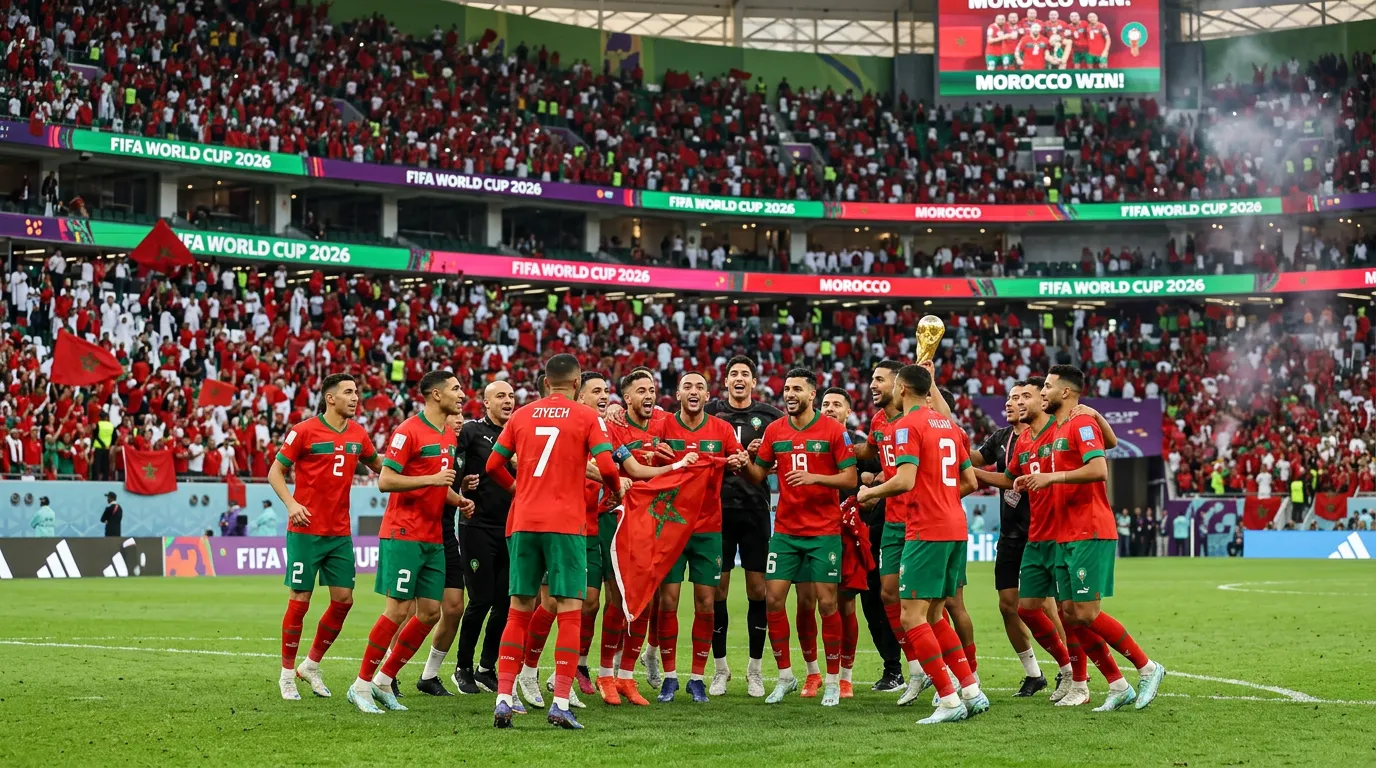
When Morocco beat Portugal 1-0 in the 2022 World Cup quarterfinals, I was watching from a cafe in Montreal’s Parc-Extension neighbourhood. The room — packed with Moroccan-Canadians who had been up since dawn — erupted with a roar that rattled the windows. That scene repeated in living rooms, community centres, and sports bars across Canada, because Morocco’s World Cup run was not just an African football story. It was a Canadian diaspora story. Over 100,000 Canadians trace their heritage to Morocco, concentrated in Montreal and increasingly in Toronto and Ottawa, and the 2022 semifinal run transformed the Atlas Lions from a regional curiosity into a team that Canadian fans follow with genuine passion. The morocco world cup 2026 campaign arrives with the expectation of repeating that magic — or at least proving that 2022 was not a fluke.
The question of whether Morocco can replicate their 2022 run is both simpler and more complex than it appears. The core of the 2022 squad — Achraf Hakimi, Sofiane Amrabat, Hakim Ziyech, Youssef En-Nesyri — remains available, though four years older and in some cases past their peak. The defensive organization under Walid Regragui, which was the tactical foundation of the 2022 run, has been maintained and refined. But the element of surprise — the factor that allowed Morocco to ambush Belgium, Spain, and Portugal — is gone. Every opponent in 2026 will prepare for Morocco as a genuine threat, not an underdog to be underestimated.
How Morocco Qualified — CAF Campaign
Morocco qualified through the CAF third round with a dominant campaign that confirmed their status as Africa’s strongest team. They topped their qualifying group with five wins and one draw across six matches, scoring 14 goals while conceding just two. The defensive record was particularly impressive — two goals conceded in six competitive matches against African opposition that included Egypt, Tanzania, and Ethiopia. Regragui used the qualifying campaign to integrate younger players alongside the 2022 core, building squad depth for a tournament that now requires up to eight matches to reach the final. The tactical approach remained consistent: a compact 4-3-3 that defends in a low block and transitions rapidly through Hakimi’s overlapping runs on the right and the pace of the wide forwards on the counter.
The one concern from qualifying was the attacking output. While 14 goals in six matches is respectable, Morocco’s open-play creativity was inconsistent — five of their qualifying goals came from set pieces, suggesting that the movement and combination play needed to break down organized defences at the World Cup level may be lacking. The coaching staff addressed this by experimenting with a more aggressive pressing approach in friendlies against European opposition, with mixed results. Morocco’s challenge at the 2026 World Cup is balancing the defensive discipline that made them successful in 2022 with enough attacking intent to win matches when opponents refuse to commit forward.
Key Players — Hakimi, Amrabat & Morocco’s Backbone
Hakimi is Morocco’s most complete player and the tactical lynchpin of Regragui’s system. From right wing-back, Hakimi provides defensive solidity, overlapping width, and the pace to transition from defending to attacking in three or four seconds. His delivery from wide areas — crosses to the far post, cutbacks to the edge of the box, diagonal passes across the face of the defence — creates the majority of Morocco’s best scoring opportunities, and his defensive work rate ensures that the right side of Morocco’s defence is rarely exposed. At PSG, Hakimi continues to perform at the highest level, and his Champions League experience adds a composure in big moments that most players in the Morocco squad lack.
Amrabat provides the midfield steel. His ability to win the ball through aggressive tackling, shield the defence with positional intelligence, and distribute accurately under pressure makes him the anchor around whom Morocco’s entire defensive structure is built. His time in European football — including a stint at Manchester United — has added experience against the highest quality opposition. Ziyech, when fit and motivated, adds creative spark from the right side or as a number ten, though his inconsistent club career in recent years raises questions about his ability to sustain form across a tournament. En-Nesyri, the aerial threat up front, provides the focal point for Hakimi’s crosses and the set-piece delivery that produces goals when the open-play attack stalls.
The emerging talent in the squad includes Azzedine Ounahi, whose breakout at the 2022 World Cup — where his midfield performances earned comparisons to Zinedine Zidane — has been followed by solid seasons in La Liga. Ounahi’s ability to carry the ball through midfield, beat opponents with dribbling, and deliver final-third passes gives Morocco a creative dimension beyond set pieces and counter-attacks. Bilal El Khannouss, still just 20, has developed at Leicester City in a way that suggests he could be a significant contributor off the bench when fresh legs are needed in the second half of tight matches.
The 2024 Africa Cup of Nations provided a competitive bridge between the 2022 World Cup and the 2026 tournament. Morocco reached the Round of 16 as hosts before a surprising exit to South Africa, a result that temporarily shook confidence in Regragui’s system but ultimately served as a useful wake-up call. The AFCON elimination exposed a complacency that had crept into the squad after the Qatar euphoria, and Regragui used the experience to reinforce the demanding defensive standards that had made the 2022 run possible. Since that AFCON exit, Morocco have not lost a competitive match, winning eight consecutive qualifiers while conceding just four goals. The defensive recalibration worked.
The generational depth in Moroccan football deserves recognition. Beyond the established stars, players like Azzedine Ounahi (whose performances in the 2022 World Cup earned a move to a top European club), Bilal El Khannouss (a young midfielder with extraordinary technical quality), and Brahim Díaz (whose dual eligibility saga resolved in Morocco’s favour) provide attacking options that the 2022 squad lacked. Morocco’s player pool draws from across Europe’s top leagues — France, Spain, the Netherlands, Belgium, Italy — giving them a diversity of tactical exposure that enriches the squad’s collective football intelligence. When Morocco defend as a unit, every player understands their responsibility because they practice these structures at their respective European clubs every week. That consistency of defensive education across the squad is what made the 2022 miracle possible and what makes the 2026 campaign a genuine threat rather than a nostalgic exercise.
Group C — Brazil, Haiti & Scotland
Group C is both a gift and a challenge. Brazil are the group’s heavy favourites, but Morocco proved in 2022 that they can compete with — and beat — traditional powerhouses when the tactical preparation is right. Haiti are making their World Cup debut and represent the clearest path to three points. Scotland bring Premier League physicality and the kind of direct, aggressive football that can trouble any team for 90 minutes but rarely sustains across a full tournament campaign.
The Brazil-Morocco match is the fixture that defines the group. If Morocco can replicate their 2022 defensive performance — when they conceded just one goal across five matches against Belgium, Canada, Spain, Portugal, and Croatia — a draw or even a victory against Brazil is achievable. The tactical matchup favours Morocco’s counter-attacking approach: Brazil commit numbers forward, leaving space behind their full-backs that Hakimi and the wide forwards can exploit on the transition. The under 2.5 goals market for this match at approximately 1.65 is one of my favourite bets in the entire group stage.
Morocco’s Betting Odds & Dark Horse Value
Morocco are priced at approximately 34.00 to win the 2026 World Cup, reflecting their status as the strongest African team and a dark horse with genuine knockout-round pedigree. To advance from Group C, Morocco sit at approximately 1.40, a price that reflects the expectation of finishing second behind Brazil. The value bet I see is Morocco to reach the quarterfinals at approximately 2.80 — a price that underestimates their defensive quality and tournament experience from 2022, when they reached the semifinals with a squad that is only marginally weaker four years later.
Morocco’s match odds against Haiti and Scotland should produce comfortable victories at short prices, and the Brazil match provides the opportunity for a statement result that would shift their tournament odds dramatically. For Canadian bettors in the Ontario market, Morocco carry an additional appeal through the diaspora connection — matches will be broadcast across Canadian networks with significant Moroccan-Canadian viewership, and the emotional investment of the community adds a layer of interest that extends beyond the purely analytical.
The Canadian Connection — Moroccan Diaspora Factor
Montreal is the epicentre of Moroccan culture in Canada, and the 2022 World Cup demonstrated what that community can generate in terms of atmosphere and support. Thousands of Moroccan-Canadians filled public viewing areas across the city during the quarterfinal and semifinal matches, creating scenes that rivalled the celebrations in Rabat and Casablanca. The 2026 World Cup, played on North American soil, brings those celebrations closer to home — and if Morocco play a knockout-round match in a Canadian or northeastern US venue, the travelling support will be enormous.
The diaspora factor also influences the betting market. Moroccan-Canadians are among the most engaged communities in Ontario’s sports betting ecosystem, and Morocco’s match-specific lines tend to attract public money that shortens the odds beyond what the underlying data suggests. For sharp bettors, this creates opportunities on the other side — fading Morocco in match-result markets where the public money has compressed the price — while still backing Morocco in advancement markets where the value remains genuine. The intersection of community passion and betting market efficiency is one of the most interesting dynamics in Canadian sports betting, and Morocco’s 2026 campaign will amplify that dynamic significantly.
Our Prediction for Morocco
Morocco finish second in Group C behind Brazil, beating Haiti and Scotland while drawing 0-0 or losing 1-0 to Brazil in a tight, tactically disciplined match. The Round of 32 produces a confident victory, and the Round of 16 pits Morocco against a strong opponent from the bracket — potentially England or a Group L survivor. My prediction is a Round of 16 exit, one round short of their 2022 achievement, determined by the slightly reduced quality of the aging core and the loss of the surprise factor that made the 2022 run possible. At 34.00 outright, Morocco are not a bet I am taking, but the quarterfinal market at 2.80 offers genuine value for a team that has proven they belong among the tournament’s top 12. The full team overview shows where Morocco sit relative to the dark horse field — the strongest African representative and a team that no opponent wants to draw in the knockout rounds.
The tactical evolution under Regragui deserves detailed attention. The 2022 World Cup system was primarily reactive — Morocco sat deep, absorbed pressure, and counter-attacked through Hakimi and the wide forwards. In the two years since, Regragui has introduced more proactive elements: higher pressing triggers against weaker opponents, more patient build-up play through the midfield, and a greater willingness to retain possession in the opponent’s half rather than immediately looking for the long ball over the top. This evolution reflects the improving quality of the squad — with more players at top European clubs, Morocco can now sustain possession at higher intensity than the 2022 vintage could manage. The tactical versatility gives Regragui options that most African coaches lack: the ability to switch between a defensive 5-4-1 and an attacking 4-3-3 within the same match, depending on the score and the opponent’s approach. That flexibility is Morocco’s most underrated weapon heading into the 2026 World Cup, and it is the reason I rate them as legitimate quarterfinal contenders rather than a team that benefited from a one-off tournament alignment in 2022.
The set-piece threat is another dimension. Morocco scored four goals from corners and free kicks during the 2022 World Cup — a conversion rate that ranked among the best in the tournament. The height advantage at the back — Aguerd, Saiss’s successors, and the defensive midfielders are all over 185 cm — gives Morocco a genuine aerial weapon that supplements their open-play creativity. Ziyech’s delivery from dead-ball situations is elite when he is motivated and fit, and the coaching staff have developed rehearsed corner routines that exploit the specific defensive tendencies of upcoming opponents. In tournament football, where knockout matches are frequently decided by set pieces, Morocco’s proficiency from dead-ball situations is a competitive advantage that the market consistently underprices.
