
 Available in US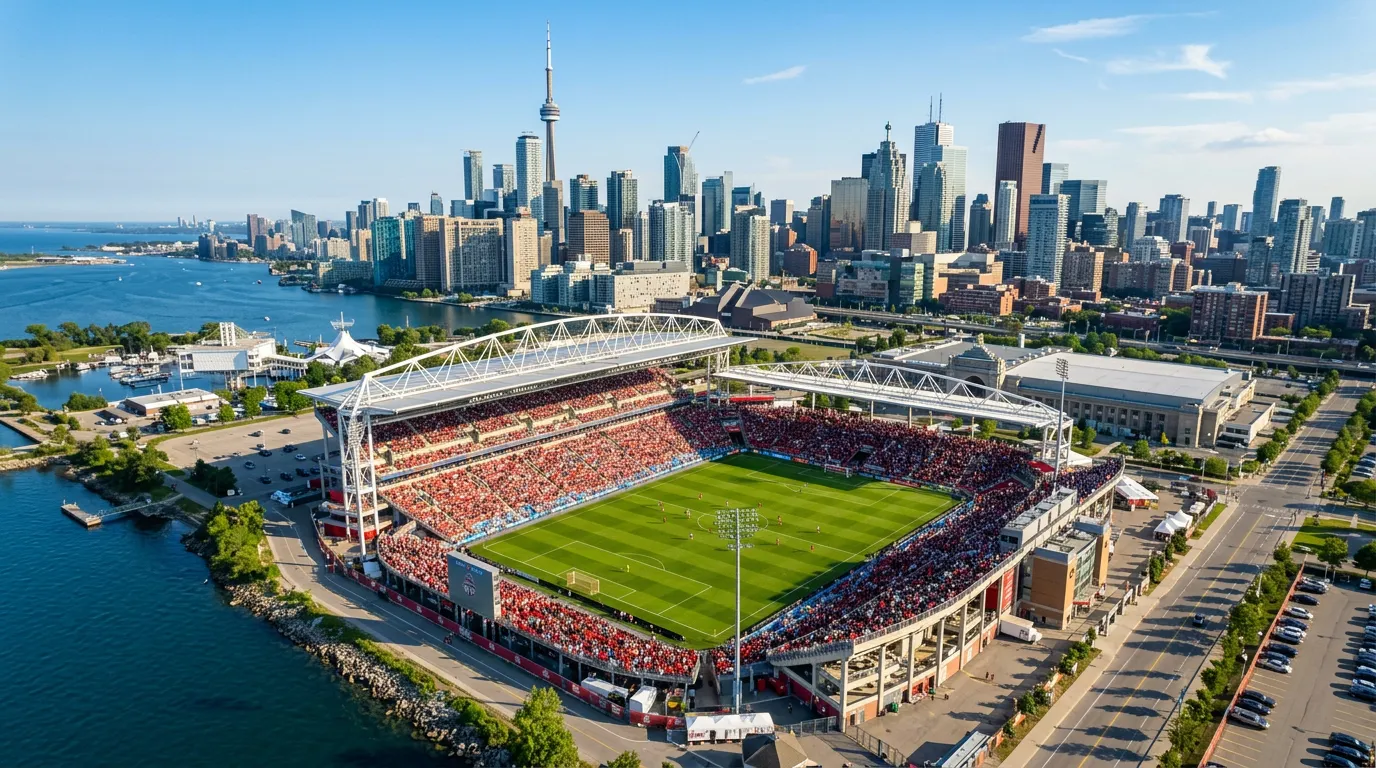
On the afternoon of June 12, 2026, roughly 30,000 fans will pack into BMO Field at Exhibition Place in Toronto to witness something that has never happened before: a World Cup match on Canadian soil. Canada versus Bosnia and Herzegovina at 3:00 PM ET is not just the opening fixture of Group B — it is the opening chapter of a story this country has waited generations to tell. I have been inside BMO Field for Toronto FC matches, Canadian national team qualifiers, and concerts, and I can tell you without hesitation that nothing in the venue’s two-decade history will compare to the atmosphere on that June afternoon.
BMO Field is the smaller of Canada’s two World Cup venues, and that intimacy is its greatest asset. Where BC Place in Vancouver offers scale, BMO Field offers proximity — fans sit close to the pitch, the noise reverberates off the open-air structure, and the players can hear individual voices from the stands. For a World Cup opener with the emotional weight that this match carries, that closeness will turn the stadium into a pressure cooker. Every tackle, every near-miss, every goal will land with physical force in the stands. I have attended World Cup matches at larger venues that felt half-empty and sterile. BMO Field will feel like the loudest place on earth.
About BMO Field — Toronto’s Soccer Home
Three blocks south of the CN Tower and the downtown core, BMO Field occupies a waterfront site at Exhibition Place that has hosted public events since the 1870s. The stadium opened in 2007 as a purpose-built soccer venue for Toronto FC, one of the expansion franchises that helped establish Major League Soccer in Canada. At its opening, BMO Field held approximately 20,000 spectators and was one of the first soccer-specific stadiums in Canada — a deliberate departure from the multi-purpose arenas and CFL stadiums that had previously hosted soccer in the country.
The stadium has undergone multiple expansions since 2007. A 2014-2016 renovation added a south-end canopy roof, premium seating, and a significant capacity increase to its current configuration of approximately 30,000 for soccer events. That capacity is modest by World Cup standards — MetLife Stadium in New Jersey holds nearly three times as many fans — but FIFA selected BMO Field for the tournament based on its location, infrastructure, and symbolic importance as the home of Canadian soccer. Toronto is the country’s largest city, with a metropolitan population exceeding six million, and the stadium’s downtown waterfront location makes it one of the most accessible World Cup venues in the entire tournament.
The playing surface at BMO Field is typically FieldTurf artificial turf, which Toronto FC uses for MLS matches throughout the season. For the World Cup, FIFA requires natural grass, and a temporary grass pitch will be installed over the existing surface — a process that has been tested successfully at other World Cup venues with artificial playing fields. The pitch dimensions will meet FIFA’s World Cup minimum of 105 by 68 metres, and the grass installation will be completed well in advance of the June 12 opener to allow for growth and settling.
One detail that matters for fans planning repeat visits: BMO Field is an open-air stadium with no retractable roof. June weather in Toronto is typically warm and pleasant — average high temperatures around 24 degrees Celsius with moderate humidity — but rain is possible, and there is limited cover for spectators in certain sections. Fans in the lower bowl will be fully exposed to the elements, while upper-level sections benefit from partial canopy coverage.
World Cup 2026 Matches at BMO Field
I was at BMO Field the night Toronto FC won the MLS Cup in 2017, and the energy in the stands was extraordinary. Multiply that by ten and you approach what June 12 will feel like. BMO Field will host six World Cup matches in total, a schedule that spans the group stage and extends into the knockout rounds.
The centrepiece is Canada versus Bosnia and Herzegovina on June 12 at 3:00 PM ET — Canada’s first-ever World Cup match on home soil and the emotional peak of the group stage for Canadian fans. The stadium will also host Ghana versus Panama on June 17 at 7:00 PM ET (Group L, Matchday 1), Germany versus Ivory Coast on June 20 at 4:00 PM ET (Group E, Matchday 2), Panama versus Croatia on June 23 at 7:00 PM ET (Group L, Matchday 2), and Senegal versus Iraq on June 26 at 3:00 PM ET (Group I, Matchday 3). Beyond the group stage, BMO Field hosts a Round of 32 match on July 2 at 7:00 PM ET, featuring the Group K runner-up against the Group L runner-up.
The six-match schedule means BMO Field will be active across three weeks of the tournament, hosting matches roughly every three to four days. For Toronto residents, this creates an extended festival atmosphere in the Exhibition Place neighbourhood, with fan zones, viewing areas, and related events planned around the stadium throughout the group stage. The Round of 32 fixture on July 2 is particularly intriguing — if England or Croatia finishes second in Group L, that knockout match at BMO Field could feature one of the tournament’s biggest names in an elimination match on Canadian soil.
Canada’s World Cup Opener — June 12 vs Bosnia
I remember exactly where I was when Canada qualified for the 2022 World Cup in Qatar — sitting in a bar on King Street West in Toronto, watching the match on three screens simultaneously while the entire room screamed at a television. That feeling of disbelief, of a dream suddenly becoming real, will return on June 12 at BMO Field. Except this time, the match is not on a screen in a bar. It is happening live, in our city, in our stadium.
Canada versus Bosnia and Herzegovina at 3:00 PM ET kicks off Canada’s World Cup campaign and carries enough emotional weight to affect the entire tournament. A victory here sets the tone — confidence flows, the crowd belief builds, and the team carries positive momentum into the second match against Qatar in Vancouver six days later. A draw or a loss creates pressure that compounds with every subsequent fixture. I have watched enough opening matches to know that the first result does not just affect the group standings; it shapes the squad’s psychological state for the remainder of the tournament.
The tactical matchup favours Canada on paper. Jesse Marsch’s high-pressing system thrives in front of a home crowd, where the energy from the stands feeds the pressing intensity and makes defensive errors by the opposition more likely. Bosnia will sit deep in a compact 4-4-2, absorb pressure, and look for set-piece opportunities and quick transitions — the same approach they used to eliminate Italy. The key for Canada is patience. If they force the issue too aggressively in the opening twenty minutes and concede a counter-attacking goal, the match dynamic shifts entirely. If they build methodically, create chances through wing play and combinations between Davies and David, the goals will come.
For fans attending the match, arrive early. BMO Field’s compact footprint means the surrounding streets fill quickly on match days, and the World Cup will bring security screening procedures that add time to the entry process. Gates typically open ninety minutes before kickoff for international matches. The TTC streetcar loop at Exhibition Place will be the primary transit option for most fans, with shuttle services from Union Station also available. Driving and parking at Exhibition Place is possible but limited — the parking lots fill hours before major events, and post-match traffic on Lake Shore Boulevard can take an hour or more to clear.
Fan Guide — Getting to BMO Field
I live in Toronto, and I can tell you from years of attending BMO Field events that transportation planning is the difference between an enjoyable experience and a stressful one. The stadium sits at Exhibition Place on the Toronto waterfront, bounded by Lake Shore Boulevard to the south and the Gardiner Expressway to the north. It is well connected to the downtown core but requires some navigation to reach efficiently.
The fastest route from downtown Toronto is the TTC 509 Harbourfront or 511 Bathurst streetcar, both of which stop at the Exhibition Loop immediately adjacent to the stadium. From Union Station, the streetcar ride takes approximately fifteen minutes. GO Transit also serves Exhibition Station, which is a five-minute walk from the stadium along a dedicated pedestrian path — this is the best option for fans travelling from suburban areas outside the TTC network, including Oakville, Burlington, Hamilton, Mississauga, and Brampton. The UP Express train from Toronto Pearson Airport connects to Union Station, where fans can transfer to the streetcar or walk approximately twenty-five minutes along the waterfront trail to BMO Field.
For fans driving from outside Toronto, the major highways converge on the Gardiner Expressway, which runs directly past Exhibition Place. Take the Lake Shore Boulevard exit and follow signs to Exhibition Place parking. Pre-paid parking passes for World Cup matches are expected to be available through the tournament’s official ticketing platform, and I strongly recommend purchasing in advance — day-of parking availability will be extremely limited. The parking lots at Exhibition Place accommodate several thousand vehicles, but demand for World Cup matches will far exceed supply.
Fans flying into Toronto for the match have two airport options. Toronto Pearson International (YYZ) is the primary international gateway, located approximately 25 kilometres northwest of BMO Field, with travel times of 30 to 50 minutes depending on traffic and transit choice. Billy Bishop Toronto City Airport (YTZ) is located on the Toronto Islands, just two kilometres from BMO Field, and is served by Porter Airlines with flights from Montreal, Ottawa, Halifax, and several US cities. Billy Bishop’s proximity to the stadium makes it the most convenient airport option for Canadian fans arriving from eastern provinces.
Accommodation in downtown Toronto during the World Cup will be in high demand. The hotels along the waterfront — in the Entertainment District, Liberty Village, and CityPlace neighbourhoods — offer the closest access to BMO Field, with walking distances of 15 to 30 minutes. For fans seeking more affordable options, Airbnb rentals in the west end of Toronto (Parkdale, Roncesvalles, High Park) provide good value and are well connected to the stadium via the 504 King streetcar line.
