
 Available in US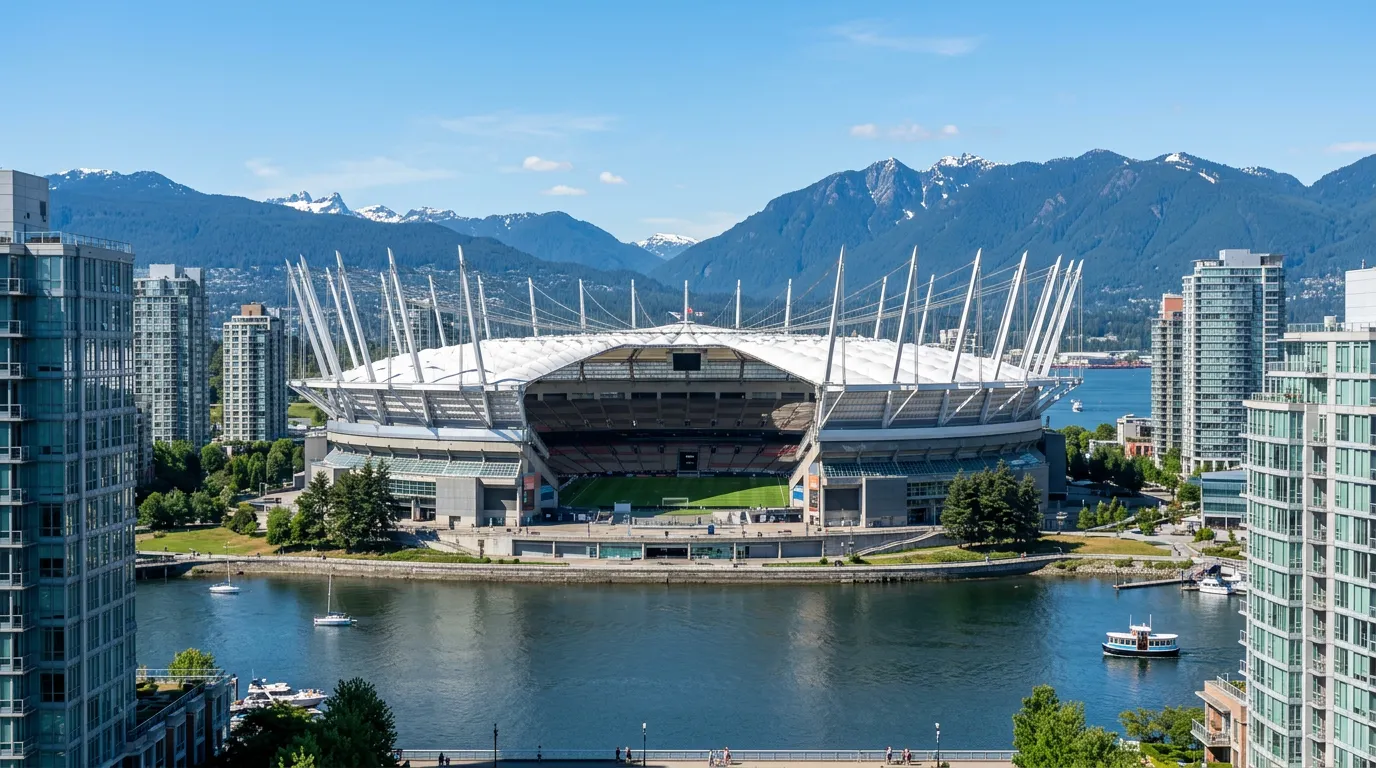
Vancouver is a city that does not need the World Cup to feel international — you hear Mandarin, Punjabi, Tagalog, and French on every block of the downtown core, and the mountains behind the skyline remind you that nature built something more impressive than any stadium long before humans arrived. But when BC Place opens its retractable roof for seven World Cup matches this summer, including two Canada fixtures, this city will transform from a quietly cosmopolitan Pacific outpost into the loudest soccer arena in the Western Hemisphere. I have been covering events at BC Place since 2018, and the building is purpose-built for the kind of atmosphere that makes World Cup football unforgettable.
BC Place is Canada’s busiest World Cup venue, hosting seven matches to BMO Field’s six. More importantly, it hosts two of Canada’s three group-stage fixtures — the June 18 match against Qatar and the June 24 decider against Switzerland. If Canada wins Group B, the Round of 32 match on July 2 also takes place at BC Place, meaning Vancouver could host up to three Canada matches in a three-week span. That concentration of home fixtures gives Canadian fans on the Pacific coast an extraordinary opportunity to attend multiple World Cup matches without leaving their city.
About BC Place — Vancouver’s Retractable Roof Arena
Driving across the Cambie Bridge into downtown Vancouver, BC Place is the first landmark you see — a white, cable-supported dome that sits at the northeastern edge of False Creek, flanked by the Science World geodesic sphere to the east and the towers of Yaletown to the west. The stadium opened in 1983 as an air-supported dome for Expo 86 and has served as the home of the BC Lions of the CFL ever since. In 2011, a $563 million renovation replaced the original inflatable roof with a retractable cable-supported structure, transforming BC Place into a modern, convertible venue capable of hosting events in both open-air and enclosed configurations.
The current capacity for soccer events is approximately 54,500, making BC Place the larger of Canada’s two World Cup venues by a significant margin. The retractable roof is a decisive advantage for tournament organizers — Vancouver’s June weather can be unpredictable, with temperatures ranging from 15 to 25 degrees Celsius and occasional rain, and the ability to close the roof guarantees playable conditions regardless of weather. For fans, the closed-roof configuration amplifies crowd noise dramatically, creating an atmosphere that rivals indoor arenas despite the stadium’s massive footprint.
BC Place’s playing surface is normally BC Lions FieldTurf, an artificial surface used for CFL football and Vancouver Whitecaps FC matches in MLS. Like BMO Field in Toronto, a temporary natural grass pitch will be installed for the World Cup to meet FIFA’s playing surface requirements. The grass installation process has been refined through previous international events at venues with artificial surfaces, and FIFA’s agronomists will oversee the transition to ensure pitch quality meets tournament standards.
The stadium’s downtown location is exceptional by World Cup standards. BC Place sits within walking distance of the city’s main transit hub (Waterfront Station), the cruise ship terminal, the convention centre, and dozens of hotels in the downtown core. The surrounding False Creek and Yaletown neighbourhoods offer restaurants, bars, and public waterfront space that will serve as natural gathering points for fans before and after matches. No other World Cup venue in the 2026 tournament — with the possible exception of MetLife Stadium’s proximity to Manhattan — offers this level of urban integration.
World Cup 2026 Matches at BC Place
Seven matches over three weeks turn BC Place into the heartbeat of Canada’s World Cup experience on the west coast. The schedule spans multiple groups and includes a knockout fixture, giving Vancouver fans exposure to teams from four continents.
The first match at BC Place is Australia versus Turkey on June 13 at 12:00 AM ET (9:00 PM PT on June 12) — a Group D fixture that arrives just hours after Canada’s opener at BMO Field in Toronto. For Vancouver fans who cannot be in Toronto for the Canada match, this late-evening kickoff offers an immediate World Cup experience at their home venue. Canada’s first BC Place match follows on June 18 at 6:00 PM ET (3:00 PM PT) against Qatar in a Group B fixture that should draw a capacity crowd. New Zealand versus Egypt on June 21 at 9:00 PM ET (6:00 PM PT) brings Group G action, and then Canada returns on June 24 at 3:00 PM ET (12:00 PM PT) for the decisive Group B match against Switzerland — a fixture that will likely determine who finishes first in the group.
The group stage closes at BC Place with New Zealand versus Belgium on June 26 at 11:00 PM ET (8:00 PM PT), a Group G finale. Then, if Canada wins Group B, the Round of 32 match on July 2 at 11:00 PM ET (8:00 PM PT) takes place at BC Place — a potential fourth Canada match in Vancouver for fans who attend every fixture. Even if Canada does not top the group, the Round of 32 match will feature the Group B winner against a best third-placed team, guaranteeing meaningful knockout football in Vancouver regardless of which teams advance.
Canada at BC Place — Qatar & Switzerland
Two matches, six days apart, in the same stadium, against two opponents with dramatically different profiles. Canada versus Qatar on June 18 is the match where Canada should consolidate their position in Group B — a victory here, combined with a win in the Toronto opener, would secure qualification with a match to spare. Canada versus Switzerland on June 24 is the match that will determine the group winner and, by extension, the Round of 32 matchup and bracket position for the knockout rounds.
The Qatar fixture carries a 3:00 PM PT kickoff that is perfectly timed for the Pacific coast. I expect BC Place to be at or near capacity, with the retractable roof open if weather permits — the sight of the North Shore mountains framing a World Cup match in the Vancouver sunshine is the kind of visual that sticks with you for a lifetime. Tactically, this is a match Canada should control from start to finish. Qatar’s possession-based style lacks the defensive steel needed to contain Canada’s pace on the wings, and the home crowd will amplify every Canadian attack and stifle every Qatari build-up. My prediction for this match is a comfortable 3-1 Canada victory, with Jonathan David scoring at least once.
The Switzerland match six days later is an entirely different proposition. Switzerland is the one team in Group B with the tactical discipline and tournament experience to match Canada’s quality. Granit Xhaka will look to control the midfield, slow Canada’s transitions, and impose the patient tempo that Switzerland prefers. The atmosphere at BC Place will be intense — 54,500 fans willing Canada to win the group — and that pressure can work both ways. If Canada scores early, the crowd lifts the team to a dominant performance. If Switzerland takes the lead, the same crowd’s anxiety becomes palpable and can affect the players’ decision-making. I expect a tight, tactical match decided by a single goal or settled in a draw that leaves goal difference as the tiebreaker between the two sides.
Getting to BC Place — Transport & Tips
I have a rule for attending events at BC Place: leave the car at home. Vancouver’s downtown road network was not designed for 54,000 people arriving simultaneously, and the combination of bridge access constraints, limited parking, and post-event congestion makes driving the worst option by a wide margin. The good news is that BC Place sits on top of one of the best public transit networks in Canada.
SkyTrain is the primary option. Stadium-Chinatown Station on the Expo and Millennium lines is located directly adjacent to BC Place, with a covered walkway connecting the station concourse to the stadium gates. From Waterfront Station in the downtown core, the SkyTrain ride takes three minutes. From the suburbs — Surrey, Burnaby, New Westminster, Richmond — journey times range from 15 to 35 minutes depending on the line and direction. The Canada Line, which connects Vancouver International Airport (YVR) to downtown, stops at Waterfront Station, making the airport-to-stadium journey approximately 25 minutes door-to-door. That is faster than any other World Cup venue’s airport connection in the entire tournament.
For fans arriving from elsewhere in Canada, Vancouver International Airport (YVR) serves direct flights from Toronto, Montreal, Calgary, Edmonton, and virtually every other major Canadian city. Air Canada and WestJet both operate multiple daily flights on the Toronto-Vancouver route, with flight times of approximately four and a half hours. From the airport, the Canada Line SkyTrain reaches downtown in 25 minutes, with no transfer required. The total journey from YVR baggage claim to BC Place gates is under 40 minutes by transit — a remarkable convenience for fans flying in on match day.
Accommodation near BC Place is plentiful but will be in high demand during the World Cup. The hotels in Yaletown, Coal Harbour, and the West End are within walking distance of the stadium, and the Airbnb market in the Mount Pleasant and Commercial Drive neighbourhoods offers more affordable options with excellent SkyTrain access. Fans planning to attend multiple matches at BC Place should book accommodation early — Vancouver’s hotel capacity is smaller than Toronto’s, and competition from other World Cup visitors and regular summer tourism will compress availability.
