
 Available in US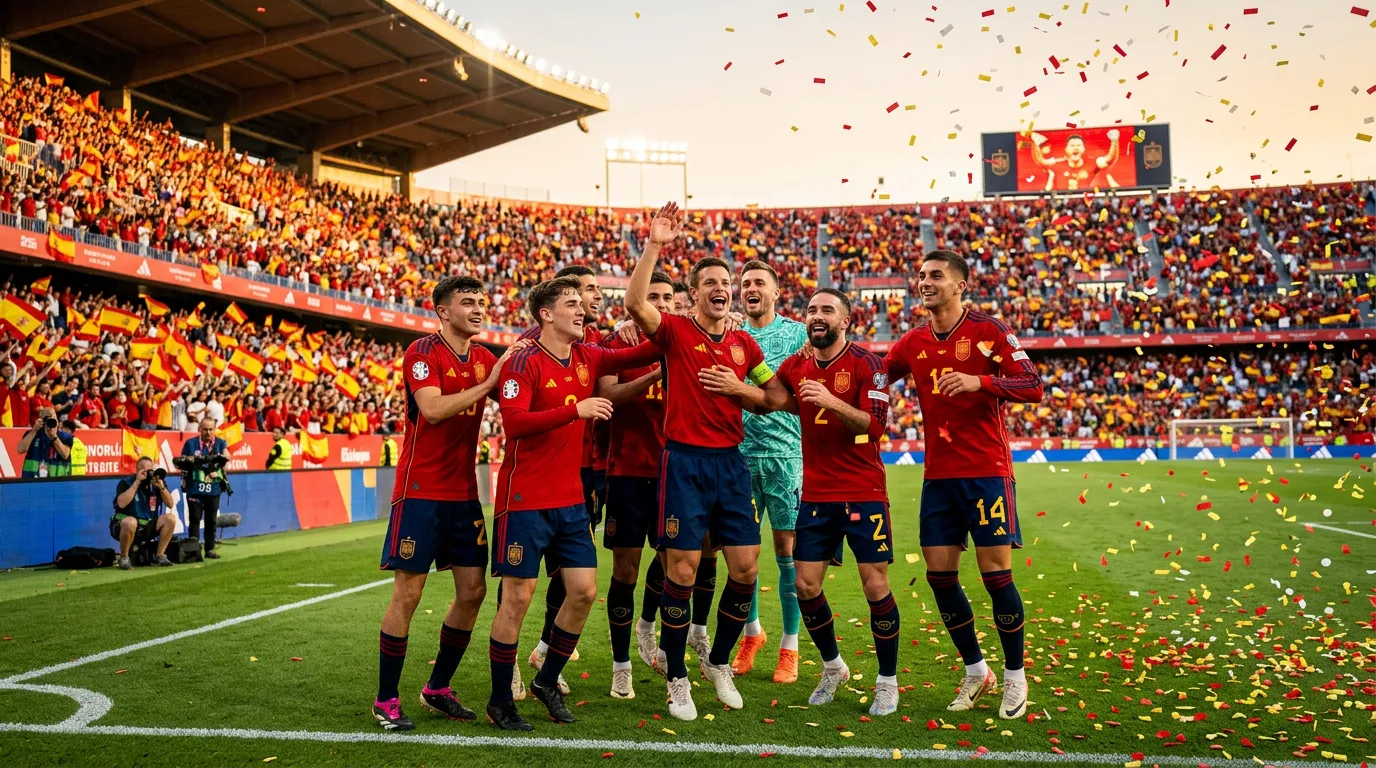
The number one team in the FIFA rankings. The reigning European champions. A squad so absurdly young that their best player — Lamine Yamal — will be 18 years old when the World Cup kicks off, and their midfield engine Pedri will still be just 23. Spain arrive at the 2026 World Cup as the bookmakers’ favourite, and for reasons that extend beyond the usual hype cycle. This is not the Spain of 2014, when a golden generation arrived at the World Cup in Brazil bloated by success and was promptly dismantled by the Netherlands and Chile. This is a Spain that won Euro 2024 by playing the most exciting, aggressive, high-pressing football of any national team in the tournament’s history — and then kept improving. The spain world cup 2026 campaign carries the weight of legitimate favouritism, and from everything I have analyzed over the past six months, the market is right to put them at the top.
What separates this Spanish side from the tiki-taka era that won the 2010 World Cup is intent. The 2010 team suffocated opponents with possession; the 2026 team attacks them with it. The pressing triggers are more aggressive, the transitions from defence to attack are faster, and the individual quality in the final third — Yamal’s dribbling, Nico Williams’ pace, Alvaro Morata’s movement — creates goal-scoring opportunities at a rate that Spain’s previous possession-based iterations rarely achieved. The tactical evolution under the coaching staff has produced a team that keeps the ball when necessary but attacks relentlessly when the opportunity presents itself, and that combination makes them the most complete side in the 2026 field. For bettors in the Canadian market, Spain’s dominance raises a practical question: at 6.00 outright, is the favourite worth backing, or does the compressed value at the top of the market make alternative bets — Spain to reach the final, Yamal for Golden Boot — more attractive? I will address that question in detail below.
How Spain Qualified
Spain qualified for the 2026 World Cup as group winners in UEFA qualifying, winning nine of their ten matches and drawing one. The numbers were emphatic: 28 goals scored, three conceded, a goal difference of plus-25 that was the best in European qualifying by a significant margin. But statistics only tell part of the story. What struck me most about Spain’s qualifying campaign was the manner of the victories — they were not grinding 1-0 wins built on defensive discipline but 3-0 and 4-1 performances where Spain overwhelmed opponents with the same aggressive pressing and rapid transitions that won Euro 2024.
The sole draw — 1-1 against Scotland at Hampden Park — was notable because it demonstrated Spain’s one vulnerability: physical, direct football played at high tempo on a difficult pitch can disrupt their rhythm. Scotland pressed aggressively, won aerial duels in midfield, and denied Spain the time and space to build attacks through their preferred passing patterns. That result is relevant to the World Cup because several potential knockout-round opponents — England, the Netherlands, potentially the United States — play with similar physical intensity and will attempt the same approach. Spain’s coaching staff adjusted after the Scotland draw by incorporating more direct attacking options when the passing game is being disrupted, and Nico Williams’ pace on the left wing provides an outlet that bypasses the midfield congestion entirely.
The integration of younger players alongside the Euro 2024 core was seamless. Yamal, who was 16 when he burst onto the scene at Euro 2024, played in eight of the ten qualifiers and contributed seven goals and five assists — numbers that would be remarkable for an established star, let alone a teenager. Pedri’s return from injury concerns was managed carefully, and his midfield partnership with Gavi — when both are fit — gives Spain the most technically gifted central midfield pairing in world football. The depth of Spain’s qualifying squad, with 26 different players used across ten matches, reflects a coaching philosophy that values rotation and freshness over a fixed starting eleven.
Key Players — Yamal, Pedri & La Roja’s New Generation
Lamine Yamal does things with a football that should not be possible at 18. I have rewatched his Euro 2024 semifinal goal against France — the curling shot from outside the box that eliminated the hosts — at least 30 times, and each viewing reveals a new detail: the body feint that shifted the defender’s weight, the half-step that created the angle, the wrist-flick follow-through that generated the curl. At Barcelona, Yamal has accumulated over 100 La Liga appearances before his 19th birthday, a precocity that has no precedent in Spanish football and very few parallels globally. His right foot is the most dangerous weapon any team will bring to the 2026 World Cup, and defenders across the tournament will spend their preparation sessions studying footage of his movement patterns — and still fail to stop him.
Pedri is the metronome. His ability to receive the ball under pressure, turn, and find the forward pass that unlocks a defence is the skill that makes Spain’s entire attacking system function. Without Pedri, Spain’s possession becomes circular rather than progressive — the ball moves sideways and backwards without penetrating the opponent’s defensive block. With Pedri, every touch has purpose, every pass creates an advantage, and the tempo of Spain’s play accelerates in ways that force opponents to react rather than dictate. His injury history — multiple muscular problems that have disrupted his club career at Barcelona — is the single biggest risk factor in Spain’s World Cup campaign. If Pedri plays all seven or eight matches at full fitness, Spain win the tournament. If he misses knockout-round games, the creative drop-off to the replacement is noticeable.
Nico Williams provides the pace and directness that Spain’s possession game sometimes lacks. His ability to beat defenders one-on-one from the left wing, driving toward the byline and delivering crosses or cutting inside to shoot, gives Spain a different attacking dimension that opponents cannot prepare for simultaneously with Yamal’s threat from the right. The Williams-Yamal wing combination is the most exciting in international football, and their understanding — developed through the Euro 2024 campaign and subsequent matches — produces combination plays that wrong-foot defensive structures designed to deal with one threat at a time.
Rodri, the 2024 Ballon d’Or winner, anchors everything from the base of midfield. His positional discipline — always in the right place to receive a pass, always covering the correct passing lane when Spain lose the ball — is the foundation upon which the entire system is built. At Manchester City, Rodri’s absence through injury in the 2024-25 season coincided with a dramatic decline in City’s results, demonstrating how dependent even the most talented squads can be on a single player’s organisational quality. For Spain, Rodri’s fitness is the second critical variable after Pedri’s, and the coaching staff will manage his minutes carefully through the group stage to ensure he is fresh for the knockout rounds. The defensive core of Aymeric Laporte and Pau Cubarsi — a teenager at Barcelona who has already earned over 15 caps — provides the centre-back partnership with the passing ability to play out from the back under the intense pressing that modern tournament football demands.
Group H — Cabo Verde, Saudi Arabia & Uruguay
Spain’s Group H draw contains one genuinely dangerous opponent and two that Spain should handle comfortably. Uruguay, ranked 16th in the world and armed with the grit that South American qualifying demands, are the clear second seed and the team most likely to push Spain. Cabo Verde, making their World Cup debut, bring the enthusiasm of first-timers but lack the squad quality to compete at this level across three matches. Saudi Arabia, who famously beat Argentina in the 2022 World Cup group stage, have the tactical organization and home-region experience to cause problems in a single match but are unlikely to sustain that level across the group.
The Spain-Uruguay match is the fixture that determines group seedings and potentially Round of 32 matchups. Uruguay’s defensive discipline — anchored by Jose Maria Gimenez and Ronald Araujo — is among the best in South American football, and their counter-attacking threat through Darwin Nunez and Federico Valverde makes them dangerous against teams that commit numbers forward. This is exactly the kind of opponent Spain have historically struggled against: a team that refuses to engage in a possession battle and instead absorbs pressure before striking on the break. The 2022 World Cup group match between these two teams was a 0-0 draw, and a similar result in 2026 would not surprise me.
Saudi Arabia’s 2022 upset of Argentina remains one of the most memorable results in World Cup history, and their coaching staff will approach the Spain match with a similar tactical template: a compact defensive block, an aggressive offside trap, and the willingness to press high in short bursts to disrupt Spain’s build-up. The key difference between the 2022 Argentina match and a 2026 meeting with Spain is preparation — Spain’s coaching staff will have studied the Saudi approach in forensic detail and will adjust their attacking patterns accordingly. Saudi Arabia’s squad has evolved since 2022, with more players gaining experience in European leagues, but the quality gap remains substantial. Cabo Verde are the weakest team in the group and provide Spain with an opportunity to build goal difference and experiment tactically without risking the campaign. Their CONCACAF-adjacent qualifying pathway was remarkable for a nation of roughly 600,000 people, and their World Cup debut is a celebration of football development in a small island nation. But celebration and competitiveness are different things, and Cabo Verde’s defence will face an attacking onslaught from Spain that is unlikely to produce anything other than a comfortable Spanish victory. The question for Spain in this match is not whether they win, but by how many goals, and whether the margin of victory provides psychological momentum heading into the tougher tests that follow.
Spain’s Betting Odds & Outright Markets
Spain are the outright favourites to win the 2026 World Cup at approximately 6.00 in decimal odds, implying a roughly 16-17% probability. That makes them the shortest-priced team in the field, ahead of France (7.50), Argentina (7.00), and England (8.00). I agree with the market’s assessment. Spain’s combination of youth, tactical cohesion, individual brilliance, and recent tournament success (Euro 2024) makes them the most complete package in the 2026 field, and the 16-17% probability implied by their odds is, if anything, slightly conservative.
To win Group H, Spain are priced at approximately 1.40 — short, but justified by the quality differential. Uruguay are the only team capable of topping the group ahead of Spain, and while the Uruguayan squad is strong, Spain’s superiority across all positions makes a first-place finish the most likely outcome. The match-specific market I find most compelling is Spain total group-stage goals over 6.5 at approximately 1.85. Against Cabo Verde and Saudi Arabia, Spain’s attacking firepower should produce four or five goals minimum, and even a tight match against Uruguay should yield at least one. Seven or more group-stage goals feels achievable given the attacking options available.
Yamal’s Golden Boot odds at approximately 15.00 represent significant value. If Spain reach the semifinals or final — which their odds imply is the most likely deep run for any team — Yamal will have played seven or eight matches and his involvement in Spain’s attacking play will produce consistent scoring opportunities. His Euro 2024 output of three goals and one assist across six matches provides the baseline, and a seven-match World Cup campaign could realistically produce four or five goals. At 15.00, the implied probability of roughly 6.5% feels low for a player who will be central to the tournament favourites’ attack.
Spain’s Tactical DNA — Possession Evolved
The phrase “tiki-taka is dead” has been repeated so often that it has become a cliche, but the reality is more nuanced. Spain still value possession — they averaged 68% across Euro 2024 and 71% in qualifying — but the purpose of that possession has shifted fundamentally. The 2010 World Cup-winning team used possession as a defensive mechanism: if we have the ball, the opponent cannot score. The 2026 team uses possession as an attacking weapon: we keep the ball to create overloads, isolate defenders, and generate scoring chances through rapid positional rotations.
The pressing system is the most visible change. Spain press in coordinated waves, with Yamal and Williams leading from the front and the midfield trio of Pedri, Gavi, and Rodri compressing space behind them. The data from Euro 2024 showed that Spain won possession in the opponent’s defensive third more frequently than any other team in the tournament, and those recoveries led directly to six of their 15 tournament goals. The press is not just a defensive tool — it is an attacking mechanism that creates goal-scoring opportunities through forced errors in dangerous areas.
When opponents break through the press, Spain’s defensive line — positioned approximately 40 metres from their own goal — has the speed and reading of the game to recover. Cubarsi’s pace at centre-back allows Spain to play a higher line than most teams would dare, and the full-backs — typically Marc Cucurella on the left and Dani Carvajal on the right — tuck inside to create a compact back four that denies counter-attacking space. The vulnerability, as always with high-line defences, is the ball over the top — and teams with pace in the forward line (France through Mbappé, Brazil through Vinícius) can exploit that space if their passing is precise enough. That vulnerability is manageable, though, because Spain’s possession dominance limits the number of occasions opponents have the ball in positions to play those through-balls.
Set pieces represent an area where Spain have traditionally underperformed relative to their open-play quality. At Euro 2024, Spain scored just one goal from a set piece across seven matches — a figure that left value on the table given the height advantage their squad possesses in certain configurations. The coaching staff have reportedly invested in set-piece preparation since the European Championship, recognizing that in the tighter margins of World Cup knockout football, a goal from a corner or free kick can be the difference between advancing and elimination. Carvajal’s delivery from the right side and Cucurella’s from the left provide crossing options that target Laporte, Rodri, and Morata in the box. If Spain can add set-piece efficiency to their already dominant open-play attacking game, the combination becomes extremely difficult for any opponent to contain across 90 minutes.
The bench options deserve mention because they explain why Spain’s favouritism is sustained across a seven or eight-match tournament rather than just a single knockout game. Ferran Torres provides a direct replacement for Yamal or Williams with similar qualities. Dani Olmo, the Euro 2024 standout who scored crucial goals in the semifinal and final, can replace Pedri or Gavi without a significant drop in creative output. Mikel Oyarzabal, the Euro 2020 final goalscorer, offers experience from the bench that steadies the squad in pressure moments. Joselu brings a different striker profile — aerial presence and hold-up play — when the passing game is not producing chances against compact defences. This depth, combined with the youth of the starting eleven, means Spain can sustain their intensity across the expanded tournament format without the fatigue-related decline that affects older squads in the later rounds. That sustainability is the single biggest advantage any team possesses in 2026, and it is why Spain sit at the top of the market.
How Far Does Spain Go?
Spain top Group H with nine points, beating all three opponents while rotating key players across the group stage to manage fitness. The Round of 32 and Round of 16 produce comfortable victories that build confidence without revealing tactical vulnerabilities. The quarterfinal pits Spain against a strong opponent — potentially Germany or the Netherlands — in a match that tests their defensive resilience but ultimately goes Spain’s way through a moment of Yamal brilliance or a Rodri midfield masterclass.
My prediction: Spain reach the final and are the most likely team to win the 2026 World Cup. The semifinal opponent — France, Argentina, or England — provides the genuine test, but Spain’s tactical superiority, squad depth, and the irresistible combination of Yamal and Williams in the wide areas give them an edge against any opponent in a single match. The final at MetLife Stadium on July 19 is the stage this team was built for, and at 6.00 outright, Spain represent the closest thing to a value bet among the tournament favourites. The complete odds breakdown across all 48 teams confirms what the eye test suggests: Spain are the team to beat in 2026.
