
 Available in US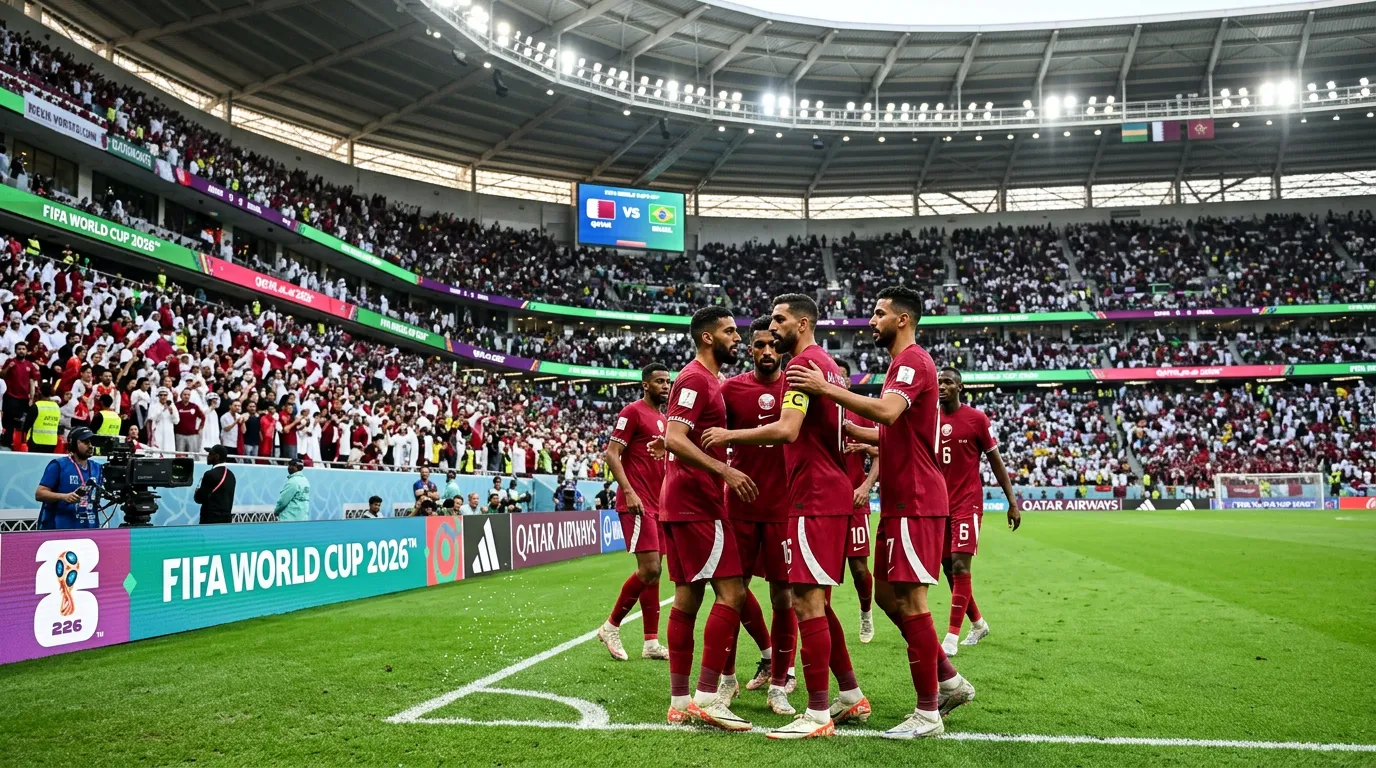
Four years ago, Qatar hosted the most controversial World Cup in FIFA history. The stadiums were architectural marvels. The logistics were immaculate. And the football? Three matches, three defeats, zero goals — the worst performance by a host nation at a World Cup, a record that erased the goodwill of a tournament that divided global opinion before a ball was kicked. Now Qatar return to the World Cup as something entirely different: a team that earned their place through qualification rather than hosting rights, carrying the chip on their shoulder that comes with being the squad nobody believes in. The qatar world cup 2026 campaign is a chance for redemption — not for the country’s controversial hosting, which remains a separate debate, but for the players who wore the maroon shirt in 2022 and were labelled the weakest team in World Cup history.
Qatar are in Group B with Canada, Switzerland, and Bosnia — a group where they are universally regarded as the weakest side and where anything other than three defeats would be considered an overperformance. I am not going to pretend that Qatar have a realistic chance of advancing to the knockout rounds. The quality gap between Qatar and their group opponents is significant, and the absence of home advantage — which was the one factor that might have levelled the playing field in 2022 — means they will be playing in front of crowds that are either hostile or indifferent. But there are reasons to pay attention to Qatar’s campaign that extend beyond the competitive outcome, and for Canadian bettors, understanding Qatar’s strengths and weaknesses is essential for accurately pricing the Group B matches.
How Qatar Qualified — Asian Cup Champions
Qatar qualified for the 2026 World Cup through the AFC pathway — a significant achievement that distinguishes this campaign from their automatic 2022 berth. Their qualification was built on the 2024 Asian Cup triumph, where Qatar beat Jordan 3-1 in the final to claim their second consecutive continental title. The Asian Cup performance demonstrated genuine competitive quality: Qatar beat Japan, Iran, and Jordan en route to the trophy, producing tactical performances that belied their reputation as a team that could only succeed on home soil.
The AFC qualifying campaign that followed was less convincing. Qatar finished third in their final-round group behind Japan and Australia, scraping qualification through the continental playoff pathway. The qualifying record — five wins, three draws, and four losses across 12 matches — was modest, and the attacking output (18 goals in 12 matches) suggested a team that relies on defensive organization rather than offensive firepower. The positive takeaway was the clean-sheet record: Qatar kept five clean sheets in 12 qualifiers, demonstrating the defensive discipline that has been the foundation of their football development program since the Aspire Academy began producing players over a decade ago.
The qualification journey was emotionally significant. For the first time in Qatar’s football history, players had to earn their World Cup spot through competitive matches against regional rivals. The pressure of qualifying — where a single loss could end the campaign — produced a competitive edge that was conspicuously absent during the 2022 home tournament, where automatic qualification removed any sense of earned achievement. Whether that competitive edge survives the step up from Asian football to a World Cup group containing Canada, Switzerland, and Bosnia is the central question of Qatar’s 2026 campaign.
Key Players to Watch
Akram Afif is Qatar’s most talented player and the 2024 Asian Cup’s Most Valuable Player. His technical ability on the ball — close control, dribbling past defenders, precise crossing from wide areas — gives Qatar an attacking dimension that separates them from the purely defensive approach they defaulted to in 2022. Afif’s club career has been spent entirely in the Qatar Stars League, which limits his exposure to European-level opposition, but his international record — 45 goals in 100-plus caps — demonstrates consistent production at the highest level Asian football offers. At 27, Afif enters the World Cup at his physical peak and with the motivation to prove that his Asian Cup performances translate to the global stage.
Almoez Ali, the striker who holds the record for most goals in a single Asian Cup (nine, in 2019), provides the aerial threat and movement in the box that Qatar’s attacking system requires. His goalscoring record for the national team — over 50 goals — is remarkable for a player from a non-traditional footballing nation, though the majority of those goals came against Asian opposition of variable quality. The midfield is anchored by Karim Boudiaf, the experienced holding player whose positional discipline and ball-winning ability provide the defensive screening that Qatar’s system depends on. The defensive unit, led by Bassam Al-Rawi and Pedro Miguel, has been drilled in the compact, organized approach that produced the Asian Cup clean sheets.
The overall squad quality, though, falls below the standard required to compete consistently at the World Cup level. Qatar’s players are predominantly based in the Qatar Stars League, a domestic competition whose intensity and tactical sophistication are several tiers below the European leagues where Canada, Switzerland, and Bosnia’s players operate. The gap in match tempo — the speed of decision-making, the physicality of challenges, the precision required under pressure — is the factor that most undermines Qatar’s chances. In 2022, that gap produced three goalless defeats. In 2026, the question is whether the Asian Cup triumph and qualifying experience have narrowed it enough to produce competitive performances, if not competitive results.
Group B — Canada, Switzerland & Bosnia
Qatar are the clear bottom seed in Group B, and the market prices reflect that assessment. Against Canada, Qatar face a host nation playing at home in front of 30,000 fans whose enthusiasm will create an atmosphere that Qatar’s players have not experienced in competitive football. Against Switzerland, Qatar face a team whose defensive discipline and tactical organization represent the highest standard in European football. Against Bosnia, Qatar face a team riding the emotional high of their Italy playoff victory and desperate to extend their World Cup experience beyond three group matches. None of these matchups favour Qatar, and the realistic expectation is three defeats with a combined goal difference of minus-five or worse.
The scenario where Qatar surprise — a draw against Bosnia, a competitive 1-0 loss to Canada — requires their defensive organization to operate at a level significantly above their 2022 performances and their Asian qualifying form. It is possible. The compact 5-4-1 that Qatar deploy against stronger opponents is designed to frustrate and restrict scoring opportunities, and if the midfield block holds for 60 or 70 minutes, the opposition’s frustration can produce tactical errors that Qatar’s counter-attacking runners exploit. But the probability of this scenario producing points is low — perhaps 15-20% per match — and the cumulative probability of Qatar earning even a single point from three Group B matches is under 50%.
Qatar’s Betting Odds
Qatar are priced at approximately 501.00 to win the 2026 World Cup — the longest odds in Group B and among the longest in the entire tournament. To advance from Group B, the odds sit at approximately 7.00, reflecting the very low probability of Qatar finishing in the top three of the group (or among the best third-place finishers). These are not markets where I see value. The only Qatar-related bet I would consider is the match-specific under 2.5 goals in the Bosnia-Qatar match at approximately 1.80 — both teams prioritize defensive structure, and the match between the group’s two lowest-ranked sides could easily produce a tight, low-scoring contest.
For Canadian bettors, Qatar’s primary relevance is as Canada’s opponent on June 18 at BC Place. Canada should be priced around 1.30 for that match, and the Asian handicap line of Canada -1.5 at approximately 1.85 reflects the expected margin of victory. Qatar’s defensive discipline could keep the scoreline respectable (2-0 or 1-0), which means the -1.5 line carries more risk than casual observers might expect. If you are backing Canada heavily in the Group B winner market, the Qatar match is the one where three points should feel automatic — but World Cup football has a way of punishing assumptions, and Qatar’s Asian Cup pedigree demands at least a passing measure of respect.
Our Prediction for Qatar
Qatar finish fourth in Group B with zero points, losing all three matches by narrow margins (1-0 to Switzerland, 2-0 to Canada, 1-0 to Bosnia). The performances are competitive in a way that the 2022 campaign was not — Qatar create chances, defend with organization, and avoid the kind of capitulation that defined their home tournament. Afif scores a goal — Qatar’s first-ever World Cup goal would be the moment that validates the Aspire Academy’s 20-year investment and provides the emotional highlight of an otherwise difficult campaign. The exit is expected, dignified, and provides the foundation for Qatar’s continued development as a footballing nation that competes at the World Cup level through qualification rather than hosting. For Group B bettors, Qatar are the variable that determines scorelines and margins rather than group outcomes — and the Group B preview shows exactly how those margins affect the calculations for Canada, Switzerland, and Bosnia.
