
 Available in US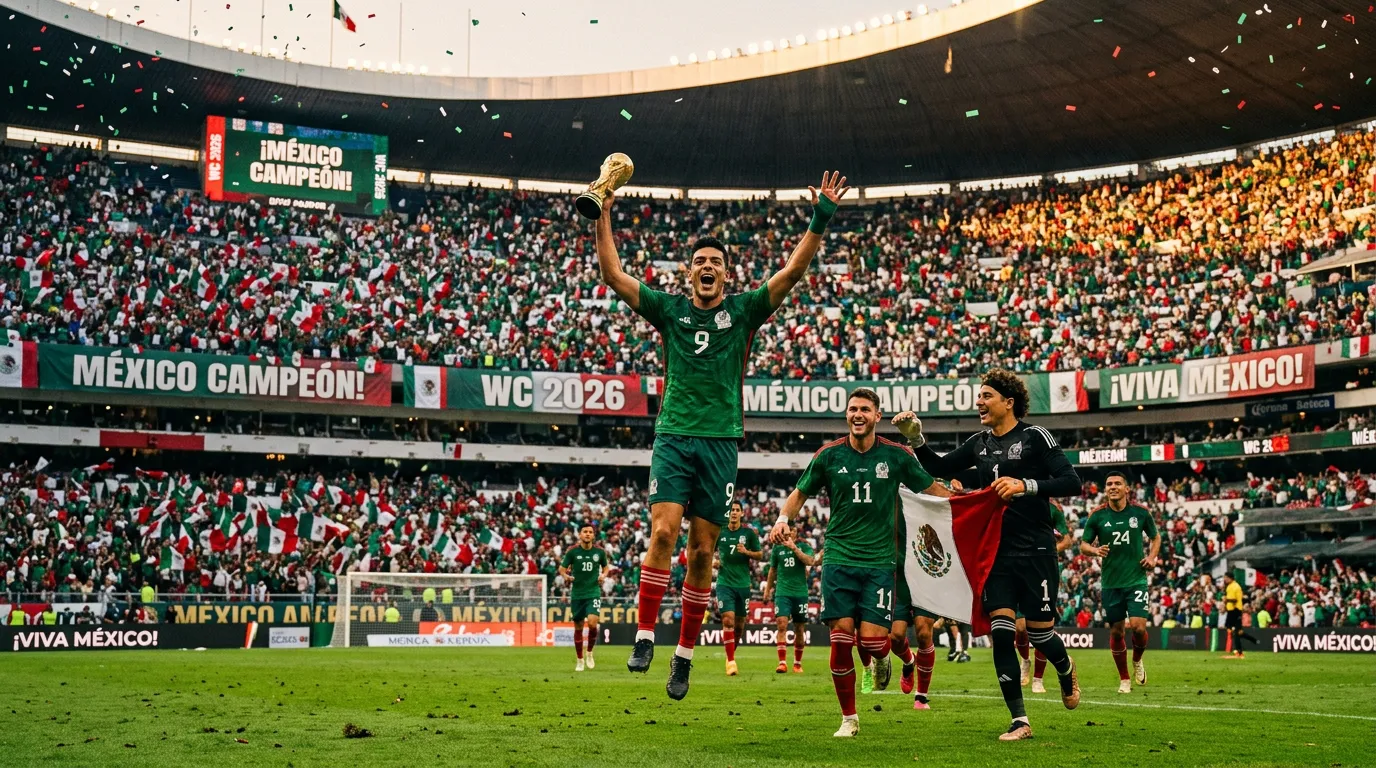
The roar at Estadio Azteca on June 11 will be heard across the continent. Mexico open the 2026 World Cup against South Africa in a replay of the 2010 tournament opener, and for El Tri, this is more than a football match — it is a statement of identity. Mexico have hosted the World Cup twice before (1970, 1986), and each time the tournament has produced iconic moments that defined an era. This time, as co-hosts alongside Canada and the United States, Mexico carry the weight of expectation from a nation of 130 million football obsessives who demand nothing less than a deep run. The mexico world cup 2026 story begins with the opening whistle at the Azteca and will be defined by whether this generation can finally break the “quinto partido” — the fifth match — curse that has haunted Mexican football for over two decades.
I have covered Mexican football extensively through my work on North American betting markets, and El Tri present one of the most fascinating analytical puzzles in the 2026 field. The talent is unquestionable — players from La Liga, the Premier League, Serie A, and Liga MX form a squad that is deep enough to compete with anyone in the group stage. But Mexico’s tournament history tells a story of consistent competence that never quite translates into breakthrough: seven consecutive Round of 16 exits at World Cups from 1994 to 2018, followed by a humiliating group-stage elimination in Qatar 2022. The pattern is so entrenched that it has become self-fulfilling, with players and fans alike approaching knockout matches with a fatalism that undermines the squad’s genuine quality.
Co-Hosts — Automatic Qualification
Mexico qualified automatically as co-hosts, bypassing the CONCACAF qualifying process that has historically produced drama and controversy for El Tri. The 2022 qualifying campaign — where Mexico scraped through in fourth place, ahead of Costa Rica only on goal difference — was widely considered the worst qualifying performance by a Mexican team in decades, and the automatic berth for 2026 was received with relief rather than celebration. The coaching staff used the 2024-2025 international windows to test formations and blood younger players, with mixed results. Friendlies against European opposition produced inconsistent performances, and the debate about Mexico’s optimal tactical system remained unresolved heading into the final preparation window.
The advantage of automatic qualification is particularly significant for Mexico because of the demands Liga MX places on its players. The Mexican domestic league operates on a split-season format with clausura and apertura campaigns that run nearly year-round, leaving players who ply their trade domestically exhausted by the time international windows arrive. By skipping qualifying, Mexico’s Liga MX-based players arrive at the World Cup fresher than they would otherwise be, and the European-based contingent — Edson Alvarez, Hirving Lozano’s successors, and younger players breaking through in European leagues — has had time to integrate into the national team framework without the pressure of must-win qualifiers disrupting the process.
Key Players to Watch
Edson Alvarez anchors Mexico’s midfield with the kind of destructive quality that CONCACAF football demands and European leagues reward. His time in the Premier League has added tactical sophistication to his natural ball-winning instincts, and his ability to shield the defence while distributing accurately to the attackers makes him Mexico’s most important player. At 28, Alvarez enters the World Cup at peak physical and tactical maturity, and his leadership — both vocal and through example — sets the tone for the squad’s competitive intensity. Without Alvarez, Mexico’s midfield loses its spine; with him, they can compete with any team in the tournament for 90 minutes.
The attacking options reflect Mexico’s generational transition. Santiago Gimenez, the striker who has thrived in the Eredivisie and earned a move to a top-five European league, provides the clinical finishing that Mexico have lacked from the centre-forward position since Javier Hernández’s peak. His movement in the box — intelligent runs across centre-backs, instinctive positioning for crosses — makes him the focal point of Mexico’s attacking play. Diego Lainez and younger creative talents from Liga MX and European academies provide width and dribbling ability from the flanks, and the competition for places in the final squad is intense enough to keep every player sharp through the final preparation period.
The defensive unit has been Mexico’s most debated area. Cesar Montes and Johan Vasquez form the likely centre-back pairing, bringing aerial quality and Serie A tactical education to the heart of the defence. The full-back positions are where Mexico’s depth is thinnest — the drop-off from the first-choice options to the backups is more significant than at any other position, and injuries to starting full-backs during the tournament would force tactical adjustments that could compromise Mexico’s attacking width. Goalkeeper Guillermo Ochoa, now at a veteran stage of his career, may be replaced by a younger option, but his World Cup experience — four tournaments as Mexico’s number one — represents a leadership asset that is difficult to replace.
Group A — South Africa, South Korea & Czechia
Mexico’s Group A draw is manageable but far from easy. South Korea bring the tactical discipline and physical intensity that saw them reach the semifinals as hosts in 2002, and their current squad includes Tottenham’s Son Heung-min (if fit), one of the most dangerous attackers in the tournament. Czechia qualified through the UEFA playoffs and play with a European organizational quality that will test Mexico’s defensive structure. South Africa, Mexico’s opening-match opponents, are the weakest side in the group but carry the emotional weight of the tournament opener and the unpredictability that comes with a squad that has nothing to lose.
The Mexico-South Korea match is the group’s key fixture. South Korea’s pressing system, which targets opponents who build from the back, will force Mexico to choose between a patient possession game that risks turnovers and a more direct approach that bypasses the midfield. The historical record between these teams at World Cups — South Korea beat Mexico in the 2018 group stage — adds an edge to the fixture that transcends tactical analysis. Mexico need to manage this match carefully, avoiding the kind of early defensive errors that South Korea are adept at exploiting through counter-attacks and set pieces.
Mexico’s Betting Odds & Markets
Mexico are priced at approximately 51.00 to win the 2026 World Cup, reflecting their status as a second-tier team with home advantage in one of the three host nations. To win Group A, Mexico sit at approximately 1.90, a price that accounts for South Korea’s quality and the competitiveness of the group. To advance from the group, Mexico are priced at around 1.25, reflecting the near-certainty of at least a third-place finish under the expanded format’s generous advancement rules.
The value bet on Mexico’s board is the outright avoidance market — Mexico to be eliminated before the quarterfinals at approximately 1.40. This sounds negative, but it captures the historical pattern that has defined Mexican football at World Cups for decades: comfortable group-stage advancement followed by a knockout-round exit that feels inevitable. If you want to back Mexico positively, the group-stage total goals over 4.5 at around 1.85 offers better value than the outright, capturing Mexico’s attacking quality against weaker group opponents without requiring the knockout-round breakthrough that has eluded them for over 20 years.
Breaking the “Quinto Partido” Curse
Seven consecutive Round of 16 exits. That record — stretching from 1994 to 2018, broken only by the group-stage elimination in 2022 — has become such a defining feature of Mexican football that it has its own name: the quinto partido, the fifth match, the one Mexico can never win. The causes have varied (a dubious offside call against Argentina in 2010, a Neymar masterclass in 2014, a Brazilian demolition in 2018), but the pattern has been consistent enough to suggest something deeper than bad luck. Mexican teams at World Cups tend to peak in the group stage and then lose the psychological edge that is required to win knockout matches against stronger opposition. The pressure from Mexican media — which is relentless, personal, and often cruel — creates an environment where players tighten up rather than express themselves when the stakes are highest.
The 2026 tournament offers the best opportunity to break the curse. Playing on home soil at Estadio Azteca removes the travel fatigue and cultural dislocation that have contributed to knockout-round struggles in distant host countries. The expanded format — with a Round of 32 before the Round of 16 — means Mexico’s “fifth match” is now the Round of 16 rather than the quarterfinals, which could provide an additional knockout-round win before they face a top-tier opponent. And the emotional energy of a home World Cup — with millions of Mexican fans creating an atmosphere that visiting teams will find overwhelming — provides the kind of boost that can carry a team through the fine margins of tournament football.
Our Prediction for Mexico
Mexico top Group A with seven points, winning the opener against South Africa at the Azteca in front of 80,000 fans and securing enough points from the South Korea and Czechia matches to finish first. The Round of 32 produces a workmanlike victory against a third-place qualifier, and the Round of 16 is where the quinto partido dynamic reasserts itself. Mexico face a strong opponent — potentially a Group B or C survivor — and exit the tournament in a match that is competitive for 75 minutes before the opposition’s superior quality decides it in the final quarter.
A Round of 16 exit is a step forward from the 2022 group-stage failure but falls short of the quarterfinal breakthrough that Mexican fans crave. For bettors, Mexico’s Group A offers opportunities in match-specific markets — the opening match, in particular, should produce goals and drama — without the risk of backing a team whose knockout-round ceiling has been tested and found wanting at seven consecutive World Cups.
For Canadian bettors, Mexico’s tournament carries cross-border significance. The CONCACAF rivalries between Canada, the USA, and Mexico have intensified since 2021, and a deep run by any of the three host nations generates interest in the others’ campaigns. Mexico’s matches at Estadio Azteca and other Mexican venues will be broadcast across Canadian networks, and the growing Mexican-Canadian community — particularly in cities like Toronto, Vancouver, and Calgary — adds a domestic audience for El Tri’s matches that supplements the neutral viewership. The betting markets in Ontario’s open market will reflect this interest, with Mexico’s match-specific lines attracting significant volume from Canadian sportsbooks. Whether Mexico can convert that attention into a breakthrough result remains the central question of their 2026 campaign, and the answer — as it has been for seven consecutive World Cups — will likely be delivered in the agonizing margins of a knockout-round match where talent alone is not enough.
