
 Available in US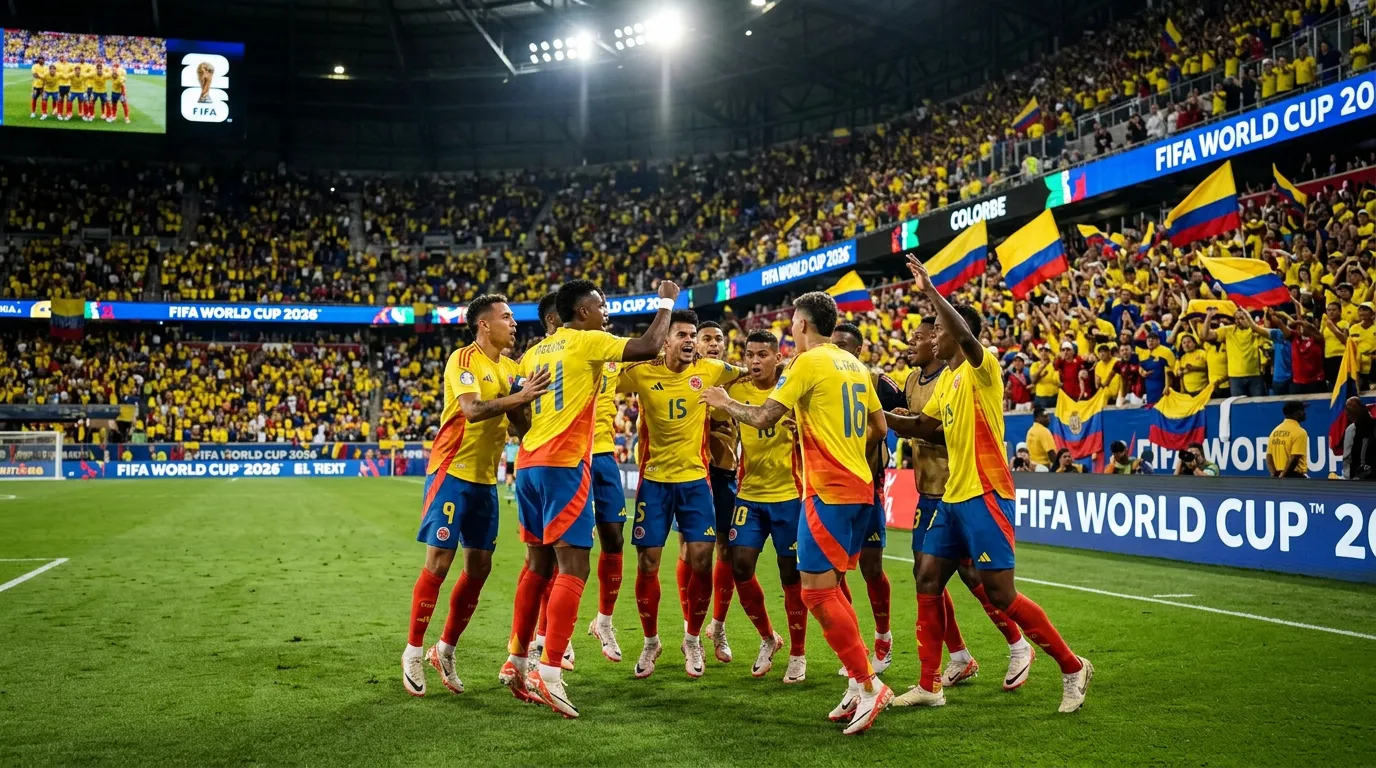
Colombian football runs on passion — raw, unfiltered, street-corner passion that turns stadiums into caldrons and qualification matches into national events. I watched Colombia’s Copa America 2024 final against Argentina in Miami, and even in defeat — a 1-0 extra-time loss — the Colombian supporters created an atmosphere that overshadowed everything on the pitch. That passion fuels a squad that has quietly assembled one of the most talented attacking lineups in the 2026 World Cup field. Luis Díaz at Liverpool, James Rodriguez defying age as the creative architect, and a generation of younger players who have earned starting spots at top European clubs — the colombia world cup 2026 campaign has the ingredients for a deep run if the squad can channel its emotional energy into tactical discipline when the knockout rounds arrive.
Colombia qualified through the CONMEBOL pathway — the most demanding qualification route in world football — finishing fourth in the standings after Argentina, Uruguay, and Ecuador. Their qualifying campaign was marked by brilliant home form (eight wins from nine matches in Barranquilla) and inconsistent away results that reflected the travel demands and hostile environments of South American qualifying. The transition from qualifying to tournament football suits Colombia, where the neutral venues, sea-level conditions, and structured scheduling remove the environmental disadvantages that CONMEBOL away matches impose.
How Colombia Qualified — CONMEBOL Route
Colombia’s CONMEBOL qualifying campaign followed a familiar pattern: dominant at home, vulnerable on the road. The Metropolitano Roberto Melendez in Barranquilla — sea level, searing heat, deafening noise — produced eight wins from nine home matches, with only a draw against Argentina preventing a perfect home record. The away form was less convincing: three wins, two draws, and four losses in nine road fixtures, with defeats in La Paz, Buenos Aires, Montevideo, and Santiago highlighting the difficulty of winning at altitude and in hostile South American environments.
The qualifying campaign served as a proving ground for Colombia’s generational transition. James Rodriguez, now 34, started just seven of the 18 qualifiers but delivered in every appearance — six assists and two goals, including a stunning free kick against Chile that was nominated for FIFA’s Puskas Award. The coaching staff used James strategically, bringing him on as a substitute when matches needed a creative injection in the final 30 minutes. Luis Díaz, by contrast, started 15 matches and established himself as Colombia’s primary attacking threat, scoring nine goals and providing consistent width from the left wing that stretched opposing defences. The blend of James’s experience and Díaz’s explosive talent gave Colombia a tactical flexibility that few CONMEBOL opponents could match.
Key Players — Luis Díaz & Colombia’s Attack
Díaz is the player who makes Colombia dangerous. At Liverpool, he has developed from a skilful but inconsistent winger into one of the Premier League’s most decisive attackers — his 2025-26 season produced 15 goals and 10 assists, numbers that placed him among the league’s top ten contributors. For Colombia, Díaz operates with even more freedom, drifting from the left wing into central areas, cutting inside on his right foot to shoot, or driving to the byline to deliver crosses. His pace in transition — the ability to carry the ball from the halfway line to the opponent’s penalty area in four or five seconds — is the quality that makes Colombia’s counter-attacking game lethal, and his willingness to press from the front adds a defensive dimension that the coaching staff values enormously.
James provides the creative intelligence that transforms Colombia’s attacking play from direct to sophisticated. His passing range — short combinations, long diagonals, through-balls weighted with the precision that comes from 100-plus international caps — gives Colombia a playmaking option that operates at a level most teams in the 2026 field cannot match. The question is fitness and minutes: James has not been a regular starter at club level for several seasons, and his ability to influence matches is directly tied to his physical condition. When fresh and motivated, James is capable of winning a match single-handedly through his dead-ball delivery and creative passing. When fatigued or carrying a knock, his lack of defensive contribution becomes a tactical liability that opponents exploit through the space he vacates in midfield.
The supporting cast includes Richard Rios, the midfield destroyer whose physical presence and ball-winning ability provide the defensive platform that James and Díaz need to attack freely. Jhon Arias offers a different attacking profile from the right — pace, directness, and a willingness to shoot from distance. Rafael Santos Borre leads the line with the mobility and pressing intensity that the system demands from its centre-forward, and younger options like Jhon Duran provide impact from the bench with physical presence and aerial quality.
Group K — Portugal, DR Congo & Uzbekistan
Group K pairs Colombia with Portugal in the group’s marquee fixture — a match between two attacking teams with defensive vulnerabilities that should produce an entertaining, open contest. DR Congo and Uzbekistan complete the group with contrasting styles: DR Congo bring African physicality and the emotional momentum of ending a 52-year World Cup absence, while Uzbekistan are World Cup debutants whose qualification through the AFC pathway demonstrated tactical organization and defensive resilience.
The Colombia-Portugal match is the fixture I am most excited about in the entire group stage. Both teams prioritize attacking football, both have defensive weaknesses that the other can exploit, and the individual matchups — Díaz vs Cancelo, James vs Vitinha, Hakimi vs Colombia’s left-back — produce tactical sub-plots that make this match a feast for analysts and neutrals alike. I expect this match to produce three or more goals and to be decided by a moment of individual brilliance from one of the four or five match-winners on the pitch.
Colombia’s Betting Odds
Colombia are priced at approximately 34.00 to win the 2026 World Cup, reflecting their status as a dangerous but inconsistent team whose ceiling depends on the form of two or three key players. To advance from Group K, Colombia sit at approximately 1.40 — a price that accounts for the quality gap between Colombia/Portugal and DR Congo/Uzbekistan. The value angle I see is Colombia to reach the quarterfinals at approximately 2.50, capturing the advancement from the group and one knockout-round win without requiring the consistent defensive discipline that a deeper run would demand.
Díaz’s Golden Boot odds at approximately 51.00 represent a speculative play with limited expected value unless Colombia reach the semifinals. The more realistic player bet is Díaz to score in the tournament at 1.40, which captures his involvement in Colombia’s attacking play without requiring an unrealistic scoring volume. James Rodriguez to provide an assist at 1.50 is another angle — his set-piece delivery and creative passing make a tournament assist a near-certainty across four or five matches.
Our Prediction for Colombia
Colombia finish second in Group K behind Portugal, with four or six points depending on the head-to-head result. Wins over DR Congo and Uzbekistan secure advancement, and the Round of 32 produces a victory against a beatable third-place qualifier. The Round of 16 is where Colombia’s campaign crystallizes — a match against a strong opponent from the bracket where the emotion and passion that fuels Colombian football either carries them through or becomes a liability when the pressure overwhelms the tactical structure. My prediction is a Round of 16 exit, one round further than their 2022 absence (they failed to qualify for Qatar) and consistent with the pattern of Colombian teams at World Cups: brilliant in flashes, frustrating in sustained execution.
For Canadian bettors, Colombia’s matches at the 2026 World Cup carry interest through the Colombian-Canadian diaspora — concentrated in Toronto, Montreal, and Vancouver — and through the general appeal of Colombia’s attacking, entertaining style of play. The Group K matches, played in venues across the US and Mexico, will be broadcast on Canadian networks with significant viewership from the broader Latin American audience that follows Colombian football globally. Whether Colombia can channel that energy into a quarterfinal run depends on variables — James’s fitness, Díaz’s form, the coaching staff’s ability to impose defensive discipline — that make backing them a high-variance proposition with commensurately high potential reward.
The tactical system that Colombia deploy in 2026 reflects the evolution that CONMEBOL qualifying demanded. The coaching staff abandoned the traditional Colombian 4-4-2 in favour of a more flexible 4-2-3-1 that positions James as the number ten when he starts and shifts to a 4-3-3 pressing system when he is on the bench. The double pivot of Rios and Barrios provides the defensive foundation that allows Díaz and Arias to attack with freedom, and the full-backs — particularly the right-back — push high to create overloads on the flanks when Colombia have possession in the opponent’s half. The system is designed to maximize Colombia’s attacking talent while providing enough defensive structure to compete against the organized European defences they will face in the knockout rounds.
The Canadian connection to Colombian football runs through the diaspora communities in Toronto, Montreal, and Vancouver, where Colombian-Canadian families gather to watch national team matches with the same intensity that characterizes the atmosphere in Barranquilla. The 2024 Copa America, played partly in cities accessible to Canadian fans, demonstrated the passion that the Colombian community brings to the sport — yellow jerseys filled sections of stadiums in Miami, Houston, and Las Vegas, creating home-field atmospheres in neutral venues. The 2026 World Cup, played on North American soil, brings that energy closer to home, and if Colombia advance to a knockout-round match in a Canadian or northeastern US venue, the atmosphere will rival anything produced by the host nations’ supporters.
The depth of the squad beyond the starting eleven is an area where Colombia have improved significantly since their last World Cup appearance. The emergence of Jhon Duran at Aston Villa as a Premier League-quality striker provides a physical alternative to the mobile Santos Borre. Kevin Castaño and Jorge Carrascal offer midfield creativity from the bench, and the competition for places at every position ensures that no player arrives at the tournament complacent about their starting spot. The coaching staff’s willingness to rotate — evident during the CONMEBOL qualifying campaign, where 28 different players were used across 18 matches — gives Colombia the depth to sustain performances across the expanded tournament format without the fatigue-related decline that affected them at the 2018 World Cup in Russia.
The set-piece quality is another factor that elevates Colombia above many teams at their price point. James Rodriguez’s free-kick delivery — both inswinging and outswinging, to the near post and the far post, at varying heights and speeds — is among the best in international football and has been for over a decade. His 2014 World Cup free kick against Uruguay remains one of the greatest goals in tournament history, and his ability to score or create from dead-ball situations provides Colombia with a weapon that can decide tight knockout matches. The defensive aerial threat from Mina, Santos Borre, and Duran at corners adds a physical dimension to a team that is often characterised purely in terms of technical flair, and the combination of creative delivery and attacking height produces a set-piece conversion rate that significantly exceeds the tournament average.
The CONMEBOL qualifying campaign revealed both Colombia’s potential and their limitations. They finished fourth in the standings — comfortably qualified, but below Argentina and Uruguay and level with Brazil — with a record that featured dominant home performances and inconsistent away form. The altitude factor in South American qualifying is always significant: Colombia’s home matches in Barranquilla, played at sea level in oppressive heat, produced an almost perfect record, while their away fixtures in La Paz, Quito, and Buenos Aires generated mixed results that reflected the physical challenges of competing across the continent’s diverse climates. The World Cup, played at moderate altitudes and summer temperatures across North America, removes the altitude variable and allows Colombia’s technical quality to express itself without the environmental constraints that CONMEBOL qualifying imposes.
Colombia’s bench strength extends the starting quality into the later stages of matches. Juan Fernando Quintero provides a different creative option — a player who can slow the tempo, pick a defence-splitting pass, and deliver free kicks with the precision of a specialist. Rafael Santos Borre offers a striker alternative who presses aggressively and holds the ball up effectively when Colombia need to protect a lead. The full-back positions are covered by players from Serie A and Ligue 1 who provide tactical flexibility on both flanks. The goalkeeping situation features David Ospina’s successor, a younger keeper who has established himself in European football and brings the shot-stopping quality that Colombia’s defensive approach demands. This depth — 20 players who could contribute meaningfully in tournament matches — gives Colombia the rotation capacity to sustain their pressing intensity across six or seven matches without the fatigue-related decline that affects less deep squads in the knockout rounds.
For Canadian bettors, Colombia’s tournament carries special resonance. The Colombian community in Canada — concentrated in Toronto, Montreal, and Calgary — is one of the largest Latin American diaspora populations in the country, and Colombian football culture’s emphasis on flair, passion, and collective celebration creates an atmosphere at matches that rivals the home nations’ support. When Colombia play at venues accessible to these communities, the stands fill with yellow jerseys and the energy of a fanbase that has waited since the 2014 World Cup for a deep tournament run. That emotional investment drives public money toward Colombia in Ontario’s sportsbook markets, which can create pricing inefficiencies that sharp bettors should monitor throughout the group stage.
