
Loading...
Twenty-four years without a World Cup title. Read that sentence again and let it sink in, because for a nation that defines itself through the sport — five stars on the crest, Pele, Ronaldo, Ronaldinho — that drought is not just a statistic. It is an identity crisis playing out in slow motion. Brazil has not lifted the trophy since Yokohama in 2002, when Ronaldo scored twice against Germany in the final. Since then, four tournaments have ended in frustration: a quarterfinal exit in 2006, the 7-1 humiliation against Germany on home soil in 2014, a quarterfinal loss to Belgium in 2018, and a penalty shootout defeat to Croatia in the 2022 quarterfinals.
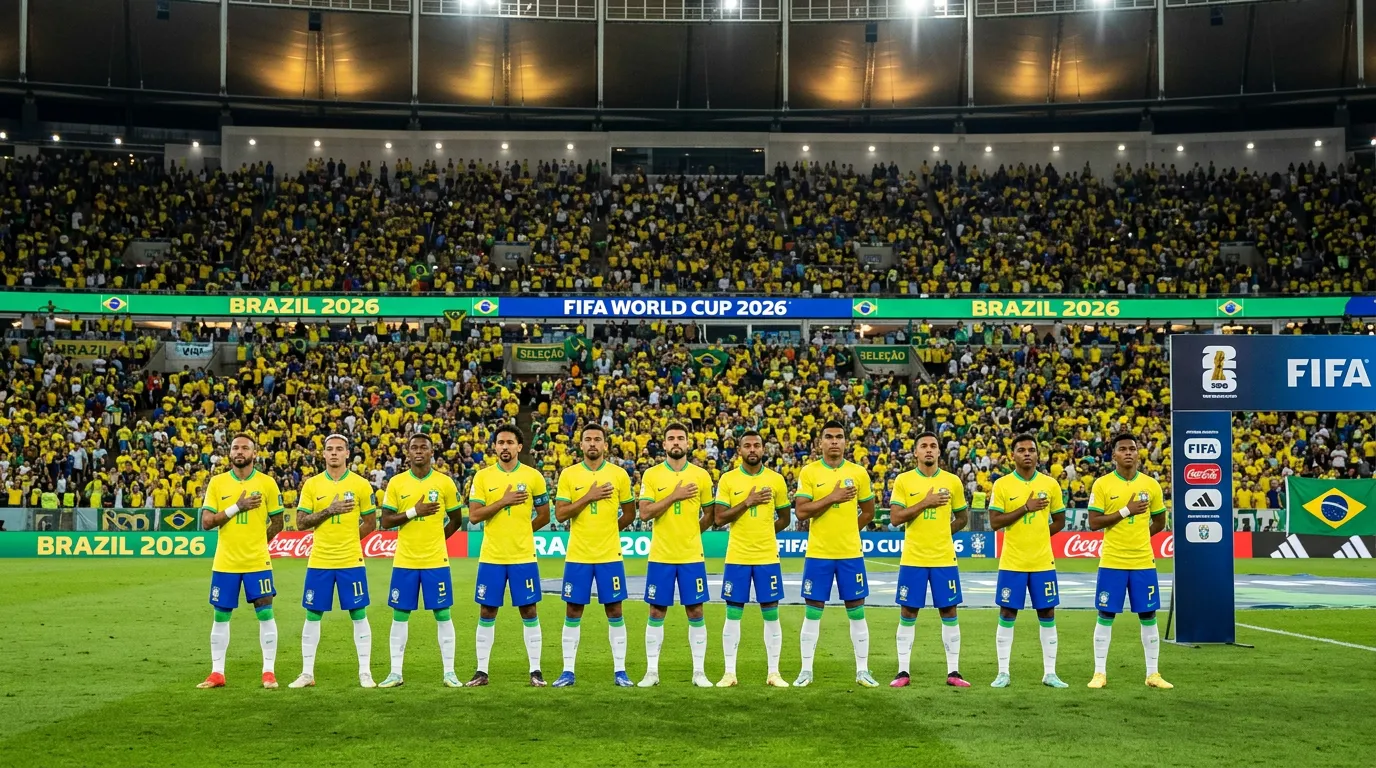
Brazil at the 2026 World Cup arrives with a squad built around a new generation — Vinicius Jr., Rodrygo, Endrick — and a tactical identity that has shifted from the jogo bonito romance toward something harder, more European, more pragmatic. The draw placed them in Group C alongside Morocco, Haiti, and Scotland, a group that should not cause serious problems but features a Moroccan side that reached the 2022 semifinals and knows how to neutralize favoured opponents. Brazil’s betting odds sit in the top tier — typically third or fourth favourites behind Argentina and France — and there are legitimate reasons to believe this is either the year the drought ends or another chapter of underperformance. The data points in both directions, and sorting through the noise is what I am here to do.
How Brazil Qualified
I watched Brazil’s CONMEBOL qualifying campaign with the kind of attention usually reserved for a team in danger of missing out, not a five-time champion. That tells you something about how bumpy the road was. Brazil finished the 18-match South American qualifying cycle in fourth place, behind Argentina, Uruguay, and Colombia. They lost at home to Argentina early in the campaign — a result that cost the previous coach his job — and drew more matches than any other qualifier in the top four.
The appointment of the current coaching staff steadied the ship from matchday 10 onward. Brazil won five of their final eight qualifiers, including a convincing 3-1 victory away to Uruguay that showcased the attacking potential of the Vinicius-Rodrygo partnership. The defence remained a concern throughout qualifying, conceding 15 goals in 18 matches — the worst record among the automatic qualifiers. That defensive fragility is the reason I hesitate to back Brazil at outright winner odds shorter than 8.00 decimal. CONMEBOL qualifying is the most competitive regional pathway in world soccer, and Brazil’s inconsistency against mid-table South American sides raises questions about their resilience against the tournament’s elite.
Still, qualifying form is an imperfect predictor of World Cup performance. Spain finished their 2010 qualifying group behind Switzerland, then won the tournament. France nearly missed Euro 2020 qualifying, then reached the final. Brazil’s talent level is not in doubt — what matters is whether the coaching staff can harness it over seven matches in five weeks, and whether the young core can handle the weight of expectation that follows the Selecao to every pitch on the planet.
Key Players — Vinicius Jr., Rodrygo & the Next Wave
Three years ago, I wrote that Vinicius Jr. was the most exciting attacker in world soccer but lacked the end product to carry a national team through a major tournament. I was wrong. His development at Real Madrid has been staggering — back-to-back Ballon d’Or shortlist finishes, a Champions League final goal, and a consistency in front of goal that has silenced every critic who questioned his finishing. At 25, Vinicius enters the 2026 World Cup as Brazil’s talisman, the player around whom the entire attacking structure is built.
What makes Vinicius dangerous for betting markets is his directness. He attempts more dribbles per 90 minutes than any other forward likely to feature at the tournament, and his foul-drawing ability means Brazil earn free kicks in dangerous areas at a rate far above the tournament average. For player prop markets, Vinicius to be fouled three or more times in a match is a line that consistently pays in domestic competition and should translate to the physical, high-stakes environment of a World Cup where defenders are willing to take yellows to stop him. His goal involvement numbers across all competitions in 2025-26 sit above 0.9 per 90 minutes, a figure that only Haaland and Mbappé match among the tournament’s likely starters.
Rodrygo operates as the mirror image on the right side of the attack — more cerebral, better positionally, and capable of dropping into midfield pockets to link play when Brazil face compact defences. His partnership with Vinicius at club level means the understanding between them is instinctive rather than coached, and that chemistry gives Brazil an edge in transition moments where a split-second connection can unlock a defence. The pair have combined for 14 assists to each other across the past two club seasons, and that number will concern every Group C opponent tasked with defending both flanks simultaneously.
Endrick, still only 19, provides the central striker option that Brazil lacked for years. His movement in the box is precocious, his finishing is clinical, and his willingness to run the channels gives Brazil a physical presence they have not had since the peak of Firmino’s international career. He scored four goals in his first ten senior caps for Brazil, and his ability to hold the ball with his back to goal — unusual for a teenager — allows Vinicius and Rodrygo to make runs off him rather than always creating from deep. Whether he starts ahead of more experienced options depends on the coaching staff’s appetite for risk, but every data point suggests Endrick is ready for tournament soccer.
In midfield, Joao Gomes has emerged as the ball-winning anchor who allows the creative players to roam. His tackle success rate in 2025-26 sits above 70%, and his distribution has improved to the point where he can bypass the press with vertical passes that trigger transitions. Bruno Guimaraes offers a different profile — technical, composed, capable of dictating tempo from the number eight position — and the pairing of these two gives Brazil a midfield balance they have struggled to find since Casemiro’s peak years. The two complement each other the way Gilberto Silva and Kleberson complemented each other in 2002: one destroys, the other creates, and the blend gives the front three freedom to attack without worrying about defensive cover.
The defence remains the squad’s weakest department, and I say that without qualification. Marquinhos provides experience at centre-back, but his pace has declined visibly over the past two seasons, and against rapid forwards in knockout matches — think Davies, Mbappé, Saka — that lack of recovery speed becomes a liability. The fullback positions are contested between several adequate options without a standout candidate. Danilo’s era has ended, and the competition between younger options has not produced a player who commands the position the way Dani Alves did for a decade. If Brazil concede goals at this World Cup, it will come from the spaces behind their high defensive line — a vulnerability that sharp opponents will target and that the betting market should price more heavily into the outright odds.
Group C — Morocco, Haiti & Scotland
A colleague described Group C as “Brazil plus three levels of difficulty.” I would not go that far — Morocco is a serious team — but the general hierarchy is clear. Brazil should top the group, Morocco should qualify in second, and Haiti and Scotland will compete for respectability and the hope of a memorable result. The betting market reflects this: Brazil to win Group C is priced around 1.55 decimal, which implies a probability just above 64%. That feels about right, though Morocco’s ability to execute a defensive masterclass against favoured sides — as they demonstrated against Belgium, Spain, and Portugal in 2022 — introduces enough uncertainty to make the group winner market more interesting than it looks on the surface.
Morocco is the opponent Brazil must take seriously. The Atlas Lions have not regressed since their historic semifinal run in Qatar; if anything, the injection of confidence from that tournament elevated their competitive baseline permanently. Achraf Hakimi remains one of the world’s best fullbacks, and the defensive organization that frustrated Cristiano Ronaldo and Kylian Mbappé is intact under Walid Regragui. A Brazil-Morocco group match carries genuine tactical intrigue, and the total goals line for that fixture — likely set around 2.0 — reflects how tight it could be. I lean toward the under in that match based on Morocco’s defensive record against top-tier opponents: they conceded just one goal in five matches during their 2022 knockout run.
Haiti’s presence in Group C is a fairy-tale story. Their qualification through CONCACAF is a historic achievement for Caribbean soccer, and the Haitian diaspora — including significant communities in Montreal and South Florida — will provide passionate support. On the pitch, Haiti lacks the individual quality to compete with Brazil or Morocco, but their physicality and organization could cause moments of discomfort for more talented opponents. Scotland qualified through a tight UEFA group and will approach the tournament with typically pragmatic defence and direct attacking patterns. Their chances of advancing depend on results elsewhere, and a defeat to Brazil in the opening match could effectively end their campaign before the second round of fixtures.
Brazil’s Betting Odds & Markets
The last time I backed Brazil to win a World Cup outright was 2018, when their squad — Neymar, Coutinho, Firmino, Casemiro — looked like the most balanced in the tournament. They lost to Belgium in the quarterfinals, and I lost my wager. That experience taught me to look past the name on the shirt and focus on the structural weaknesses that separate genuine contenders from perennial disappointments wearing prestigious jerseys.
In early April 2026, Brazil’s outright winner odds sit between 7.00 and 9.00 decimal across major Canadian sportsbooks. That range reflects a market that views Brazil as a top-four contender but not the favourite — a position occupied by Argentina and France, with England and Spain also trading shorter in some books. The implied probability of around 12-14% is fair if you believe Brazil’s defence can hold up through seven matches against progressively stronger opponents. If you share my concern about the backline, those odds are too short by 2-3 percentage points, and the value lies elsewhere on the board.
The value in Brazil’s betting profile lies in more specific markets. Brazil to top Group C at 1.55 is a near-certainty bet that offers thin but reliable value for accumulators. Brazil to reach the quarterfinals sits around 1.60, reflecting the expectation that they navigate a Round of 32 match without serious difficulty. The more interesting line is Brazil to reach the final — typically priced around 4.50 — which offers genuine upside if the knockout draw falls favourably. Brazil’s likely path from Group C runs through a Round of 32 match against a Group D qualifier (possibly Australia or Paraguay), then a quarterfinal against the Group A or B winner. If Canada or Mexico emerge from that bracket, Brazil would be heavy favourites. If Switzerland tops Group B, the quarterfinal becomes more competitive but still tilts in Brazil’s favour.
For player props, Vinicius Jr. to score in the group stage is priced around 1.65, which feels like fair value given the quality of opposition he will face in three group matches. Rodrygo to register an assist in the tournament is an underpriced market at odds near 2.50 — his creative output at club level suggests he will be involved in at least one goal across three or more group fixtures. The most speculative bet I like is Endrick to be named in the Team of the Tournament at long-shot odds above 20.00 — a wager that requires him to start at least four matches and deliver the kind of breakout performances that World Cup tournaments have a history of producing from young Brazilian strikers.
Brazil at the World Cup — Five Titles & a Drought
Every four years, the soccer world asks the same question about Brazil: is this the year they end the drought? And every four years, the answer has been no. The 2002 triumph in Japan and South Korea — when Ronaldo, Rivaldo, and Ronaldinho formed the most terrifying attack in tournament history — feels like it belongs to a different era of Brazilian soccer entirely. Since then, the Selecao have cycled through tactical identities, coaching philosophies, and generational turnover without finding the formula that turns extraordinary talent into the seven matches needed to win a World Cup.
The 2014 World Cup on home soil was supposed to be the redemption story. Instead, it produced the 7-1 semifinal loss to Germany in Belo Horizonte — a result so shocking that it transcended sport and became a national trauma that Brazilians still reference in daily conversation. That match exposed everything that was wrong with Brazilian soccer at the time: over-reliance on Neymar, defensive fragility without the suspended Thiago Silva, and a coaching staff that could not adapt when the game plan collapsed within the first ten minutes. The echoes of that failure still resonate in 2026, particularly the pressure on the current coaching staff to manage the emotional weight of a World Cup when an entire nation expects nothing less than the trophy.
What has changed since 2014 is the source of Brazil’s talent pipeline. The current generation is predominantly European-based, developed in the youth academies and first teams of La Liga, Premier League, and Serie A clubs rather than the Brazilian domestic league that produced Pele, Zico, and Romario. That shift has produced more tactically disciplined players — Vinicius understands pressing triggers instinctively, Rodrygo reads defensive structures before the ball arrives, Joao Gomes wins the ball with technique rather than brute force — but it has also diluted the improvisational flair that historically defined Brazilian soccer and made them the most beloved team in the sport’s history. Whether that trade-off makes them stronger at the World Cup is the central question of their 2026 campaign. The betting market thinks so. I am less certain, and the data supports my caution.
Tactical Setup & Manager Profile
I spoke with a former CBF technical director last year who described Brazil’s current tactical approach as “structured chaos.” The team defends in organized blocks — compact, disciplined, positionally aware — but attacks with a freedom that borders on creative anarchy. Vinicius has license to drift across the front line wherever he senses space, Rodrygo drops deep to collect the ball in pockets between the lines, and Endrick makes runs that the other attackers must read and react to in real time without pre-planned patterns. The system works when the individual quality is high enough to compensate for the lack of rehearsed combinations. Against lower-ranked opponents in Group C, it should produce goals and chances in volume. Against Morocco’s disciplined and rehearsed defence, it may produce frustration and stalemate.
The manager’s tournament experience is a factor that the market underweights in Brazil’s odds. The coaching staff includes assistants who worked at the 2022 World Cup, providing continuity in preparation methods, in-game management protocols, and an understanding of the specific pressures that World Cup knockout matches produce. The shift toward a 4-3-3 base formation — rather than the 4-2-3-1 that dominated Brazilian soccer for a decade — gives the team better control of the midfield thirds but reduces the numerical advantage on the flanks that previous systems created. In practice, the formation shifts to a 3-2-5 in attacking phases when the fullback on Vinicius’s side pushes high and the opposite fullback tucks into a back three alongside the two centre-backs.
Defensively, Brazil press high but not as aggressively as teams like Canada or Germany under their current setups. The pressing trigger is a sideways or backward pass by the opponent, at which point the nearest two Brazilian attackers engage while the midfield compresses space vertically to reduce passing lanes. It is effective against teams that build from the back methodically but vulnerable to teams that play long, direct balls into the channels behind the high defensive line. Scotland, ironically, might be the Group C opponent best equipped to exploit that vulnerability with their direct style and physical aerial presence. Morocco will sit deep and absorb pressure, which negates the press entirely and forces Brazil into a patient possession game they are not always comfortable with, as their qualifying campaign demonstrated.
How Far Does Brazil Go?
Brazil tops Group C with seven points, beating Haiti comfortably in the opener, grinding out a 1-0 win over Scotland through a second-half Vinicius goal, and drawing 0-0 with Morocco in a tactically constrained match where neither team wants to risk an open game with qualification already secured. The Round of 32 produces a convincing 3-1 victory against a third-place qualifier from the host groups, and the quarterfinal pits Brazil against a beatable opponent from the Group A or B bracket — most likely Canada or Switzerland. That is where the road forks.
If Brazil face Switzerland or Canada in the quarterfinals, they advance to a semifinal where a showdown with Argentina or France becomes the defining match of the tournament. Against either of those opponents, Brazil’s defensive vulnerabilities become the decisive factor. My prediction is that Brazil reaches the semifinals and exits to the eventual champion in a tight match decided by a single goal or penalties. It is a strong tournament by recent standards — better than 2018 or 2022 — but the defensive weaknesses that plagued the qualifying campaign resurface under the unique pressure of a knockout match against a top-three opponent with nothing to lose. The drought extends to 28 years, and the conversation about whether Brazil’s golden era is truly behind them grows louder in the aftermath. For bettors, Brazil to reach the semifinals at approximately 2.50 decimal is the best value on their board. Brazil to win the tournament at current prices is a bet I am not taking.