
 Available in US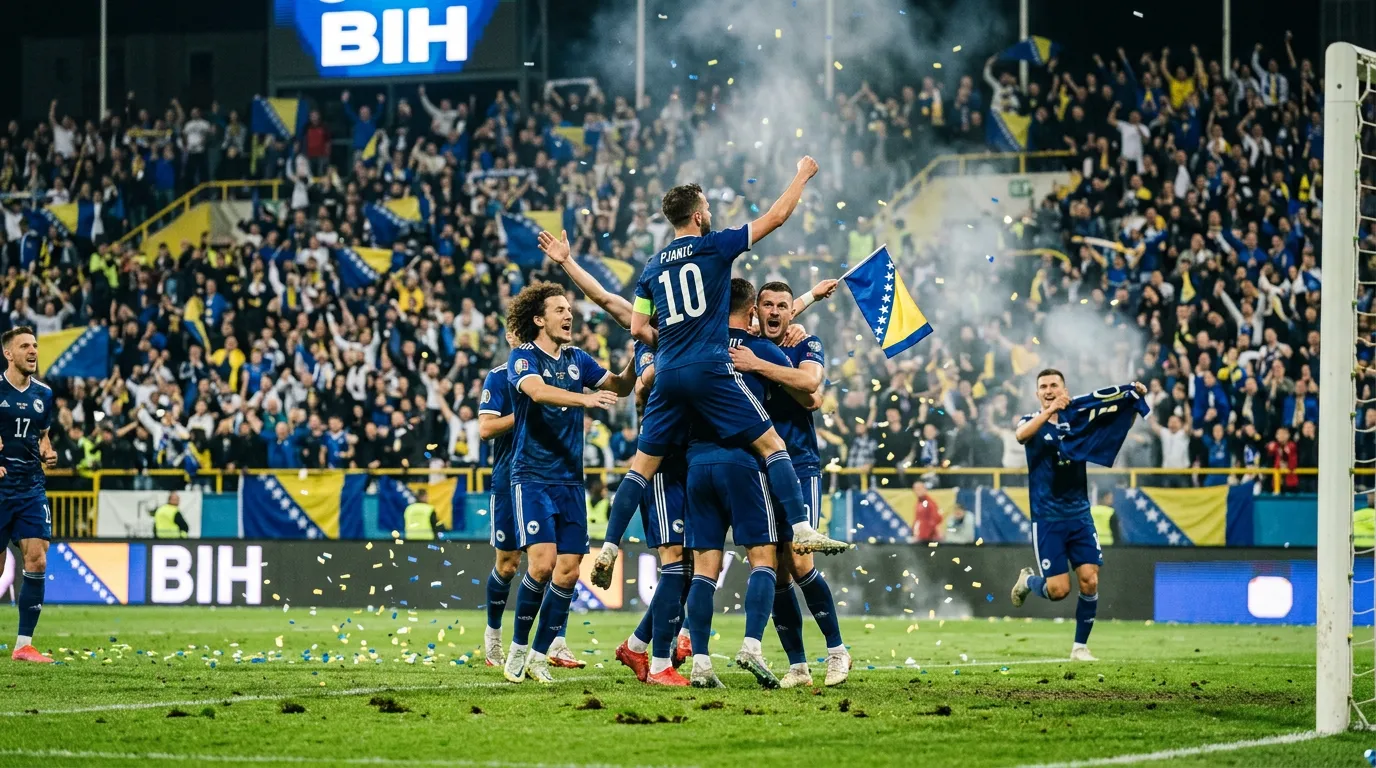
March 31, 2026. Bilino Polje Stadium in Zenica. Italy lead 1-0 and are coasting toward a World Cup spot that the footballing world considers their birthright. Then Alessandro Bastoni sees red for a reckless challenge in the 41st minute. Bosnia equalize late. Penalties. And then the impossible happens: Bosnia win the shootout 4-1, eliminating Italy from the World Cup for the third consecutive time. I was watching the match live on a stream — the commentary in Bosnian, the stadium noise distorted by my laptop speakers — and the sound that erupted when the fourth penalty hit the net was something between a scream and a prayer. The bosnia herzegovina world cup 2026 story begins with that night, and everything that follows — Group B against Canada, Switzerland, and Qatar — is coloured by the audacity of a nation that refused to accept the script the footballing establishment had written for them.
Bosnia are Canada’s opening-match opponents on June 12 at BMO Field in Toronto. For Canadian bettors and fans, understanding what Bosnia bring to Group B is essential for assessing Canada’s odds and the group dynamics. This is not a team that will roll over. They beat Italy — four-time World Cup champions — on the biggest night in Bosnian football history. They qualified for their second World Cup (after 2014) through a playoff gauntlet that required wins over Wales and Italy, producing performances under pressure that most teams in the 2026 field have never experienced. The underdog tag is accurate on paper, but Bosnia’s mentality is anything but an underdog’s.
How Bosnia Qualified — The Night They Beat Italy
Bosnia’s path to the 2026 World Cup was the most dramatic of any team in the field. They finished second in their UEFA qualifying group behind the Netherlands, earning a playoff spot that placed them on a collision course with Italy. The semifinal against Wales in Cardiff produced a 1-1 draw that Bosnia won 4-2 on penalties — their first penalty shootout victory in competitive history. The final against Italy was the defining moment. Italy, who had missed the 2018 and 2022 World Cups, were expected to qualify comfortably. They took an early lead, dominated possession, and appeared in complete control until Bastoni’s red card changed the complexion of the match.
Bosnia’s equalizer came in the 82nd minute through Ermedin Demirovic — a goal that silenced the Italian contingent and ignited the Bosnian travelling support. The penalty shootout that followed was the most one-sided in recent World Cup qualifying history: Bosnia converted all four of their penalties while Italy missed three, including Jorginho’s opener that was saved by Nikola Vasilj. The result sent shockwaves through European football. Italy missing a third consecutive World Cup is a story in itself, but Bosnia’s role as the executioner — twice qualifying for the World Cup through penalty shootouts — adds a layer of poetic justice that resonates across the sport.
The qualifying campaign as a whole was built on defensive resilience and counter-attacking efficiency. Bosnia conceded 12 goals in 12 matches (including playoffs), a respectable record against opposition that included the Netherlands, Greece, and Italy. Their attacking output was modest — 15 goals across the same matches — but the quality of the goals was high. Bosnia scored when it mattered most: late equalisers, playoff winners, penalty-shootout conversions. That clutch gene, if such a thing exists, is the intangible quality that makes Bosnia dangerous opponents regardless of the talent gap on paper.
Key Players to Watch
Edin Džeko is the name that most casual observers will recognize. The former Manchester City, Roma, and Inter Milan striker is now 40 and unlikely to start every match, but his presence in the squad — as a leader, as a tactical reference point for younger forwards, and as a substitute who can change games with his aerial quality in the final 20 minutes — remains valuable. Džeko has 65 international goals, the most in Bosnian history by a massive margin, and the 2026 World Cup represents his farewell to the national team that he has carried for nearly two decades.
Demirovic is the player who carries Bosnia’s attacking hopes. His goal against Italy — the most important in Bosnian football history — confirmed his status as the squad’s primary striker, and his Bundesliga form at Stuttgart (15 goals in the 2024-25 season) demonstrates the quality to compete at World Cup level. Demirovic’s movement in the box, his hold-up play, and his willingness to press from the front give Bosnia an attacking focal point that complements the counter-attacking system the coaching staff prefer.
In midfield, Anel Ahmedhodzic provides defensive steel and ball progression from a deep-lying position. His ability to win the ball and transition play quickly — attributes developed through his time in the Premier League and Serie A — gives Bosnia a midfield anchor who can compete physically with stronger opponents. Sead Kolasinac, the former Arsenal full-back, provides experience and defensive solidity at left-back, though his pace has declined since his Premier League peak. Goalkeeper Vasilj, the penalty-shootout hero against both Wales and Italy, enters the World Cup with a reputation that could intimidate opposing penalty takers if any Group B match goes to extra time.
Group B — Canada, Switzerland & Qatar
Bosnia are the third seed in Group B, behind Canada and Switzerland and ahead of Qatar. The realistic expectation is that Bosnia compete hard in all three matches, take points from at least one of Canada and Switzerland, and challenge for the third advancement spot under the expanded format’s best-third-place rules. The opening match against Canada at BMO Field is the fixture that will define Bosnia’s campaign — a strong performance, even in defeat, establishes credibility and provides the platform for competitive matches against Switzerland and Qatar.
Against Canada, Bosnia will deploy a compact 4-4-2 or 4-5-1 that concedes territorial control but protects the central areas where Canada create most of their chances. The counter-attacking plan is straightforward: win the ball, find Demirovic, and exploit the space behind Canada’s high defensive line through long passes and direct running. Bosnia’s set-piece quality — Kolasinac, Ahmedhodzic, and Džeko are all over 185 cm — provides an additional avenue for goals that bypasses Canada’s pressing system entirely. The match odds price Canada at approximately 1.55 and Bosnia at approximately 5.50, with the draw around 3.80. I see value in the draw at that price given Bosnia’s defensive discipline and the opening-match dynamics that typically produce cautious, tight football.
The Qatar match on matchday two or three is Bosnia’s best opportunity for three points. Qatar’s 2022 World Cup record — three defeats, zero goals — and their limited squad depth suggest they will struggle against European opposition. A win against Qatar could be the result that carries Bosnia into the Round of 32 as a third-place finisher, and the motivation to extend their World Cup experience beyond the group stage for the first time in history provides the kind of emotional fuel that statistical models cannot quantify.
Bosnia’s Betting Odds & Underdog Value
Bosnia are priced at approximately 251.00 to win the 2026 World Cup — the longest odds in Group B and among the longest in the tournament. To advance from Group B, Bosnia sit at approximately 3.50, reflecting their status as the third seed in a group where both Canada and Switzerland are expected to progress. The value I see is in the match-specific markets: Bosnia to draw with Canada at approximately 3.80 and Bosnia to beat Qatar at approximately 1.70 both represent bets where the probability of the outcome exceeds the implied odds.
The double of Bosnia to draw with Canada and beat Qatar at approximately 6.50 is a combination bet that captures Bosnia’s most likely point total of four from three matches. Four points would almost certainly be sufficient for a third-place finish that advances Bosnia to the Round of 32 under the expanded format, making this a backdoor bet on Bosnian advancement that avoids the hefty price on the outright advancement market. Bosnia’s campaign is built on the premise that one big result can define an entire tournament — and the night they beat Italy proves they are capable of producing exactly that.
Can Bosnia Spring Another Surprise?
The honest answer is: probably not, but do not tell them that. Bosnia’s squad lacks the depth and individual quality to sustain competitiveness across three group matches against Canada, Switzerland, and Qatar in the way that top-tier teams can. Fatigue, injuries, and the emotional comedown from the Italy playoff victory are all factors that could undermine their performances in June. But tournament football rewards teams that play with collective belief and tactical discipline above their individual talent level, and Bosnia have demonstrated both of those qualities in abundance during their qualification campaign.
For Canadian fans attending the Group B opener at BMO Field on June 12, Bosnia are the opponent that demands respect. They beat Italy. They won two penalty shootouts in a single playoff cycle. They play with the desperation of a nation that has experienced genuine hardship — the Bosnian War of the 1990s is still within living memory for many of the squad’s families — and channels that history into a competitive intensity that transcends football. The opening match at BMO Field will not be a formality. It will be a contest between a host nation with everything to gain and an underdog with nothing to lose, and in tournament football, that is the most dangerous combination of all.
