
 Available in US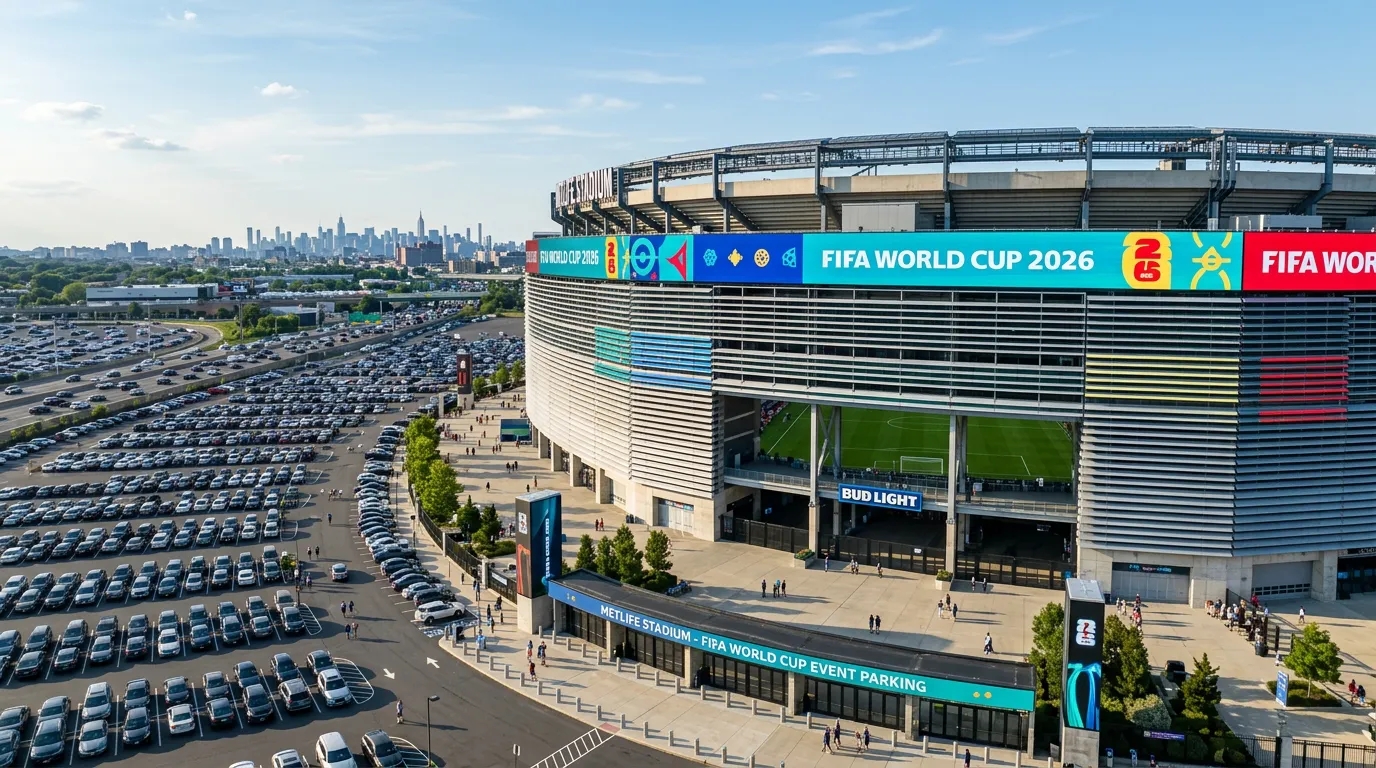
I first walked into MetLife Stadium in 2019 for a Copa America match, and the scale of the place stopped me in my tracks. The building sits in the New Jersey Meadowlands like a concrete aircraft carrier — enormous, unadorned, and built to hold 82,500 people in a configuration that wraps every seat around the pitch with surprisingly good sightlines. On July 19, 2026, this stadium will host the biggest single match in the history of team sports: the FIFA World Cup Final, the culmination of a 48-team, 104-match, 39-day tournament played across three countries. No venue at this World Cup carries more weight.
For Canadian fans planning to travel south for the knockout rounds, MetLife is the destination. It sits ten miles west of Manhattan, connected by rail, bus, and highway to one of the world’s great cities. The stadium will host eight World Cup matches in total — five group-stage fixtures, one Round of 32 match, one Round of 16 match, and the final itself. If Canada advances deep into the tournament, there is a realistic scenario where their semifinal or final appearance happens on this pitch. Understanding MetLife’s layout, access, and atmosphere is not just useful — it is essential preparation.
About MetLife Stadium
There is an old saying among stadium architects that great venues disappear — they become invisible behind the event they host. MetLife Stadium takes that philosophy literally. The exterior is a series of illuminated LED panels that can shift colour depending on the tenant: blue for the New York Giants, green for the New York Jets, and — during the 2026 World Cup — whatever palette FIFA’s branding team selects. The building itself is functional rather than beautiful, designed to maximize capacity and sightlines rather than make an architectural statement. Inside, the bowl configuration is steep and close to the pitch, which produces an atmosphere that amplifies crowd noise and creates genuine home-field pressure for marquee events.
MetLife opened in 2010 at an approximate cost of $1.6 billion, replacing the aging Giants Stadium that had occupied the same Meadowlands Sports Complex site since 1976. It is the only NFL stadium shared by two franchises from the same league — the Giants and Jets alternate as primary tenants — and that dual-use design means the facility operates year-round with minimal downtime. The stadium’s capacity of 82,500 makes it the largest venue in the NFL and one of the largest in North America, though AT&T Stadium in Dallas surpasses it with an expandable capacity exceeding 90,000.
For the World Cup, MetLife has undergone a two-phase renovation to its lower bowl. FIFA requires minimum pitch dimensions of 105 by 68 metres for World Cup matches, and MetLife’s original American football configuration did not meet that standard. The renovation involved replacing permanent corner seating with a modular system that widens the playing surface, removing approximately 1,740 seats in the process. The result is a pitch that meets FIFA’s specifications while retaining the vast majority of the stadium’s seating capacity. A temporary grass surface will be installed over the existing artificial turf — a process MetLife has managed successfully for previous international soccer events, including the 2025 FIFA Club World Cup final.
FIFA will officially refer to the venue as “New York New Jersey Stadium” during the tournament, in keeping with their policy of removing corporate naming rights from World Cup venues. That name change may cause confusion for first-time visitors searching for directions, but the physical location remains unchanged: One MetLife Stadium Drive, East Rutherford, New Jersey, 07073.
World Cup 2026 Matches at MetLife Stadium
Eight matches across five weeks make MetLife the second-busiest American venue at the tournament, behind AT&T Stadium in Dallas, which hosts nine fixtures including a semifinal. MetLife’s schedule builds from group-stage action through the knockout rounds to the final, creating a crescendo of significance that mirrors the tournament’s own arc.
The group-stage slate opens with Brazil versus Morocco on June 13 at 6:00 PM ET — a blockbuster Group C fixture between two semifinal-calibre teams that I have rated as the most anticipated group-stage match of the entire World Cup. Four days later, France takes on Senegal in a Group I match on June 16 at 3:00 PM ET, followed by Norway versus Senegal on June 22 at 8:00 PM ET, also from Group I. Ecuador versus Germany on June 25 at 4:00 PM ET brings Group E action, and the group stage concludes at MetLife with Panama versus England on June 27 at 5:00 PM ET — a Group L fixture that could determine England’s final standing.
The knockout phase at MetLife begins with a Round of 32 match on June 30 at 5:00 PM ET, featuring the Group I winner against a best third-placed team. A Round of 16 match follows on July 5 at 4:00 PM ET. Then, after two weeks of knockout football at other venues, the tournament returns to East Rutherford for the final on July 19 at 3:00 PM ET.
The final will feature a halftime show for the first time in World Cup history — a departure from tradition that FIFA and Global Citizen are co-producing. The event is designed to rival the NFL Super Bowl’s halftime spectacle, with the full performer lineup still to be announced. For bettors, the extended halftime break is worth noting: it disrupts the rhythm of play and could benefit the team that was under pressure in the first half, as the longer interval allows tactical adjustments and physical recovery that a standard 15-minute break would not.
Stadium History & Notable Events
MetLife Stadium’s event resume reads like a greatest-hits compilation of American sports and entertainment. Super Bowl XLVIII in February 2014 was the first outdoor, cold-weather Super Bowl in NFL history, drawing worldwide attention to the venue’s ability to host marquee events in challenging conditions. The Seattle Seahawks dismantled the Denver Broncos 43-8 in a performance so dominant that the weather — a concern for months leading up to the game — became an afterthought.
On the soccer front, MetLife hosted the Copa America Centenario final in 2016, where Chile defeated Argentina on penalties to retain their continental title. That match drew 82,026 spectators and established MetLife as a viable venue for elite international soccer — a credential that influenced FIFA’s decision to award the stadium the 2026 World Cup Final. More recently, MetLife hosted nine matches during the 2025 FIFA Club World Cup, including the final, serving as a dress rehearsal for the operational demands of a FIFA tournament.
The stadium has also become one of the highest-grossing concert venues in the United States, earning Billboard’s “Highest Grossing Stadium” award nine times. Taylor Swift’s Eras Tour stops in 2023 broke attendance records, as did Ed Sheeran’s performances the same year. WrestleMania has visited MetLife twice, in 2013 and 2019, drawing crowds exceeding 80,000 on each occasion. This track record of handling massive events with diverse operational demands — from stage configurations to crowd control to broadcast logistics — is precisely why FIFA trusted MetLife with the tournament’s most important match.
For historical context, the original Giants Stadium on the same site hosted matches during the 1994 World Cup, the last time the USA hosted the tournament. That facility held approximately 77,000 fans and was the venue for several group-stage matches and a quarterfinal. MetLife’s selection in 2026 represents a generational continuation — the same complex, a newer building, a larger tournament, and thirty-two years of accumulated expertise in managing FIFA-level events at the Meadowlands.
Getting There — Transport & Location
If there is one piece of advice I can offer from personal experience, it is this: do not drive to MetLife Stadium on a World Cup match day unless you have no alternative. The Meadowlands Sports Complex sits at the intersection of New Jersey Turnpike traffic, Route 3 congestion, and local road networks that were not designed for 82,000 people arriving simultaneously. Post-match egress is worse — I have spent ninety minutes in a parking lot after NFL games, and World Cup crowds will be larger and less familiar with the exit routes.
The recommended approach for Canadian fans is public transit. NJ Transit operates the Meadowlands Rail Line, a dedicated shuttle service that runs from Secaucus Junction directly to the stadium. Secaucus Junction connects to NJ Transit’s main commuter rail network, which reaches Penn Station in Manhattan in approximately twelve minutes. From Penn Station, the rail journey to the stadium takes roughly twenty minutes including the transfer at Secaucus. For fans staying in Manhattan — which most international visitors will — the total travel time from Midtown to the stadium is approximately 45 minutes door-to-door via train. Coach USA also operates dedicated bus services from the Port Authority Bus Terminal in Midtown Manhattan to the Meadowlands, with expanded service planned for World Cup match days.
For Canadian fans driving from Toronto, the journey is approximately 540 kilometres along the I-90 and I-87 corridor through upstate New York, crossing the border at either Niagara Falls or the Thousand Islands Bridge. The drive takes roughly five and a half hours without traffic. From Montreal, the route follows the I-87 south through the Adirondacks, covering approximately 600 kilometres in roughly six hours. Both routes cross the US-Canada border, so valid passports or NEXUS cards are required.
The three airports serving the MetLife area are Newark Liberty International (EWR), John F. Kennedy International (JFK), and LaGuardia (LGA). Newark is the closest, located approximately 15 kilometres from the stadium, and offers the most convenient ground transportation via the AirTrain to NJ Transit rail connections. JFK and LaGuardia both require a transfer through Manhattan, adding travel time but offering a wider range of international flight options. For Canadian fans flying from Toronto or Vancouver, direct flights to all three airports are available on Air Canada, WestJet, and Porter Airlines, with MetLife being one of sixteen World Cup stadiums across three countries.
